Story audio is generated using AI
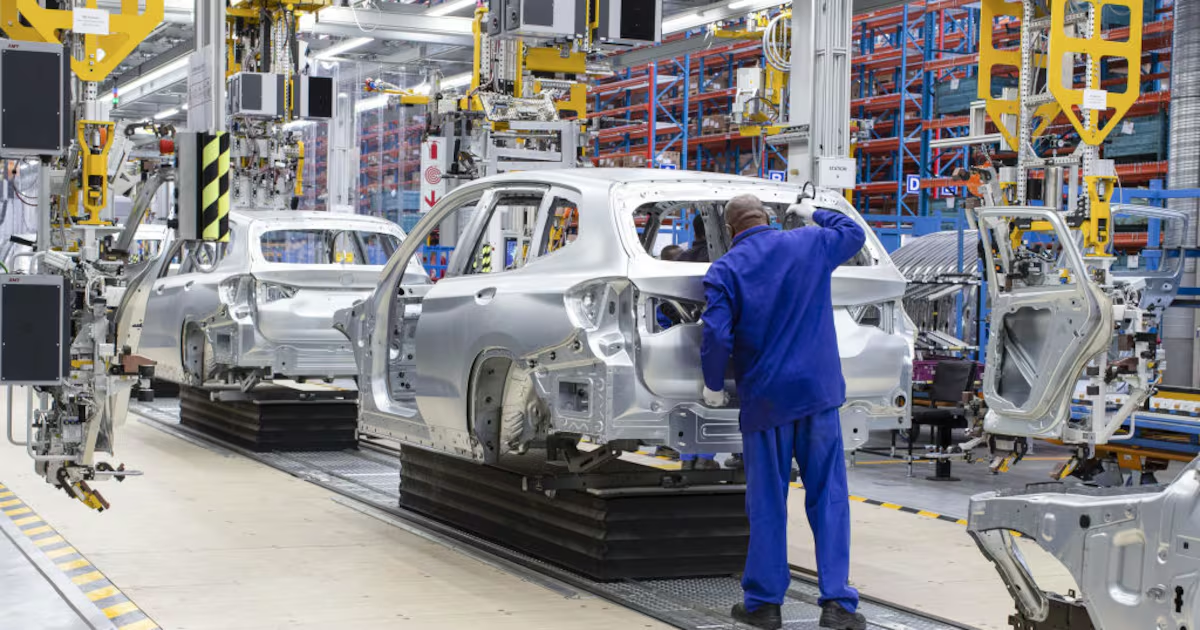
The economic value of local content in South Africa’s motor industry has more than doubled over the past six years, even though its share of total industry value has remained broadly unchanged, the National Association of Automobile Manufacturers of South Africa (Naamsa) said.The association was responding to remarks by trade, industry & competition minister Parks Tau on the industry’s “negligible” localisation achievements relative to the 2035 targets set out in the sector master plan.Naamsa, which represents 42 companies involved in manufacturing, assembling, distributing and importing new vehicles, however, in a statement agreed with Tau on the importance of localisation. In a written reply to a parliamentary question, Tau said the industry failed to meet the 2035 localisation targets laid down in the South African automotive master plan, which aims to boost vehicle production, supplier development and job creation. The plan is under review, the outcome of which is eagerly awaited by the industry. Tau said that “there has been negligible and lacklustre performance” in terms of realising the plan’s goal of 60% localisation by 2035. However, Naamsa said industry data indicates that while average vehicle local content remained broadly stable at about 39.7% in 2020-25, the economic value of local content grew significantly from R57.2bn in 2020 to R126.8bn in 2025, more than doubling in the period. “Localisation is more nuanced than a single percentage metric measured across different parts of the value chain,” it said. Naamsa said the figures demonstrate that the motor industry continues to generate growing domestic economic value, even if percentage-based localisation metrics appear relatively unchanged. “Sustainable localisation depends fundamentally on higher production volumes, globally competitive manufacturing programmes, supplier competitiveness and the development of a deeper domestic supply base,” it said.About 66% of local motor value addition is generated by OEM activities, which Naamsa said reflects the critical role OEMs play in anchoring South Africa’s motor industrial base and supporting the broader supplier ecosystem. “South African OEMs compete globally to secure vehicle production programmes that are typically allocated over long product cycles. Once secured, these programmes create the production scale required for suppliers to invest, localise additional components and expand domestic manufacturing capability over time. “Protecting the competitiveness of these programmes is therefore fundamental to achieving higher levels of localisation.” Naamsa agreed with Tau that increasing localisation remains one of the motor industry’s most important strategic priorities. Industry data indicates that one of the biggest opportunities for improving localisation lies in strengthening the domestic supply chain. Imports currently account for about 86.5% of Tier 1 supplier purchases, that is, purchases of complete systems or large modules for vehicle manufacturers. Procurement from local Tier 2 suppliers (which supply components) declined from 20.7% to 13.5% over the past six years, which Naamsa said highlights the importance of accelerated supplier development, industrial upgrading, localisation of intermediate inputs and expanded support for Tier 2 and Tier 3 manufacturers, the latter being suppliers of materials and raw materials used in the production process. Naamsa noted that the motor industry is operating in a rapidly changing global environment marked by the transition towardS new energy vehicles (NEVs). “These structural shifts reinforce the need for policy frameworks that continue to strengthen South Africa’s competitiveness as both a manufacturing and investment destination,” it said. Naamsa hopes the SAAM 2035 review will propose measures that strengthen OEM competitiveness, secure future production programmes, expand supplier participation and accelerate localisation across the motor value chain. The importance of the motor industry to the economy is reflected in its contribution of 5.2% to GDP (3.3% from manufacturing and 1.9% from retail); vehicle and motor component exports worth R291bn in 2025, equivalent to 15.6% of South Africa’s total exports; and its share of 23.8% of the country’s manufacturing output. The manufacturing segment employs 113,000 people, and, including multiplier effects, the industry sustains 498,000 jobs across the formal economy.