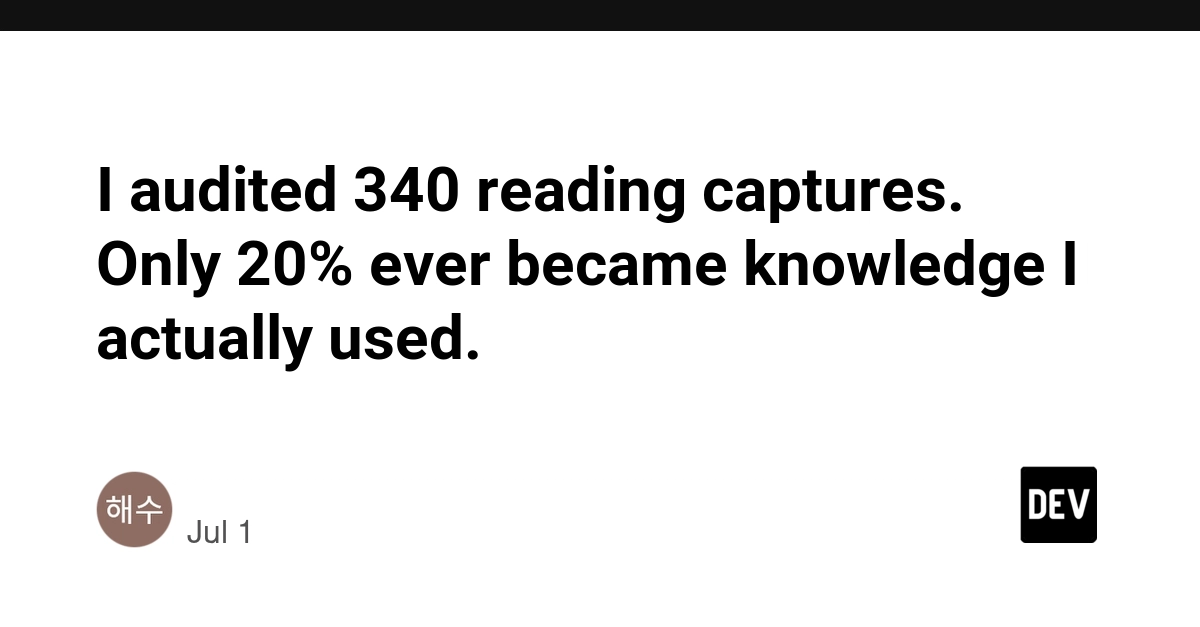
Out of 340 captures over 90 days — Readwise highlights, Obsidian quick-captures, browser bookmarks — exactly 68 ever became a note I actually used. That's a 20% completion rate. The other 272 had a timestamp and nothing else.
The uncomfortable part wasn't the number itself. It was what the data said about where things died. I assumed the bottleneck was my weekly review — not thorough enough, not consistent enough. Wrong. I tagged every capture for three weeks as either "capture-only" or "annotated-at-source." Capture-only items had an 8% chance of becoming a usable note. Items where I spent 90 seconds writing a single sentence — in my own words, not a copied highlight — completed at around 55%. The weekly review wasn't failing because I was bad at reviews. It was failing because context decays faster than a week.
By Sunday, I genuinely couldn't remember why I'd saved half the items. A highlighted paragraph looked important. The argument I was building when I saved it was gone. So I'd either re-read the source (expensive) or archive without processing (wasteful). The knowledge was perishable in a way that tasks simply aren't. What fixed it wasn't a better review template — it was a same-session annotation rule. I won't close a tab after reading something capture-worthy unless I've written one sentence into my Obsidian daily note first. The sentence doesn't have to be good. It has to be mine. Sixty to ninety seconds. That single constraint moved my annotation rate more than four months of Sunday review slots ever did.