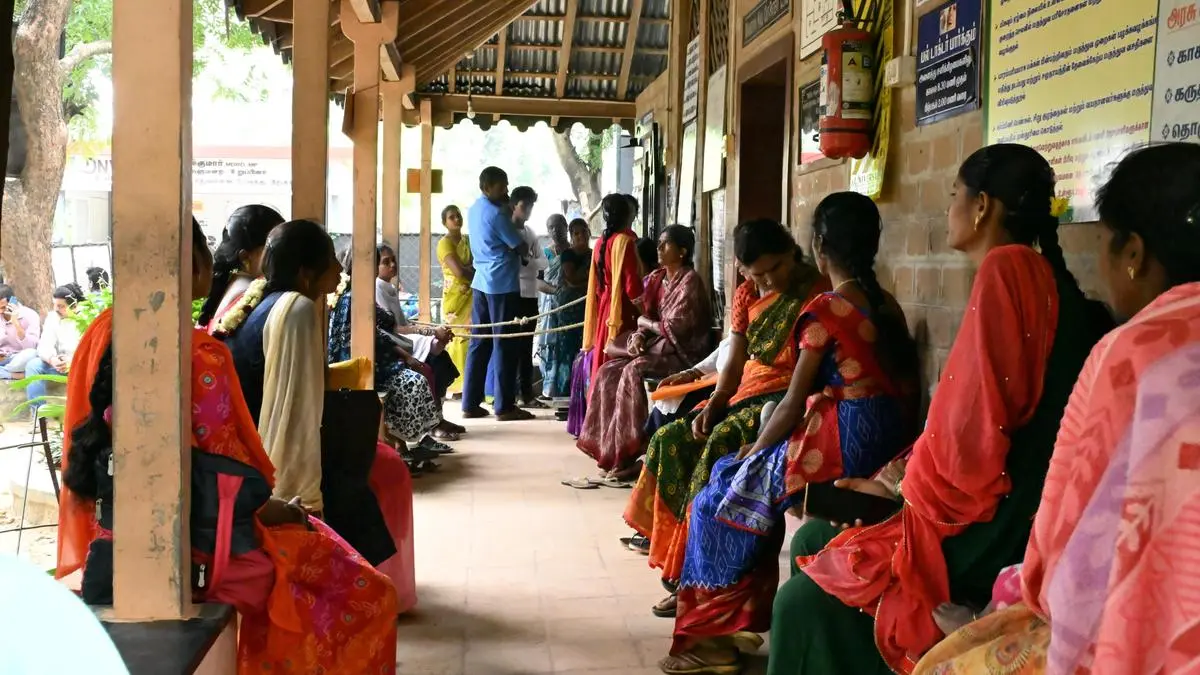
The current framework may not fully capture the reality faced by retail customers because grievance figures are often presented in a blended form
| Photo Credit:
India is the 10th largest insurance market globally by nominal premium volumes, and has a market share of 1.8 per cent (per 2024 data). However, the country’s insurance penetration is a mere 3.7 per cent, lower than the global average of 7.2 per cent.As rightly identified by a government report in the Press Information Bureau, “rising healthcare costs, livelihood risks, and economic uncertainties underline the importance of accessible insurance coverage for citizens, families, and businesses”. Achieving insurance for all requires not only a policy shift, but a coordinated national effort across product design, distribution, regulation, literacy, technology and governance. Most importantly, it requires building trust among masses, especially with regards to access and fair claim settlement.For a vast country like India, expanding the reach of health insurance to its remotest parts is a desirable objective, given the government’s commitment to ensuring universal healthcare. While the insurance regulator has been at the forefront of delivering diverse and affordable health insurance, the very nature of the country’s healthcare system makes the sector vulnerable.Grievance redressalTo enhance policyholders’ trust and confidence, it is imperative that health insurance companies establish accessible and efficient grievance redressal mechanisms, including online complaint submission and clarifying redressal procedures. After all, complaints are a valuable data, and they essentially reveal the gaps between product design and usage. Thus, a deeper analysis of health insurance complaints will be a powerful input for product development and would help address three fundamental aspects, namely: what to build; how to improve existing products; and, most importantly, the positioning and pricing of the products. The nature of complaints also tells a lot about the coverage of a said insurance company. India’s vastness and diversity, no doubt, are a challenge to any health insurer to be able to meet its customers’ expectations.The performance of any health insurance company depends on the grievance ratio (number of consumer grievances received by an insurer relative to its total number of policies) and the claim settlement ratio, a standard benchmark used to evaluate the efficacy of settlements. On the surface, grievance ratio is indicative of customer satisfaction and the insurer’s claim processing efficiency.However, the health insurance sector, it must be stressed, is highly sensitive to grievances, given its highly elastic demand vis-à-vis its grievances. Even a small news report or a social media post critical of an insurance firm has a direct bearing on its performance and its perception among people at large.The grievance ratio is increasingly used as a proxy for customer experience in health insurance. However, the current framework may not fully capture the reality faced by retail customers because grievance figures are often presented in a blended form across retail health, group health, personal accident and travel insurance.These products have fundamentally different complaint profiles. Group health insurance typically generates fewer grievances due to employer-negotiated benefits, broader coverage, established escalation mechanisms and large-scale claims processing. Retail health insurance, on the other hand, is more likely to see disputes relating to claim repudiations, pre-existing disease exclusions, waiting periods, room-rent deductions, partial settlements and reimbursement delays.For example, a group health policy may cover pre-existing diseases from day one and provide HR-supported grievance escalation, while a retail policy may involve waiting periods and direct engagement with the insurer. These structural differences naturally lead to fewer grievances in group health than in retail health.Obscuring realityWhen low-friction products are combined with higher-friction retail health products, the overall grievance ratio can appear lower, potentially obscuring where consumer complaints are actually concentrated.The key question is whether grievance disclosure should mirror the product-wise reporting already available in other areas of insurance regulation. Since business and claims data are already captured separately across product categories, greater transparency through product-level grievance disclosure could provide consumers with a more accurate assessment of insurer performance.Many international regulators already publish complaints data by product line, allowing consumers to see the full picture and compare insurers based on the specific products they are purchasing. The fundamental idea is to prevent low grievance products from masking high friction retail health products.It is time India had product-level grievance disclosure. IRDAI’s guidelines, too, support this framework, as seen through Form NL-35 and Form NL-37. This also allows the consumer to see the full picture of the product he/she is availing.The regulator could consider separate grievance disclosure for retail, group, personal accident, travel, etc.In sum, India needs to redefine existing benchmarks to evaluate the sector and adopt the best practices which could improve transparency, accountability and informed decision-making in the health insurance sector.The writer is a former Executive Director, IRDAIPublished on July 1, 2026