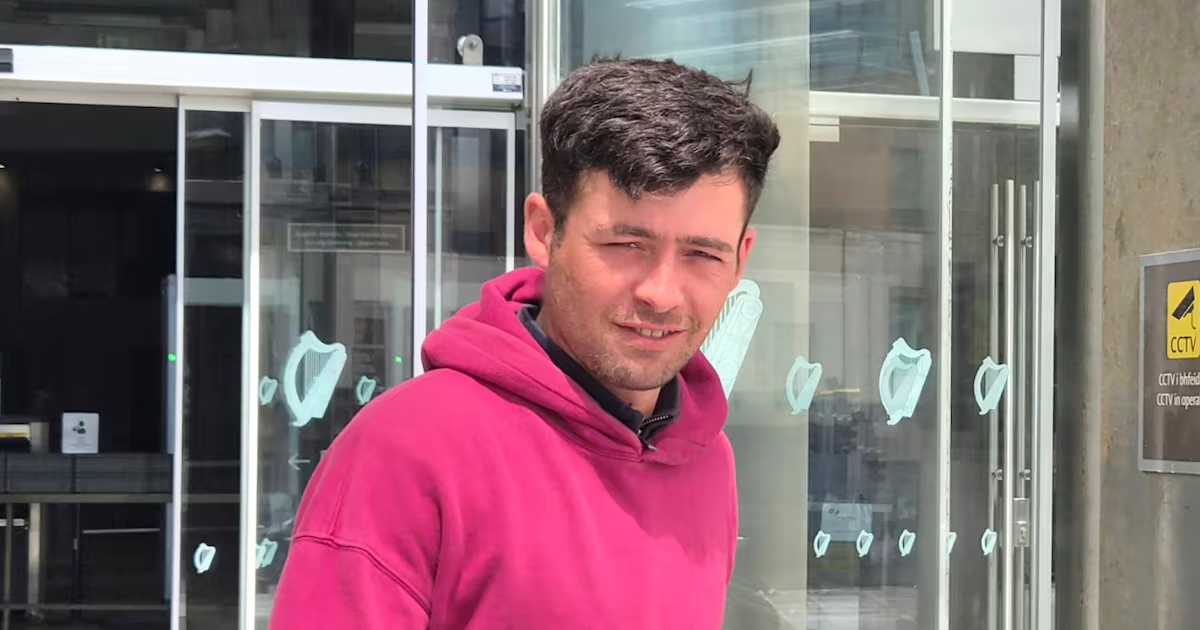
A former garda who was found guilty of assaulting a security man during the highly charged repossession of a house in Strokestown, Co Roscommon, almost eight years ago has had his conviction quashed by the High Court.Kevin Taylor, of Ardnacassa Lawns, Dublin Road, Longford, was convicted of assaulting the man during the execution of a possession order for the property at Falsk, Strokestown, on December 11th, 2018. The security man had alleged Taylor grabbed his private parts, causing him to go to ground, but it was later accepted that CCTV footage did not show such an act taking place.Strokestown District Court convicted Taylor, then aged 65, of assault for “laying hands” on the security man and it imposed a fine of €200 in August 2021.In March 2024 Taylor brought an appeal to the Circuit Court against the conviction, which resulted in a two-month custodial sentence.Taylor said the assault charge against him lacked sufficient specificity such that he could not adequately cross-examine, nor defend himself, under the principle of fair procedures.He took his case against the Director of Public Prosecutions to the High Court seeking a quashing of his conviction.At the High Court Judge Garrett Simons said the group executing the enforcement order included the county registrar, Aidan Devlin, and a number of security personnel, including Ian Gordon.Video footage played to the District Court and the Circuit Court, it was accepted, did not show Taylor grabbing Gordon’s private parts. However, it did show him “laying hands” on Gordon, leading to the section-two assault conviction.Taylor asserted he had acted to protect another man, who was at the scene but was not a resident, and whom he described as a disabled person with a brain injury.He contended the man was being pushed or attacked by security personnel and that his own intervention was directed towards protecting the man, rather than assaulting Gordon.The Circuit Court trial judge acknowledged video evidence did not depict the precise act alleged by Gordon and acknowledged there was some divergence in Gordon’s evidence as to the exact location of the incident.One of the grounds upon which leave to apply for judicial review in the High Court was granted to Taylor was the prosecution failed to specify the precise factual basis of the alleged assault.It was argued this violated the principle of “clear and unambiguous charges”. It was further argued this made it difficult to prepare a proper defence and raised doubt about whether the prosecution met its burden of proof.Taylor also raised an objection to the trial judge’s decision to question Gordon while Taylor was cross-examining.In the High Court judgment, Simons said: “The applicant submits that the prosecution proceeded on the basis of a single, clearly particularised factual allegation, namely, that he had assaulted the complainant by grabbing him by the genitals.”He also said: “The trial judge failed to determine the applicant’s asserted belief as to the circumstances in which force was used and failed to assess the reasonableness of the force by reference to those believed circumstances.”Simons said the Circuit Court judge had undermined the effectiveness of cross-examination “by taking over the questioning for a period and putting the matters in a compressed form”.“The applicant was thereby deprived of a fair and effective opportunity to test the complainant’s account on matters central to the prosecution case,” he said.The High Court quashed the assault conviction. The judge said it was not in the public interest to have the matter remitted as Taylor had already served a two-month sentence for contempt in the matter.
Former garda has assault conviction linked to Strokestown eviction quashed by High Court
Security man had alleged Kevin Taylor grabbed him, causing him to go to ground
584 words~3 min read