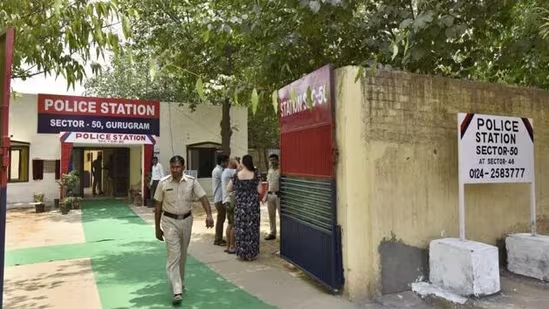
The Gurugram police have constituted a specialised unit, the Labour Liaison and Industrial Coordination Team (LLICT), to work with industries, labour unions, workers and the Haryana labour department to ensure a prompt response to workers’ disputes and tackle industrial emergencies, officials said on Tuesday.Gurugram Police form labour liaison teams to prevent industrial unrestAt least 10 to 12 LLICT teams have been constituted across seven police stations based on the density of industrial units. These include IMT Manesar, Manesar, Gurugram Sadar, Sector-37, Sector-10, Bajghera and Badshapur. Officials said all teams will become operational within four days and will be staffed by reassigning existing police personnel, with no additional manpower being deployed.Officials said the decision followed workers’ protests in Manesar in April over minimum wages after the introduction of new labour codes. Senior police officers said discussions were held at various levels after Gautam Buddh Nagar created an Industries police cell headed by a dedicated DCP (Industries) following similar labour unrest.“However, several pros and cons were studied before the decision was taken to form the liaison teams which will be headed by concerned DCPs of the four zones of Gurugram,” a senior police official said, adding that the initiative is expected to strengthen trust between industries, workers and law enforcement while supporting a safe and investment-friendly industrial environment in Gurugram.Officials said the teams will focus on preventing labour-related conflicts, improving coordination among the local administration, industries, labour unions and other stakeholders, and maintaining peace in industrial belts by identifying and resolving disputes before they escalate into protests or law and order situations.Each police station will constitute one or two LLICT teams depending on the number of industrial units under its jurisdiction and operational requirements. Every team will comprise four to five police personnel selected for their public dealing skills and ability to coordinate with industrial management, labour representatives and government departments.The teams will maintain regular contact with factory managements, labour unions, security officers, human resources officials and the Haryana labour department. They will conduct frequent visits to industrial areas, identify potential labour disputes at an early stage, immediately report demonstrations, strikes or any likely tense situation to senior officers, and monitor developments to prevent disruptions. They have also been tasked with paying special attention to the safety and security of women employees and monitoring anti-social or external elements that could disturb peace.Sandeep Turan, public relations officer of Gurugram police, said duty charts for each team will be prepared by the respective DCP, detailing patrolling areas, liaison responsibilities and reporting mechanisms. “The concerned ACPs will regularly supervise the functioning of the teams,” he said.Personnel will undergo a one-day training programme every month at the conference room of the Old CP Office, covering industrial dispute handling, labour laws, crowd control, law and order management, negotiation and communication skills, women safety, emergency response, crisis management and intelligence collection.Under the new mechanism, teams will submit daily activity reports to the station house officer and assistant commissioner of police. Weekly reviews will be forwarded to the DCPs, while the Gurugram Police joint commissioner and DCP (Headquarters) will conduct monthly assessments to monitor performance and issue further directions.
Gurugram Police form labour liaison teams to prevent industrial unrest
Teams at seven police stations will coordinate with HR, unions and the labour department, undergo monthly training and submit daily reports.
520 words~2 min read