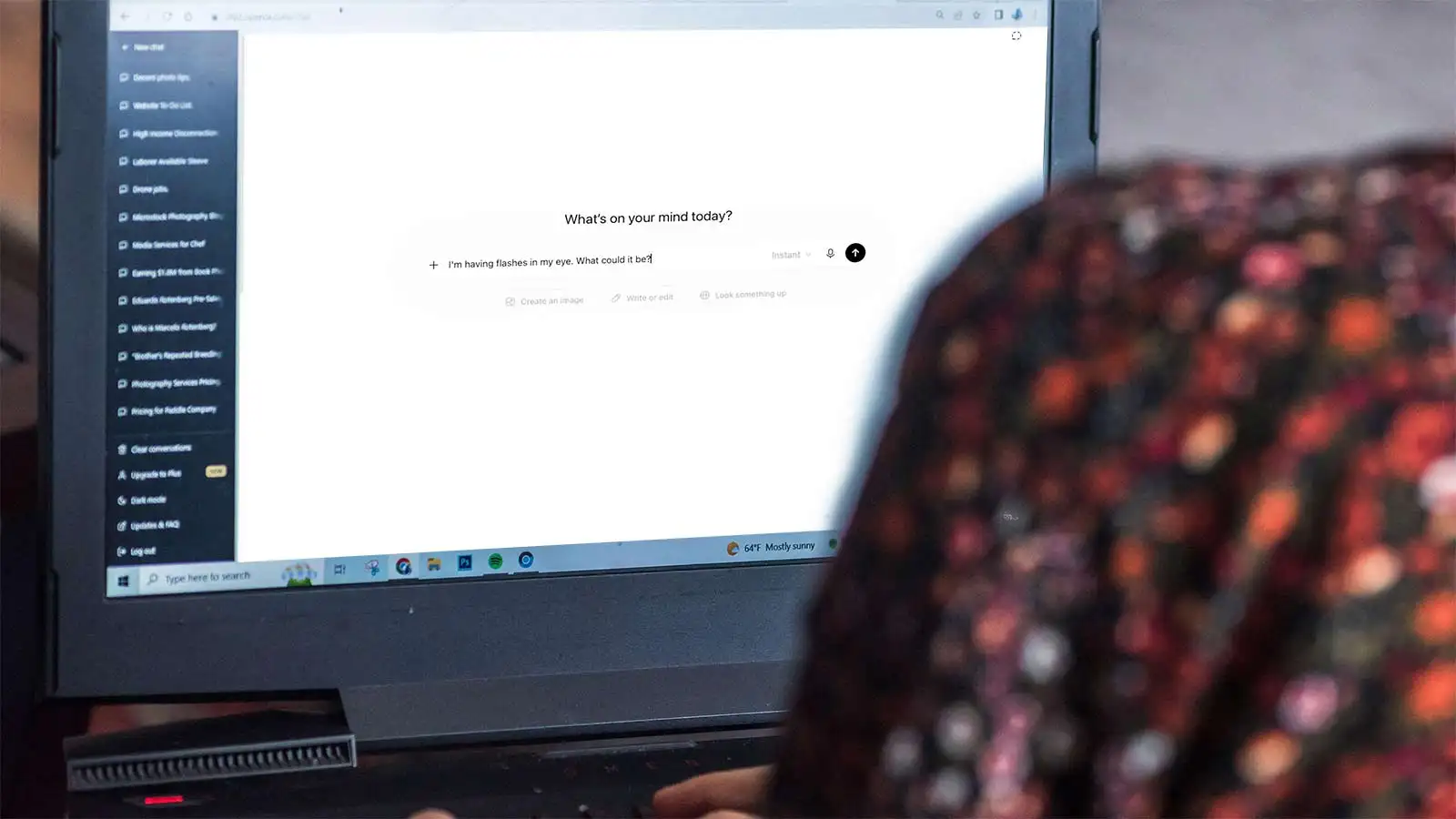
A patient in her 50s came to my eye clinic for flashes of light in one eye. Before she sat down, she told me, calmly, that she already knew what this was: migraine with visual aura. She had worked it out with ChatGPT over several days. By the time I met her, her story had acquired the language of aura: a shimmer, a zigzag, something like a 20-minute spread, perhaps a mild discomfort behind her eye afterward. But on exam, I found a retinal tear. She would need laser treatment that day to protect her vision.
When I asked her to go back to the beginning (what had she noticed before she typed anything into ChatGPT?), the aura story began to fall apart. The original symptoms were briefer, peripheral, recurrent flashes, especially noticeable in the dark. The chatbot hadn't just fabricated a total falsehood but had done something more subtle: it had offered a plausible template, asked questions in that template's language, and helped her fit ambiguous memories into the wrong disease.
The usual worry about patients and artificial intelligence (AI) is that the chatbot will tell them something untrue. That concern is real, but it was just part of what had nearly cost this patient her vision. The more important issue here was the coherence of the story. Generative AI typically does not hand patients 10 conflicting links as Google searches used to. It returns a single fluent account, with an onset, a mechanism, and a conclusion, and then it refines that account in conversation until everything fits.