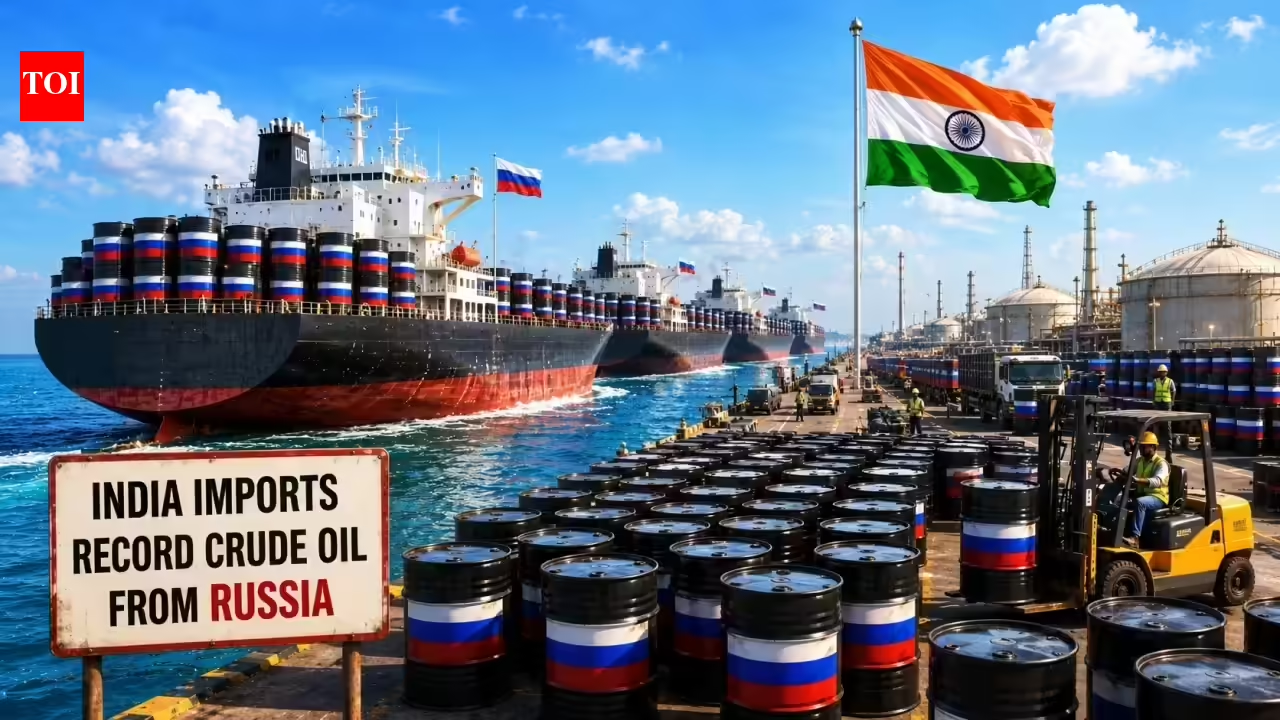
Indian refiners stocked up on crude oil for the next 45 days with Russia continuing as New Delhi’s top supplier with replacement barrels coming from the US, Venezuela, Africa and Oman.There are ample indications that the market is favouring buyer’s as the de-escalation in West Asian conflict and more Middle Eastern cargos hit the market.Sources said that there is ample crude oil in the market currently as Ukraine’s drone attacks on Russian refineries is freeing up more barrels for export. Besides, the US-Iran MoU and the 60-day sanctions reprieve has resulted in crude oil supply coming back to the market from Middle East Gulf (MEG) producers, including Iran.“Refiners have already fixed up crude till mid-August. There are ample stocks available and more is coming in as Saudi Arabia, the UAE and Iraq push more barrels into the market.It’s a buyer’s market. For remaining August and September, refiners can buy Iranian crude, but it will depend on market dynamics and payment clarity” said a top official with a leading refiner.The sanctions reprieve for Iran to sell crude oil and refined products ends on August 21, 2026.Sources said that crude oil export by MEG producers is also recovering after the opening of the Strait of Hormuz (SoH). However, many analysts do not expect West Asian supply to form a major part of India’s import basket for the remainder of August and September.Another factor is that India’s crude oil imports are on the lower end during June to September rainy season as fuel consumption declines and refiners also go into maintenance, which means that imports will be lower than those during March to June 2026, said one of the sources.Kpler noted that India’s crude supply remains resilient despite recent geopolitical disruptions.Over the past 100 days, India has arguably been one of the best-positioned major importers, successfully maintaining crude inflows through proactive diversification and procurement strategies, said the global real time data and analytics provider.“Looking ahead, India’s supply position also appears comfortable. Refiners typically procure crude cargoes one to two months in advance, implying that feedstock requirements through August are largely secured,” said Sumit Ritolia, Kpler’s Kpler’s Lead Research Analyst for Refining & Modeling.Beyond that, the global supply outlook remains supportive. Rising exports from Africa, Russia, Venezuela, and higher OPEC+ production, together with continued crude flows through the SoH should provide ample sourcing options. The recent decline in crude prices also suggests that the market is increasingly comfortable with supply availability despite lingering geopolitical risks, he told businessline.“At this stage, we do not expect any meaningful increase in Iranian crude imports into India. Even if limited cargoes materialise, Indian refiners are already largely covered through the first half of August, leaving little immediate need for additional purchases,” Rtolia explained.Moreover, any increase would need to be viewed in the context of the current sanctions waiver, which expires on August 21.“As a result, we may see one or two opportunistic cargoes during July or August, but any sustained or meaningful return of Iranian crude to India’s import slate is more likely to be considered only after the first half of August—and only if the regulatory environment allows,” he added.Overall, India’s crude import portfolio is well diversified, well balanced, and sufficiently covered. Unless there is a major escalation that materially disrupts physical exports, Indian refiners remain well positioned to meet crude requirements while optimizing procurement economics, Ritolia emphasised.He also highlighted the success of Indian refiners navigating the West Asia conflict and securing replacement barrels while preserving refinery economics.“Despite supply disruptions in parts of the Middle East, India’s crude imports from alternative suppliers have remained robust. Imports from Russia, for example, averaged around 2.2–2.3 million b/d in both May and June—higher than the levels seen a year ago,” Ritolia pointed out.Despite disruptions, India’s June imports hit a record 5 million barrels per day (mb/d), the highest for the month of June. Russian imports climbed to around 2.6 mb/d, reinforcing Russia’s position as India’s largest supplier. Published on June 30, 2026
As crude oil cargoes flush market, Indian refiners book supplies for next 45 days
Sources said that there is ample crude oil in the market currently as Ukraine’s drone attacks on Russian refineries is freeing up more barrels for export
662 words~3 min read