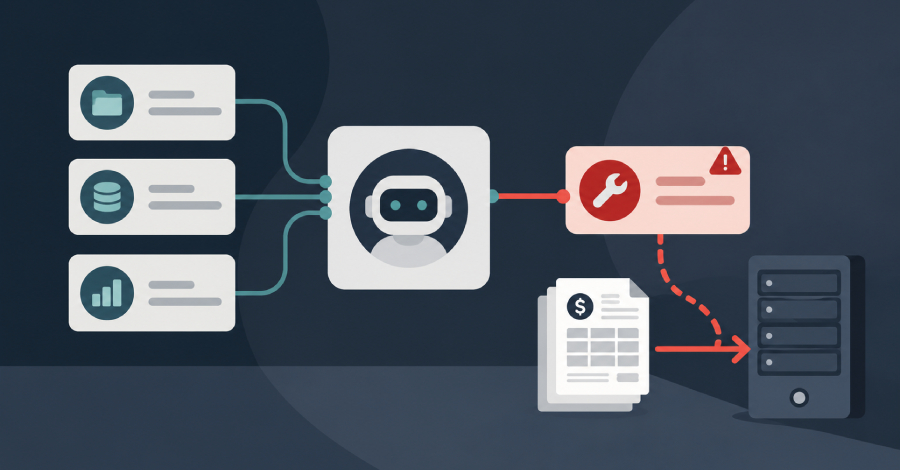
In September 2025, security researchers at Koi Security found what's widely described as the first in-the-wild malicious MCP server. It wasn't a sophisticated zero-day. It was one added line in an email tool.
What happened
postmark-mcp is an npm package that gives an AI agent a tool for sending email through Postmark. For fifteen releases — versions 1.0.0 through 1.0.15 — it did exactly that, and nothing else. It got adopted, it got trusted, it landed in people's daily agent workflows. By the time it mattered, it was pulling roughly 1,500 downloads a week.
Then version 1.0.16 shipped on September 17, 2025. The diff was small enough to miss in a glance: the send-email function gained a Bcc field pointing at phan@giftshop[.]club, a domain the maintainer controlled. Every email the agent sent — content, recipients, attachments, whatever secrets or PII happened to be inside — got silently copied to the attacker.
Nothing else changed. The tool still sent your email correctly. From the outside, and from the agent's perspective, it worked. That's the whole trick: the malicious version was indistinguishable in behavior from the benign one, except for the carbon copy you couldn't see.