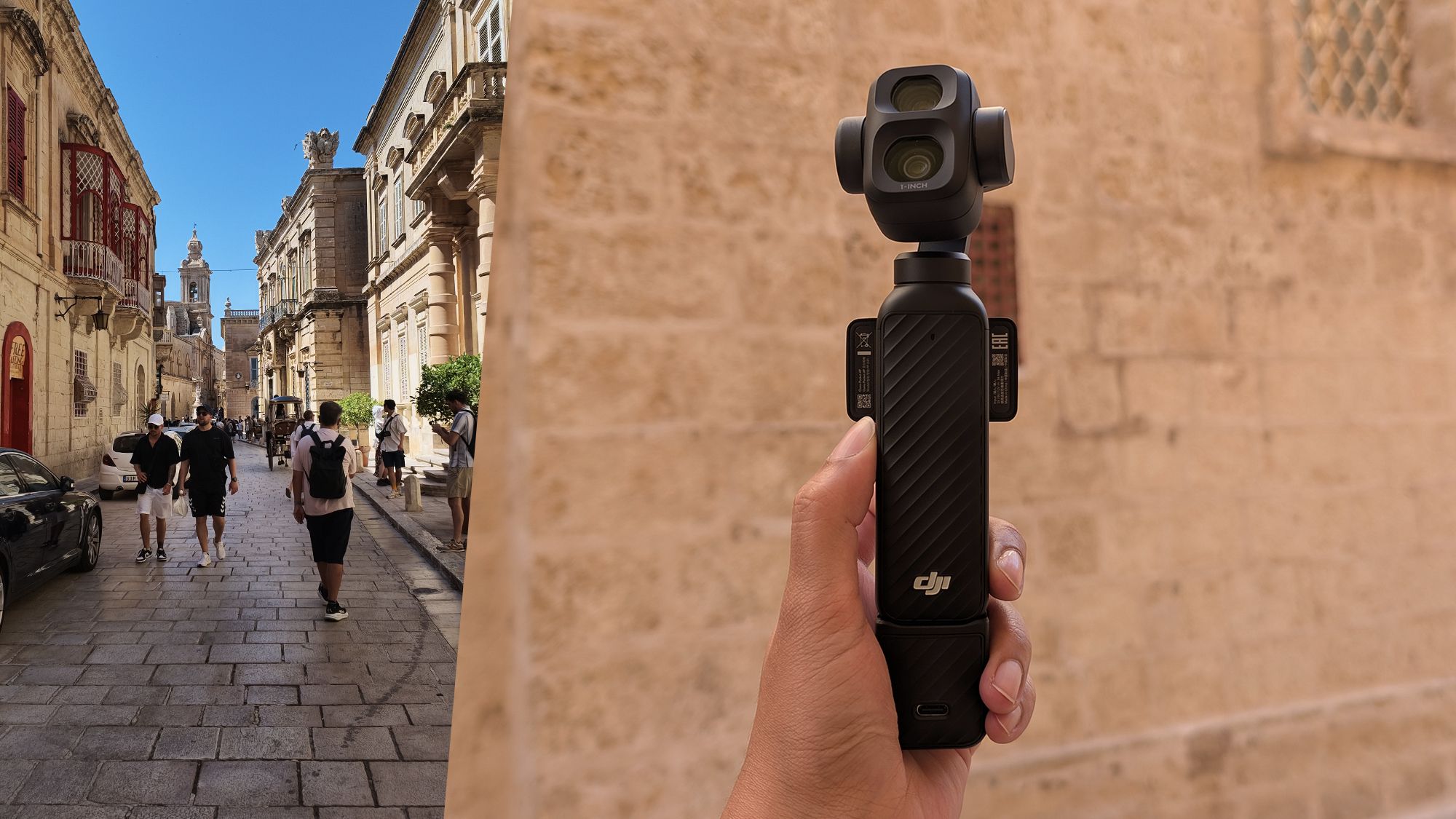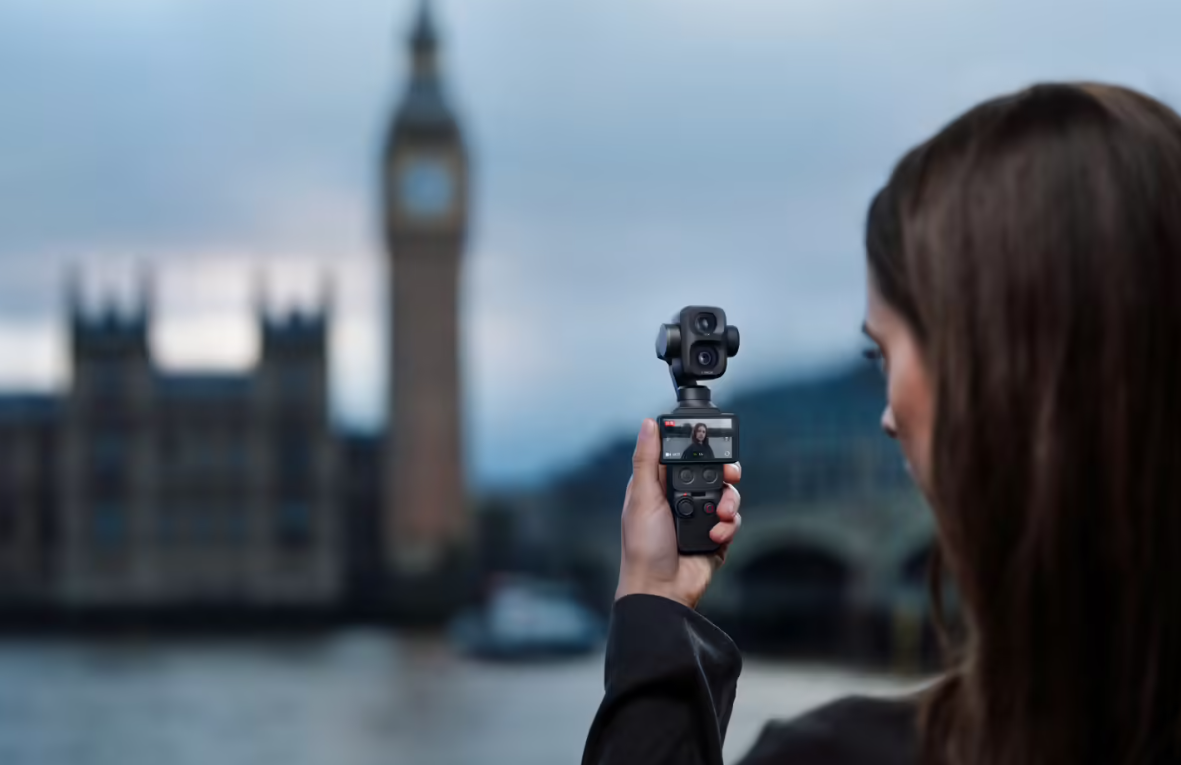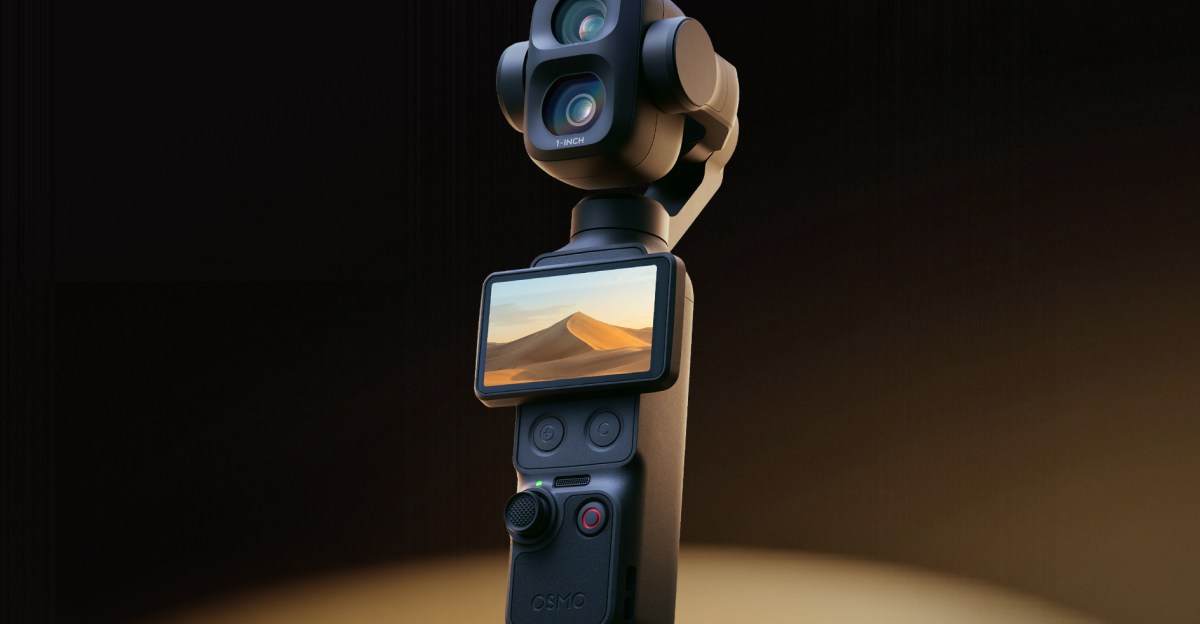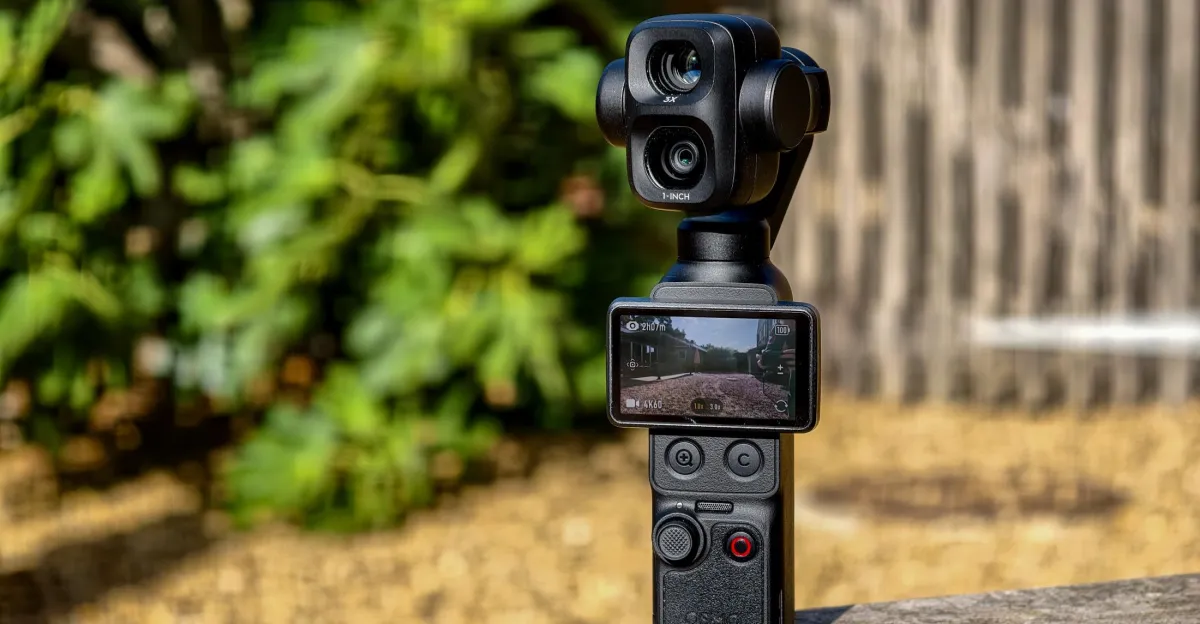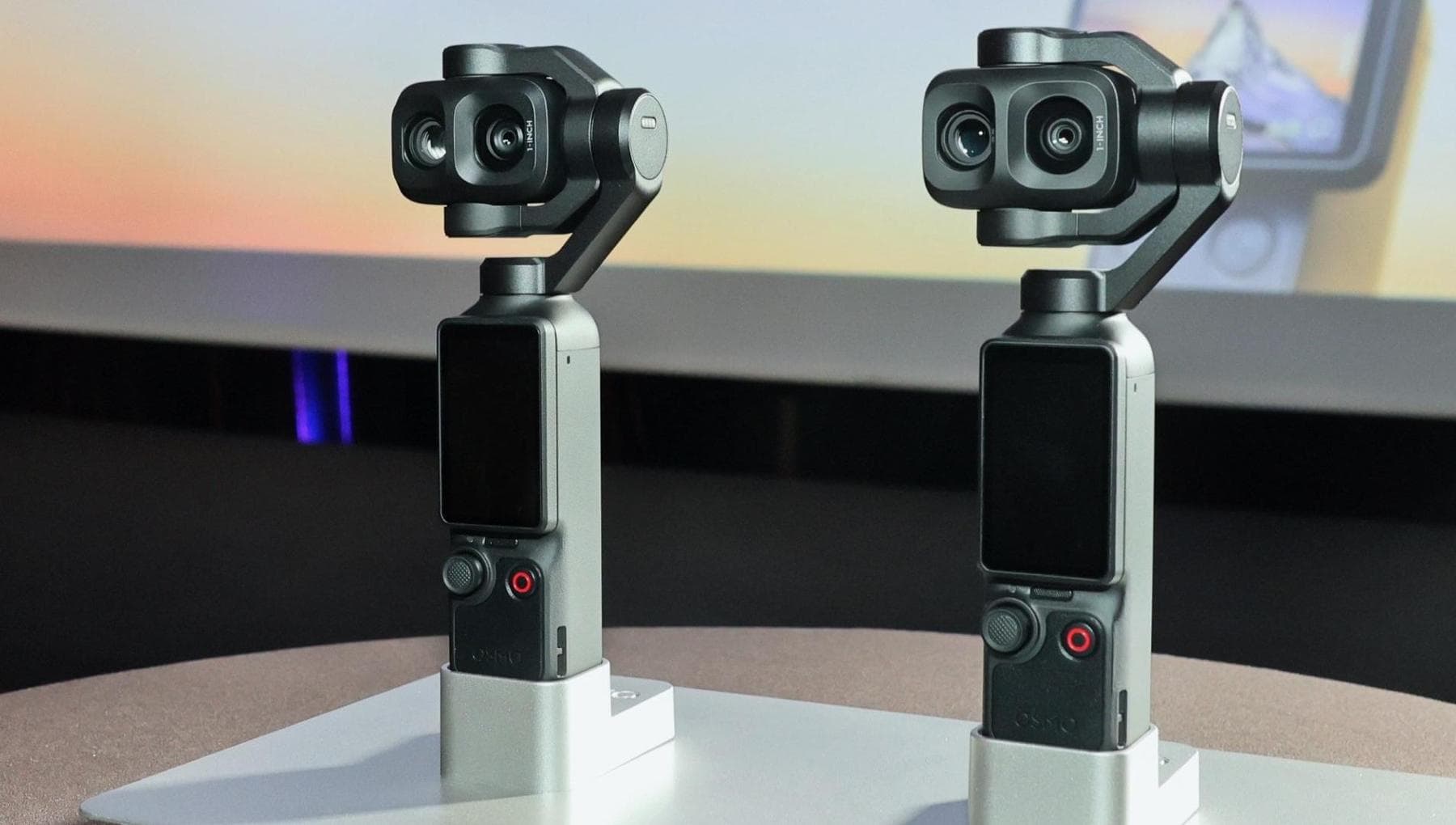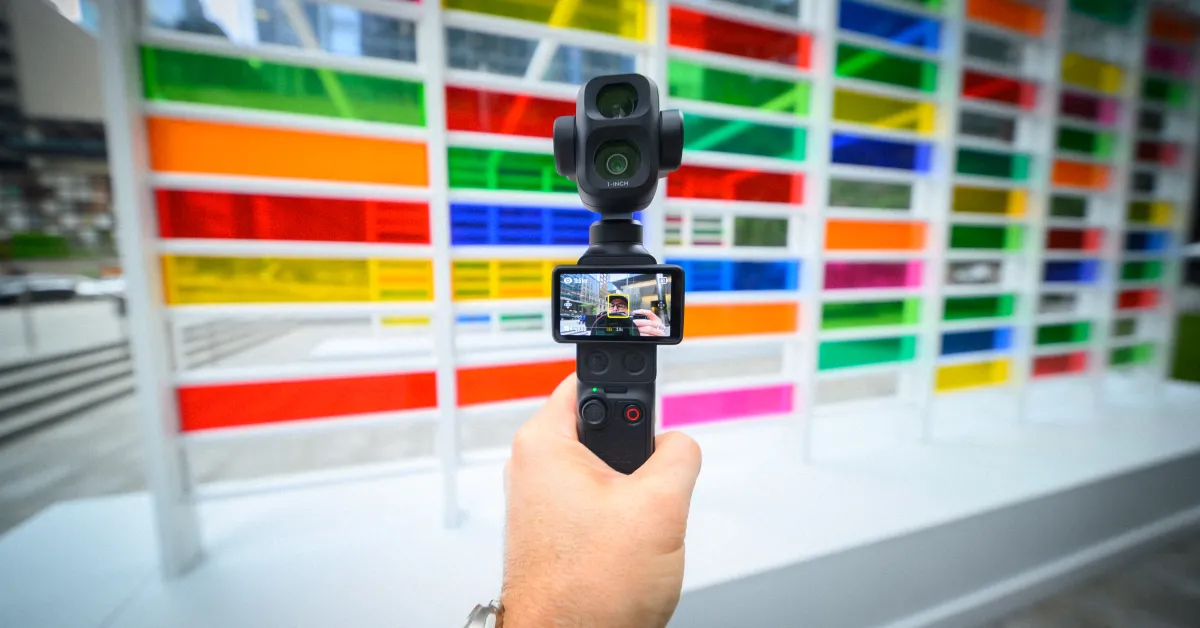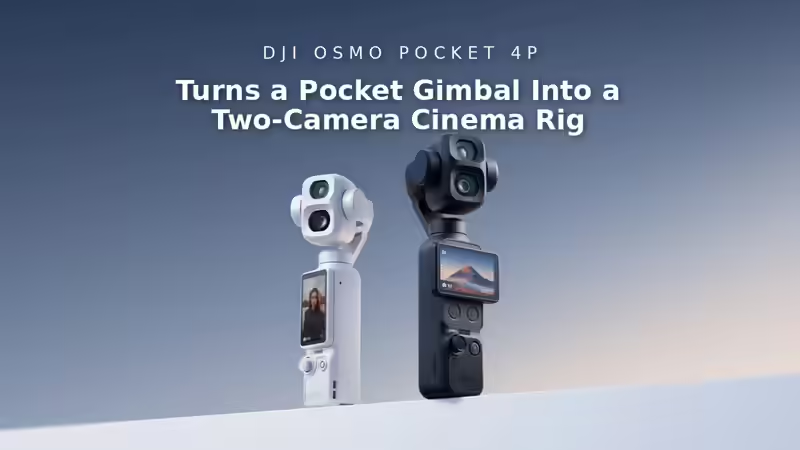
DJI launched the Osmo Pocket 4P on 29 June 2026, and for the first time in the line's history the palm-sized gimbal carries two cameras rather than one. On paper that reads like simple arithmetic. In the hand it plays like hiring a second crew member. The original Osmo Pocket sold a fantasy that a film unit could shrink to the size of a highlighter pen, and every model since has chipped away at the gap between that promise and a real production. The 4P finally staffs the unit properly. You get a wide-angle operator for the establishing shot and a portrait specialist for the close-up, and the two of them share a 230-gram body that slides into a jacket pocket.Key TakeawaysDJI launched the Osmo Pocket 4P on 29 June 2026, the first Pocket gimbal with two cameras: a 20mm wide on a one-inch sensor and a 60mm optical telephoto.The 60mm lens delivers real optical portrait compression and bokeh at f/1.8, with 3x optical zoom reaching 12x through a hybrid crop.The wide camera claims 17 stops of dynamic range via LOFIC technology and records 10-bit D-Log 2, while the telephoto rides a smaller 14-stop sensor.Pro touches arrive in a 230-gram body: in-camera timecode with sub-frame drift across eight hours, ActiveTrack 8.0 to 12x, gesture control and a webcam mode.Pricing starts at 3,799 yuan in China, US sale stays blocked by the FCC Covered List, and an Indian price and date are still to come.The chief rival is the Insta360 Luna Ultra, pricier at 769 dollars yet globally available, with a modular handle that doubles as a remote.Two optical eyes, one bodyStart with the change anyone will feel within a minute of picking it up. Two lenses. A 20mm wide riding a new one-inch sensor, and a 60mm telephoto sitting beside it, each a genuine optical eye rather than a software crop of the same picture. Every Pocket before this one offered a single fixed field of view and asked you to fake the rest by zooming digitally, which is the camera equivalent of walking closer while squinting. The 4P lets you cut between a sweeping room and a tight face the way a director cuts between an A-camera and a B-camera, and the footage holds its detail at both ends because the glass, rather than an algorithm, does the work.Why a 60mm lens flatters every faceSo why does a second lens rewrite the grammar of what a solo shooter can make? Because 60mm is the focal length cinema has used to photograph faces for the better part of a century. It sits in the flattering zone that renders a nose and cheekbones in their true proportions, where a wide lens stretches them. It compresses the background, pulling a busy street or a blurred ballroom up close behind the subject so the person pops off the frame. DJI rates the telephoto at f/1.8 with a depth of field that behaves like f/6.3 on a full-frame body, which in plain terms means real, optical, creamy separation. The blur lives in the glass. Earlier Pockets, and most phones, paint that blur on afterwards with software that smears the edges of hair and spectacle frames the moment anyone moves. The 4P earns it the honest way.The zoom itself climbs a ladder worth understanding. The first 3x is pure optics, the telephoto doing its honest job. Push past that and the 4P borrows resolution from the sensor for a 6x lossless reach that still holds its detail, then stretches to 12x as a hybrid crop for the moments a subject sits genuinely far off. ActiveTrack rides the whole ladder, so a face stays pinned in the frame at the long end, where a human thumb on a manual zoom would lose it inside a second.How a fingernail-sized sensor holds 17 stops of lightHow does a sensor the size of a fingernail hold so much light? DJI credits a slice of engineering it calls LOFIC, short for Lateral Overflow Integration Capacitor, a tiny reservoir parked beside each pixel that catches the overflow when a bright highlight would otherwise spill and clip to white. The company puts the wide camera's dynamic range at 17 stops, a figure that would sit beside cinema bodies costing many times more, and one that independent testing will confirm or trim once reviewers run it through a chart. Treat it as DJI's claim for now. The practical upshot, though, reaches you in the footage and the claim is easy to picture. Point the wide camera at a window blazing with afternoon sun while a face sits in shadow indoors, and the older Pockets forced a choice: a clean face and a white blob where the glass should be, or a readable window and a face gone to mud. The 4P aims to hold both, sky and skin in the same frame, the way the eye does. Pair that latitude with the new 10-bit D-Log 2 profile, which records over a billion colours and a flat, gradeable image, and a creator suddenly owns the kind of post-production headroom that used to demand a camera you needed two hands and a permit to carry.A film crew folded into one fistHere sits the deeper reason DJI chose a Cannes red carpet for the reveal rather than a tech-show stage. A film set is a hierarchy of hands. A camera operator frames. A focus puller keeps the eyes sharp. A grip pushes the dolly. A second unit peels off to grab the tight inserts. A script supervisor logs every take so the editor can stitch the angles together. The 4P folds that entire hierarchy into one fist. The gimbal is the dolly and the Steadicam, three motors holding the horizon level while you run. ActiveTrack 8.0 is the focus puller and the operator rolled together, locking onto a face, a pet or a moving car and keeping it centred all the way to 12x zoom, even choosing between several subjects on its own. The second lens is the second unit. A documentary maker working alone in a Delhi market, or a wedding shooter threading through a crowd, now carries a crew in a coat pocket. That compression of a whole trade into a single object is the thing worth calling a big deal.The features barely anyone mentionsNow the features DJI tucked deep in the spec sheet, the ones that quietly graduate the Pocket from vlogging toy to working tool and that almost nobody mentions over dinner. The 4P carries in-camera timecode, and it holds sync tight enough that DJI claims a drift under a single frame across eight hours. Read that twice. A pocket camera now does the job a clapperboard and a separate sync box do on a professional set, which means two of these, or one of these alongside a full cinema body, can roll together and arrive in the edit already in step. For multi-camera shoots, interviews cut between angles, live events covered from three corners, that one line changes the workflow more than any megapixel ever will.The list keeps giving. Gesture control starts a take or triggers tracking with a wave of the hand, a gift when you happen to be the talent and the entire crew at once. A slow-shutter video mode paints light trails straight in the camera, so a night street or a sparkler writes its own long exposure with zero rigging. A 4K Live Photo grabs a second and a half of motion around every still, the kind of moving memory that flatters a portfolio. There is a webcam mode, a live-streaming pipe over Wi-Fi 6, an audio backup track that records a quiet safety layer beneath your main sound, and a lens defogging routine for the cold mornings that fog a chilled front element. A 37-megapixel still leaves room to crop in hard. The electronic shutter reaches 1/16,000 of a second for shooting wide open under harsh sun. Few of these will headline an advertisement. Together they read like a camera built by people who have actually missed a shot and resolved to stop missing them.The unglamorous wins that finish a shootDJI also sweated the boring miracles that decide whether a shoot finishes. The battery runs up to 210 minutes and refills to 80 per cent in 18 minutes, so a coffee break buys back most of a day. Storage is 103GB built in, fed by a USB 3.1 pipe that offloads at 800MB/s, which turns the dreaded end-of-day card dump into a near-instant chore. The screen is a 2-inch panel that rotates and pushes 1,000 nits, bright enough to frame a shot in noon glare. Rotate that screen and the camera powers on and records in one motion, the Instant Recording trick that catches the moment a fumble with a power button would lose. Glamour has little to do with any of it. All of it is the difference between a tool and a paperweight.Sound gets the same quiet seriousness. Three microphones sit in the body for clean scratch audio, and the camera speaks DJI's OsmoAudio language, so a DJI wireless mic pairs and records straight into the footage and spares a solo shooter the lavalier-and-recorder juggling act that eats a small crew's morning. Around the camera DJI has built the usual modular orbit: a set of ND filters for shooting wide open in daylight, a Black Mist filter for that soft cinematic bloom, a clip-on fill light, a wide-angle adapter, a battery handle that stretches the runtime, and the FrameTap viewfinder remote for watching a shot you happen to be standing inside. Each piece sells on its own or folds into a combo.For creators who would rather post than grade, the 4P bakes in six film tones and real-time skin smoothing, a finished look applied in the camera and ready to upload, while the DJI Mimo app waits for anyone who wants to push colour further on a phone or a laptop. Measured against its cheaper single-lens sibling, the standard Pocket 4, the maths reads plainly: the step up buys the second camera, the jump from 14 to a claimed 17 stops, the richer D-Log 2 profile and the smarter tracking. That is a generous amount of camera for the gap between the two price tags.Where the Pocket 4P gives groundHonesty demands the asterisks, because a clear-eyed look serves a reader better than a press release. The two cameras play different weights. The wide rides the new one-inch sensor and DJI's claimed 17 stops; the 60mm rides a smaller 1/1.28-inch chip rated nearer 14 stops, and it tops out at 4K/200 against the wide's 240. Switch to the portrait eye and you trade a slice of latitude for that gorgeous compression. Fair enough for the look it buys, and worth knowing before you build a whole shoot around the long lens. DJI leaves two boxes unticked that a 2026 cinema pitch invites. The top resolution stops at 4K, so the 6K and 8K bragging rights stay with rivals and the next generation. And native vertical capture, the format that feeds Reels and Shorts and the phones most of this camera's buyers live on, sits out of the launch spec sheet, which lands oddly for a device aimed squarely at creators who think in portrait.How does it compare with the Insta360 Luna Ultra?The 4P also walks into a fight it helped start. Insta360 reached the same idea at almost the same moment with the Luna Ultra, a twin-camera gimbal so close in silhouette that the two could pass for siblings separated at a factory. The Luna answers with modular flair, a magnetic handle that pops off and becomes a remote control, a trick the fixed-grip DJI leaves on the table. It brings AI-assisted stabilisation and a rotating screen of its own. Two advantages settle the duel, and they pull in opposite directions. On raw video the Pocket 4P leads, with higher dynamic range, faster slow motion, quicker charging and roomier built-in storage. On reach the Luna wins walking away, because at 769 dollars it sells across the world, the United States included, while the DJI stays boxed out of the largest camera market on Earth. An American creator faces an easy call. Everyone else gives the Pocket the longer look.Why the American door stays shutHere the story takes a turn worthy of a customs hall. The United States has effectively shut its door on the 4P. DJI has sat on the federal Covered List since 22 December 2025, the register that blocks the authorisation any new device needs for a legal American sale, and the Pocket 4P joins the standard Pocket 4 and a clutch of other recent DJI gear stranded outside the line. The company is fighting the listing in the Ninth Circuit, arguing the agency failed to prove any real threat and reached well past its powers, and the case sits unresolved. Meanwhile a near-identical camera called the XTRA Muse 2 Pro, read across the industry as DJI hardware wearing a different badge, has quietly opened American pre-orders. A camera crossing the border in disguise tells you how badly the demand wants in. The rollout itself moved in stages, a tease at Cannes in May, Chinese pre-orders through June, then the global launch on 29 June, an order that let DJI read the room while its rival Insta360 showed its hand first.Osmo Pocket 4P price and India availabilityIndia sits in the waiting room. DJI has yet to name an Indian price or a launch date, and the dollar figure floating around the global market, somewhere near 650 to 700 dollars, offers only a rough sketch of where the rupee number lands once duty and the local margin do their work. The clearest reading comes from the prices DJI has already set elsewhere: a standard combo at 3,799 yuan in China, a vlog kit at 4,299 that folds in a microphone, a mini tripod and a remote with its own little monitor, and a Philippine sticker of 37,790 pesos that climbs to 42,290 for the bundle. Indian creators who built a livelihood on the Pocket 3, and there are a great many of them shooting cafes, travel reels and small-brand ad films, will recognise the shape of the offer. The wait for an official number starts now.Does it beat the phone in your pocket?And the rival the 4P most needs to beat is dozing in your other pocket. Phone cameras have grown astonishing, and a current flagship shoots video that would embarrass a dedicated camera from a decade ago. What the phone still struggles to fake is the very thing the Pocket hands over for free: real stabilisation from a mechanical gimbal that software keeps trying to imitate, an optical telephoto with true background compression, and the single-minded focus of a body built to do one job superbly. A phone juggles a hundred tasks and shoots video between calls. The Pocket commits to the frame alone, and that monogamy shows up on the screen.What the dual lens really signalsStep back and the launch reads as a statement about where this whole category travels next. DJI built its name teaching a gimbal the size of a boiled sweet to move like a crane on a soundstage, and for a decade the Pocket sold itself on smoothness alone. The Osmo Pocket 4P pushes the idea to its logical end. It hands a working creator the two things a camera crew exists to provide, coverage and a second angle, plus the dynamic range and the sync discipline of a far larger rig, in a shell that vanishes into a fist. The price for that ambition is a long lens that gives up a little quality, a resolution ceiling that stops at 4K, and a border that stays closed to it. Weighed against what it puts in one hand, those feel like fair tolls.Cannes was the right room to show it. A gadget walked the carpet, and a small, stubborn argument walked off it: that the next film worth watching might be shot by one person, alone, holding something that fits in a pocket.Frequently asked questionsWhat is the DJI Osmo Pocket 4P?The Osmo Pocket 4P is DJI's first pocket gimbal with two cameras, launched on 29 June 2026. It pairs a 20mm wide lens on a one-inch sensor with a 60mm optical telephoto, housed in a 230-gram body with a built-in stabilising gimbal.How much does the DJI Osmo Pocket 4P cost?DJI prices the standard combo at 3,799 yuan in China and 37,790 pesos in the Philippines, with a vlog kit above that. Global estimates sit near 650 to 700 dollars, and an Indian price stays to be confirmed.Is the DJI Osmo Pocket 4P available in the United States?DJI stays barred from selling it officially in the US, because the company sits on the FCC's Covered List. A rebadged version, the XTRA Muse 2 Pro, offers American buyers a workaround while DJI fights the listing in court.What does the 60mm telephoto lens do?The 60mm lens captures portraits with natural facial proportions and compresses the background for real optical bokeh, the look that lifts a subject off a busy scene. It offers 3x optical zoom, reaching 12x through a hybrid crop.How does the Osmo Pocket 4P differ from the standard Osmo Pocket 4?The 4P adds the second telephoto camera, a claimed 17 stops of dynamic range against the standard model's 14, the 10-bit D-Log 2 profile and ActiveTrack 8.0 tracking, for roughly 800 yuan more.How does it compare with the Insta360 Luna Ultra?The Pocket 4P leads on pure video, with higher dynamic range, faster slow motion, quicker charging and more storage. The Luna Ultra answers with a detachable modular handle and, at 769 dollars, global availability that includes the United States.What video can the Osmo Pocket 4P record?The wide camera shoots up to 4K at 240fps and the telephoto up to 4K at 200fps, both in 10-bit D-Log 2 for grading headroom. The resolution tops out at 4K; 6K stays absent from the launch spec sheet.end of article
DJI Osmo Pocket 4P Turns a Pocket Gimbal Into a Two-Camera Cinema Rig
Two optical lenses, 17 stops of claimed dynamic range and pro-grade timecode arrive in a 230-gram body — here is why the dual-lens Pocket changes the solo shoot.
3,007 words~14 min read