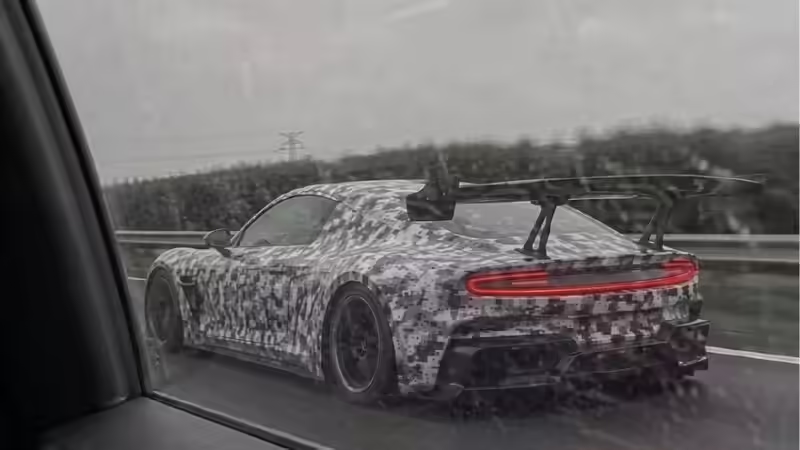
Photo credit: arenaev.comA heavily camouflaged two-door electric coupe has been photographed testing on public roads in China, prompting speculation that Xiaomi may be preparing a vehicle above the SU7 Ultra. Xiaomi has not acknowledged the prototype, confirmed a new sports-car programme or used the reported “Xiaomi GT” name.That distinction matters. The images show a low, wide test vehicle with an unusually aggressive rear wing and diffuser, but they do not establish its maker, powertrain, production timing or final design. The more interesting question is not whether Xiaomi can build a dramatic-looking coupe. It is whether the company is preparing a serious track-focused EV, one designed to maintain performance repeatedly rather than simply post a dramatic acceleration figure.Xiaomi already has a performance-led halo car in the SU7 Ultra. A more extreme two-door model would move the company into a different category: a low-volume engineering statement that could test its chassis, cooling and powertrain technology before international expansion begins. Xiaomi has said it plans to enter overseas EV markets in 2027, with Europe identified as its first destination. Key TakeawaysA camouflaged two-door electric coupe has been seen testing in China, but Xiaomi has not confirmed that it is responsible. The prototype appears to have a fixed swan-neck rear wing, a large rear diffuser and a low roofline. Reports linking it to a possible “Xiaomi GT” remain unverified. Claims of a 2,054hp quad-motor system, active chassis and steer-by-wire are rumours, not confirmed specifications. Xiaomi’s current EV range consists of the SU7 sedan and YU7 SUV; the company has separately filed for an extended-range model in China. Xiaomi has stated that Europe is planned as its first overseas EV market in 2027. The prototype suggests a different ambition from the SU7 UltraThe prototype’s visible hardware is the strongest evidence available. It has a two-door coupe profile, broad rear haunches, a large fixed rear wing and what appears to be a multi-level diffuser. Those features point towards aerodynamic intent, not just cosmetic aggression.A rear wing and diffuser work as a system. At higher speeds, the wing can create downforce over the rear axle, increasing tyre load and potentially helping stability through fast corners. A diffuser manages airflow beneath the car, accelerating air as it exits the underbody and helping reduce pressure under the vehicle.That is why these parts matter more than the camouflage. Xiaomi would not need such prominent aero for a conventional premium coupe. Their presence suggests that high-speed stability, braking and repeated track use may be part of the programme’s brief.There is still a major gap: spy photographs cannot tell us whether the wing and diffuser are functional production parts, early test equipment or design theatre fitted to disguise the underlying body. Xiaomi has not released wind-tunnel figures, downforce data or track-performance targets.The real question is not horsepower. It is repeatability.The most striking rumour is a quad-motor electric powertrain producing 2,054hp. Reports say it could combine two Xiaomi V8S motors with two newer high-output drive units.That figure should not be presented as a confirmed specification. Xiaomi has discussed high-performance motor technology publicly, but there is no official confirmation that the photographed vehicle uses a quad-motor system, that it will reach production or that it will deliver 2,054hp.Even if the claim proves accurate, peak power would only be part of the story.A performance EV with more than 2,000hp needs to manage several difficult tasks at once: battery temperature, motor temperature, inverter load, tyre grip, brake temperatures and torque delivery. A car can produce extraordinary acceleration once. The real engineering test is whether it can deliver repeatable laps or repeated high-speed runs without losing power, overheating brakes or becoming unpredictable at the limit.That is where a possible Xiaomi sports car could become strategically important. The SU7 Ultra already gives Xiaomi a performance flagship. A coupe with active chassis control, independent torque management and serious thermal capacity would be a way to demonstrate that Xiaomi’s EV division is moving beyond fast straight-line cars. Active chassis and steer-by-wire would change how the car behavesReports also link the prototype to a fully active chassis, a 48V electrical architecture and steer-by-wire. None has been confirmed by Xiaomi.The mechanics are worth explaining because these systems would shape the car more than a headline power figure.A fully active chassis can adjust suspension forces at each corner, helping control pitch under braking, squat under acceleration and body roll in corners. In an electric car with a large battery pack, that can help preserve tyre contact and reduce the sense of mass changing direction.Independent motor control can also distribute torque across the wheels. In principle, that lets the system send more power to an outside wheel through a corner or reduce torque at a wheel that is starting to lose grip. Done well, it can make a very fast car easier to place. Done badly, it can feel artificial or unpredictable.Steer-by-wire removes the fixed mechanical connection between the steering wheel and front wheels, replacing it with electronic control. It can vary steering response and filter some road disturbance, but it also raises the bar for calibration and fail-safe design. A track-focused car would need to give drivers clear, repeatable feedback rather than merely quick steering.These are precisely the areas where road testing matters. The camouflage tells us little about steering feel, brake consistency or chassis balance. Battery cooling could decide whether the car is a track tool or a showpieceThe reports describe an upgraded cooling system derived from the SU7 Ultra, designed to manage battery temperature under sustained load. That claim is plausible in engineering terms, but Xiaomi has not confirmed it for this prototype.Cooling matters because EVs can reduce power sharply when batteries, motors or inverters approach thermal limits. It is one reason an EV that feels astonishingly quick on the road can become slower after several hard laps.A genuine track-focused Xiaomi coupe would need more than a large battery and powerful motors. It would need a cooling system that can absorb heat quickly, reject it efficiently and keep operating when ambient temperatures rise. It would also need brakes, tyres and suspension capable of matching the drivetrain.That is the missing information in the current reports. There are no confirmed lap times, repeatability tests, thermal data, battery-capacity figures, charging architecture or brake specifications. What the prototype may tell us about Xiaomi’s EV strategyThe prototype arrives as Xiaomi’s EV business broadens beyond the original SU7 sedan. Xiaomi has launched the YU7 SUV, while Chinese regulatory filings also show a proposed extended-range vehicle awaiting approval.The company delivered 32,759 EVs in China in May 2026, according to China Passenger Car Association data reported by CnEVPost. That total included 24,023 SU7 sedans and 8,736 YU7 SUVs.A high-performance coupe would not materially change those volumes. Its role would be different: to push Xiaomi’s engineering image upward, create a flagship above the SU7 Ultra and give the brand an attention-grabbing product before it takes its EV business overseas.That strategy has limits. A halo car can demonstrate technical ambition, but it is also expensive to develop, difficult to homologate and unlikely to offer the profit or scale of a mainstream sedan or SUV. Xiaomi’s own first-quarter 2026 results show pressure in its smart-EV segment, with gross margin falling to 20.1 per cent amid higher component costs, vehicle-purchase-tax subsidies and a lower contribution from SU7 Ultra deliveries.That makes the prototype more interesting as a technology signal than as a volume product.What is confirmed, what is inferred and what remains rumourItemStatusWhat can be saidCamouflaged two-door coupe seen testing in ChinaReportedImages have circulated, but Xiaomi has not publicly identified the vehicle.Xiaomi is developing the prototypeUnconfirmedStyling cues have led to speculation, but there is no official attribution.“Xiaomi GT” nameRumouredXiaomi has not announced this name.Positioning above the SU7 UltraRumouredIt would fit the visible aero package, but Xiaomi has not confirmed a product hierarchy.Quad-motor powertrainRumouredNo Xiaomi statement links a quad-motor system to this car.2,054hp outputRumouredThis should not be presented as a specification.Fully active chassisRumouredNo official technical detail is available.Steer-by-wireRumouredNo official technical detail is available.Xiaomi’s Europe entry in 2027Confirmed corporate directionXiaomi has identified Europe as its first overseas EV market. Xiaomi sports-car prototype: what to watch nextThe next credible signs would be more revealing than another set of spy shots.A regulatory filing could establish the vehicle’s dimensions, battery chemistry, motor count and production entity. A Xiaomi announcement could clarify whether the car is a production programme, a technology demonstrator or an experimental prototype. Track footage could show whether the aero hardware is functional and whether Xiaomi is pursuing lap-time credibility rather than straight-line spectacle.Until then, the most defensible reading is narrow: a camouflaged coupe with serious-looking aero has been spotted in China, and reports have linked it to Xiaomi. Everything that would determine whether it is a genuine performance breakthrough, from its maker to its motors and chassis, remains unconfirmed. Frequently Asked Questions1. Has Xiaomi officially announced a new electric sports car? No. Xiaomi has not confirmed the prototype, its name, its powertrain or a production launch.2. Why are reports linking the prototype to Xiaomi? Reports point to its design language, including a full-width rear-light treatment and styling elements compared with Xiaomi’s existing EVs. These links remain inference rather than confirmation.3. Could the car have more than 2,000hp? Some reports claim a 2,054hp quad-motor system, but Xiaomi has not confirmed that output or the powertrain layout.4. What would make this car different from the Xiaomi SU7 Ultra? The reported two-door body, large aero components and claims of active chassis technology suggest a more track-focused role. Xiaomi has not confirmed that positioning.5. When will Xiaomi sell EVs internationally? Xiaomi has said Europe is planned as its first overseas EV market in 2027.end of article
Xiaomi sports-car prototype spotted in China: what the test mule may reveal
A recently seen camouflaged two-door electric coupe in China has sparked discussions regarding Xiaomi's next venture into EVs. While the firm has kept quiet, the vehicle's bold aerodynamic features imply a competitive, track-ready intention possibly exceeding the SU7 Ultra. Speculations point towards a robust quad-motor system and innovative chassis technologies, with Xiaomi hinting at launching in Europe come 2027.
1,606 words~7 min read