By
June 30, 2026 / 5:00 AM EDT
/ CBS News
Add CBS News on Google
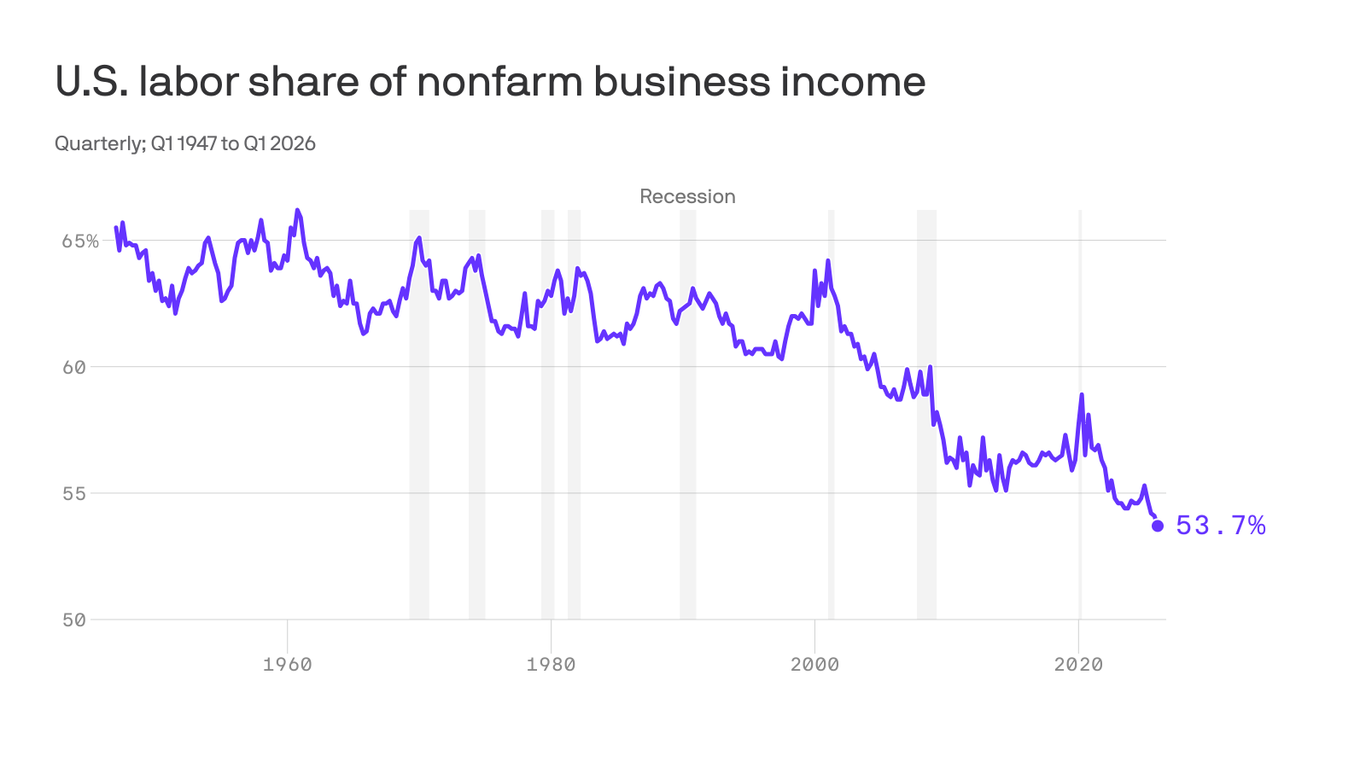
American workers' share of the economic pie has fallen to its lowest level since at least 1947, when the federal government began tracking the data, according to an analysis by Federal Reserve economists. The measure, known as "labor share of income," tracks how much of the nation's economic output flows to workers in the form of wages and salaries, as opposed to the share that goes to investors and corporations through profits, dividends and other capital income. A shrinking labor share of income indicates that more economic gains are flowing to shareholders and business owners, rather than to workers.As of early 2026, American workers received 54.1% of national income, according to research from the Federal Reserve Bank of New York. By comparison, that figure topped 65% almost 80 years ago, when the government began tracking the data following World War II. In early 2020, it stood at 57.7%, indicating that workers have continued to lose ground since the pandemic. Roughly 48% of Americans said their financial situation was worse in May than a year ago, the highest share since January 2023, according to a recent survey by the Federal Reserve Bank of New York.Three-quarters of Americans said their incomes aren't keeping up with inflation, according to a May CBS News poll. Roughly 29% of respondents said the economy was in good shape.American workers are taking home a smaller share of the nation's income — capturing less of what the economy produces — due to several long-standing issues, ranging from the erosion of union membership to tax law changes that have steered more gains to CEOs, investors and high-income Americans, economists told CBS News. As those currents played out over decades, many low- and middle-income workers have lost economic ground, making them feel increasingly financially precarious even as the economy as a whole has continued to expand and rebound in the wake of multiple crises. "You've got a lot of people who seem to work for firms that, in the aggregate, seem to be doing really well," said Josh Bivens, chief economist at the Economic Policy Institute, a nonpartisan think tank. "They're very profitable, and yet [workers'] wages aren't growing particularly fast relative to how fast the firms are growing."