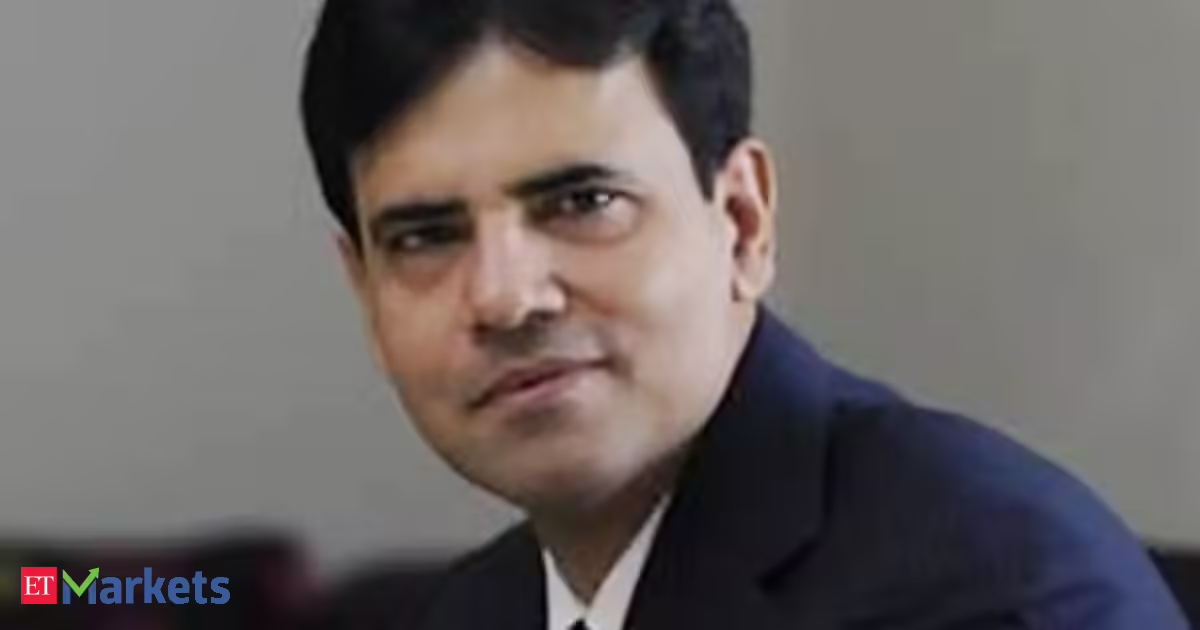
Private sector banks are entering a stronger phase as credit growth accelerates, margin pressures ease, and leadership transitions gradually remove uncertainties, says market expert Sandip Sabharwal. He also believes the recent correction in auto stocks has created opportunities, remains constructive on textiles, but questions the valuation and strategic rationale behind Persistent Systems' latest acquisition.HDFC Bank's Valuation Looks Attractive Despite Leadership WatchWhile recent management-level changes have helped reduce some uncertainty around HDFC Bank, Sabharwal believes the biggest trigger for the stock remains the appointment of the bank's next CEO."I would say that some overhangs are off, but the big one is obviously the CEO appointment and what happens on that front. So, that is what we need to see. But, that said, HDFC Bank today trades at valuations which have gone into a discount to a few private sector banks also," he said.He pointed out that the merger between HDFC Ltd. and HDFC Bank created significant operational challenges."There are reasons for it, starting from the ill-thought-of and anti-minority shareholders HDFC-HDFC Bank merger, which obviously created a lot of issues for HDFC Bank in terms of re-pricing the liabilities as well as its growth path," he said.According to him, those challenges are now largely behind the bank."So, I think that is something that is behind. I would think that the valuations are attractive at a price of Rs 1,800. But, for HDFC Bank to perform, since it is so over-owned among institutional investors, we need a revival of foreign fund flows also. Once that starts, HDFC Bank should do better," he said.Banking Fundamentals Continue to StrengthenWith leadership changes underway across major private lenders such as HDFC Bank, ICICI Bank and Kotak Mahindra Bank, investors remain focused on succession planning. Sabharwal acknowledged the importance of leadership but believes sector fundamentals are becoming increasingly supportive."So, the CEOs are very important for any corporate and also banks, so that is something we need to watch out for," he said.However, he believes the industry's operating environment has improved considerably."The overall banking sector seems to be on a good footing because credit growth has reached 18%. For high credit growth, because in the last few years, despite the asset quality improvements, we had seen that the credit growth was muted," he said.He added that easing margin pressures further improve the outlook."Credit growth is very strong. Asset quality is holding up, and most of the repricing that had to happen due to repo rate cuts is already through. Earnings margin compression is also over. We could actually see some expansion going forward. So, the banking sector is very well placed overall. Most of the large private sector banks should do well over the next one or two years," he said.Strong Credit Growth Could Drive EarningsSabharwal expects robust loan growth to translate into healthy earnings growth for banks over the coming years."Yes, obviously because 18% credit growth is huge and, in a scenario where the NIM compression also is behind us, if the large banks grow at 15% to 18% and the NIMs also grow, then the net interest income grows at 15% to 18%. With operational efficiency, that should lead to very healthy profit growth," he said.He also highlighted deposits as a key area to monitor but expects overseas inflows to provide support."One big concern has been the difference between the growth in deposits and growth in credit, where deposit growth has clearly lagged behind. That will also be aided by the FCNR flows," he said."If FCNR(B) flows come in at the expected $50 billion to $60 billion, that will ease a lot of concerns around deposit accretion and the growing gap between deposits and credit growth. Overall, the banking sector seems to be very well placed," he added.Persistent Acquisition Raises QuestionsOn Persistent Systems' recent acquisition, Sabharwal expressed reservations over both the valuation and the strategic benefits."You spelled out all the relevant points of whatever are the concerns. The acquisition seems expensive, the cash outflow is huge, and the valuation premium at which it has been acquired does not seem very justified to me," he said.He believes several Indian IT companies are trying to strengthen their artificial intelligence capabilities through acquisitions, but warned that shareholders should remain cautious."There is no reason to give such a premium, and what it will add in the long term is also a question mark. I would think that many of the Indian IT companies have lagged behind in the AI play and are now becoming desperate to do something, and it would not be in favour of minority shareholders," he said.Auto Sector Correction Creates OpportunitySabharwal believes the new Delhi EV policy could provide a meaningful boost to the electric vehicle ecosystem, benefiting both established automakers and EV-focused companies."The entire ecosystem should benefit because the aim is to replace the old vehicles, and most of the large players are now present across the EV as well as the traditional ICE space," he said.He identified Tata Motors, Ashok Leyland and Mahindra & Mahindra among the likely beneficiaries, while adding that leading two-wheeler manufacturers also stand to gain."The auto stocks have corrected during the entire Iran issue and also on predictions of a poor monsoon, but I would say that most of the negatives are really priced in. Many of the companies look cheap to me relative to what the growth prospects are," he said.Textile Exporters Regain MomentumSabharwal is also optimistic on the textile sector as global trade conditions become more favourable for Indian exporters.He noted that Indian exporters were at a disadvantage last year due to tariff disparities but believes the playing field has now improved."Last year, obviously, Indian textile companies got hit hugely because of disproportionate tariffs from the US, while other competing countries had much lower tariffs. Now, everyone is at par, so we are seeing momentum come through in many companies," he said.He expects further upside once trade agreements are finalised and also cited currency depreciation as an additional tailwind."Once the trade deals actually get fructified, we could see more momentum, especially given the fact that the Indian currency has also depreciated much more vis-à-vis most of the competing countries," he said.Highlighting one of his preferred picks, he said, "During the entire fall, we have taken some positions in Gokaldas Exports, which is at the forefront of the export story in India because that stock had corrected hugely. But there are many other plays which could also do well."
HDFC Bank valuations attractive, banking sector ready for next growth phase: Sandip Sabharwal
Market expert Sandip Sabharwal sees private banks entering a robust phase driven by accelerating credit growth and easing margin pressures. He finds HDFC Bank's valuation attractive despite leadership uncertainties, while noting operational challenges from the merger are largely behind. Sabharwal also highlights opportunities in auto stocks post-correction and remains constructive on textiles, but questions Persistent Systems' acquisition.
1,068 words~5 min read