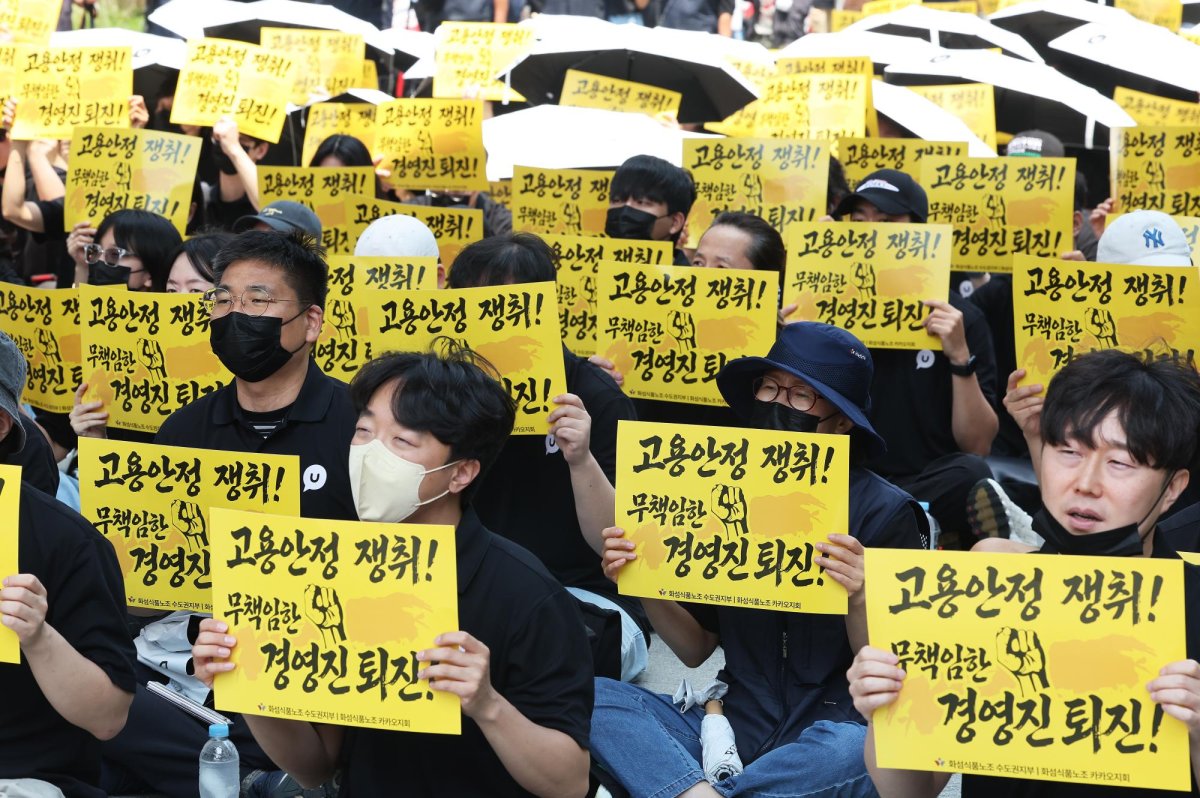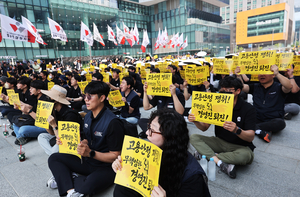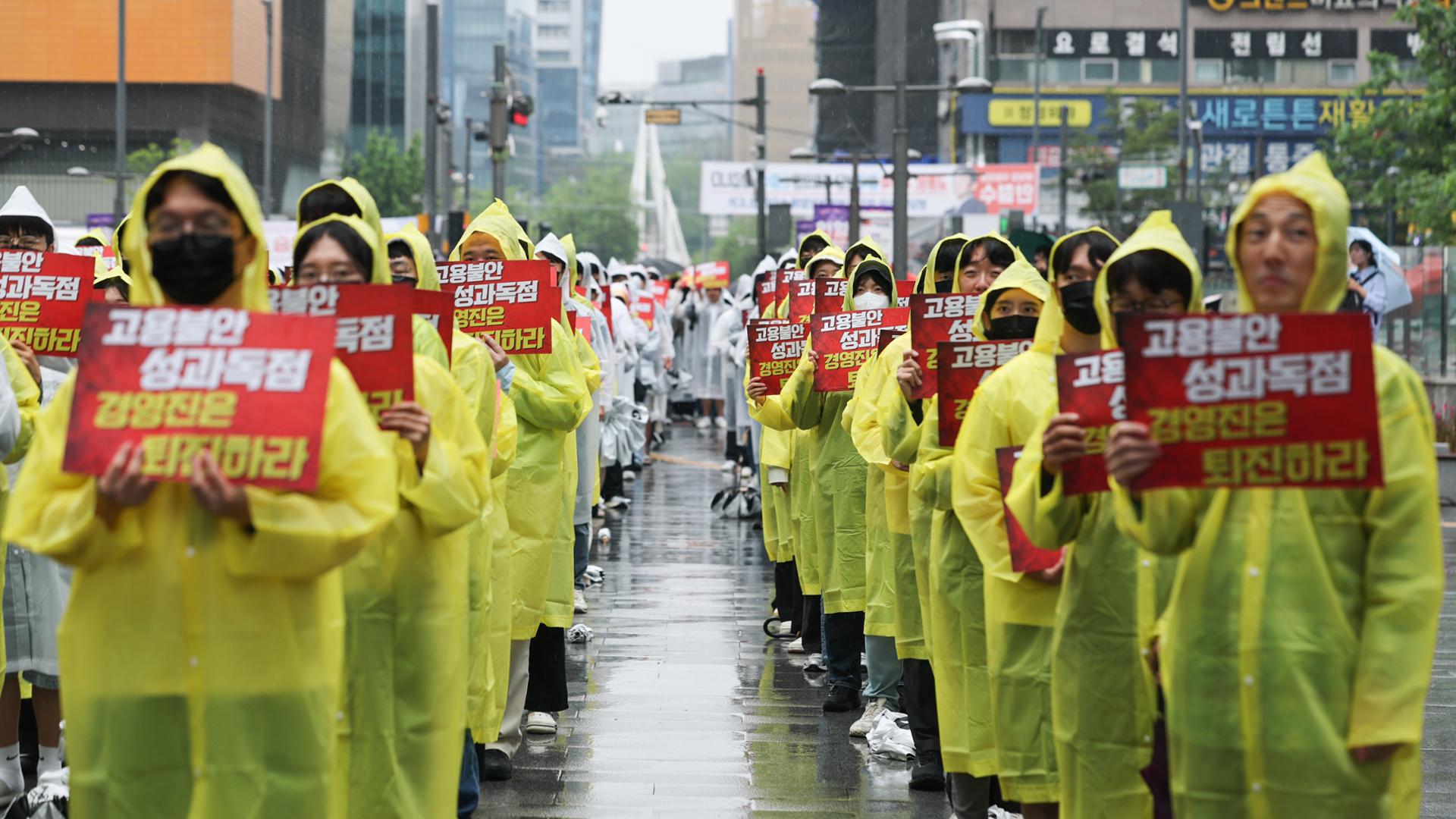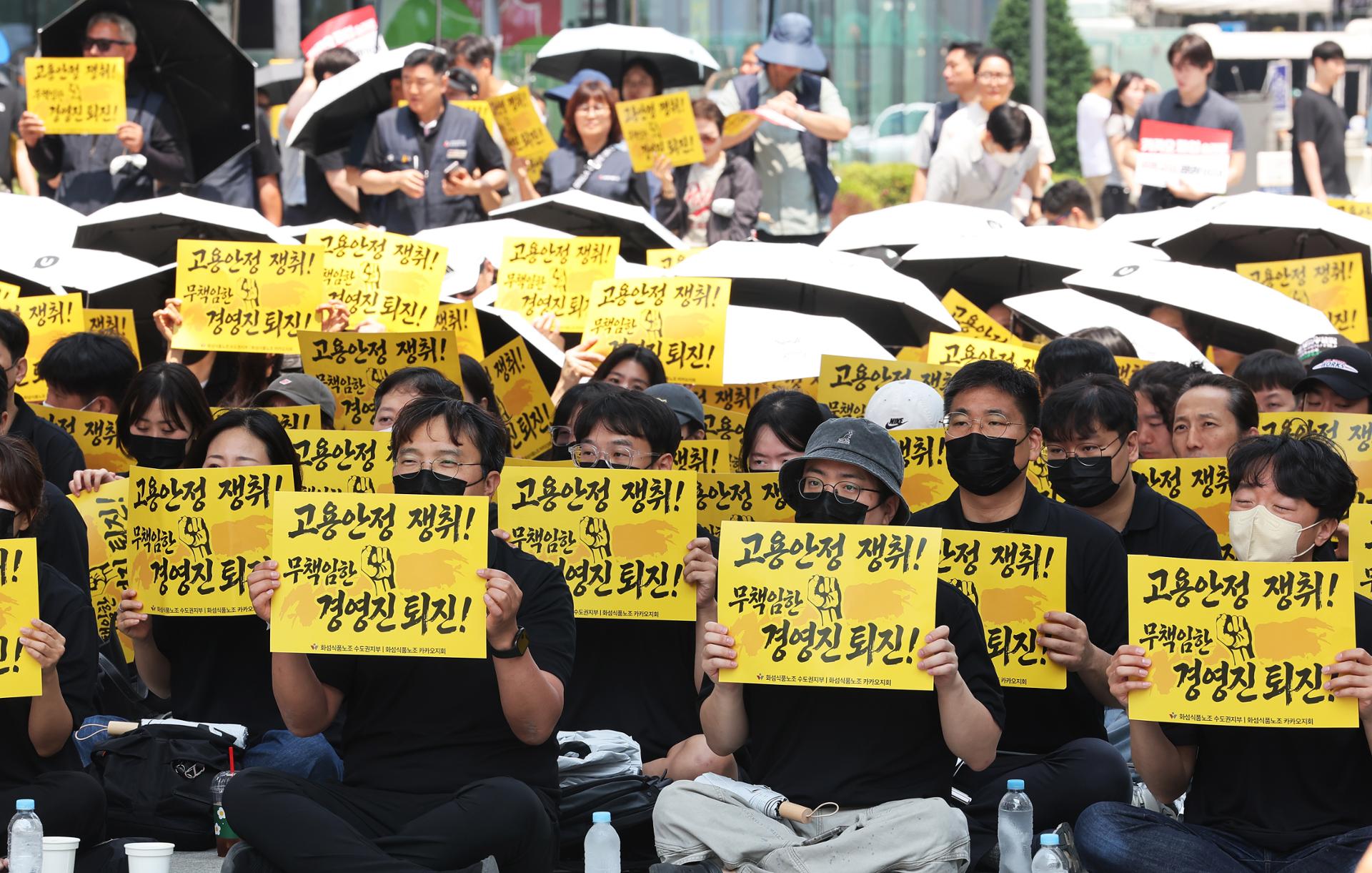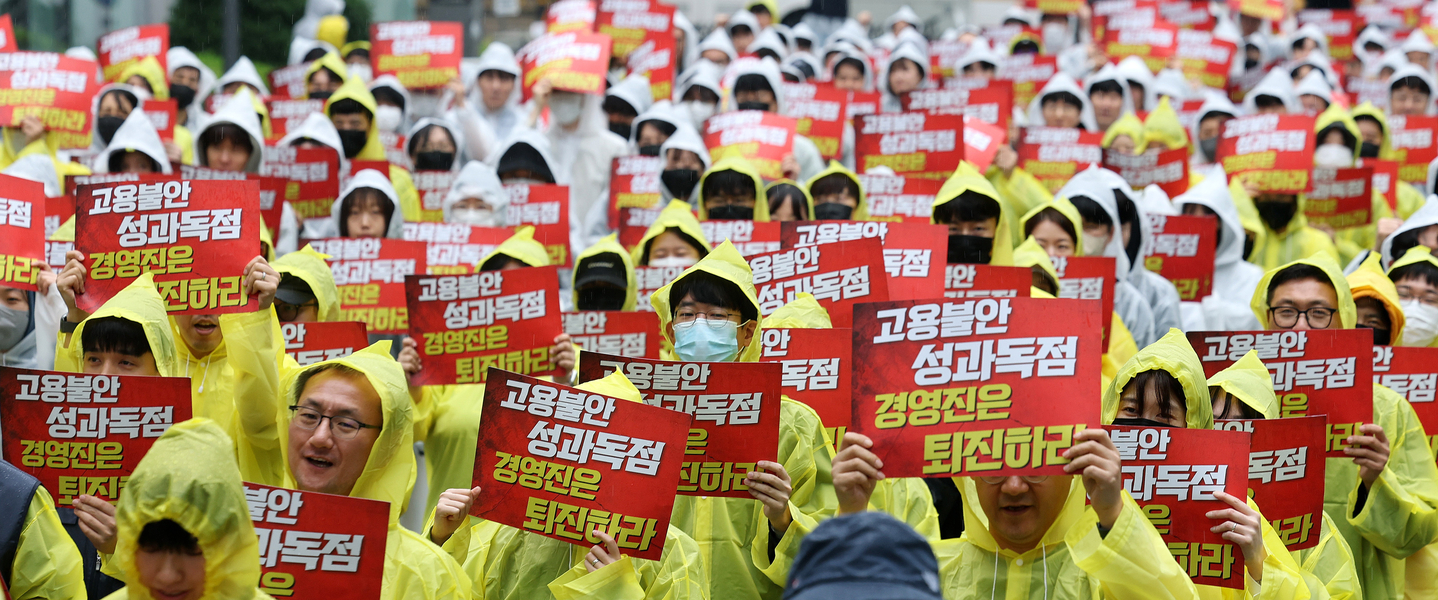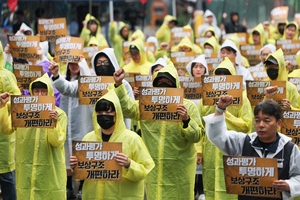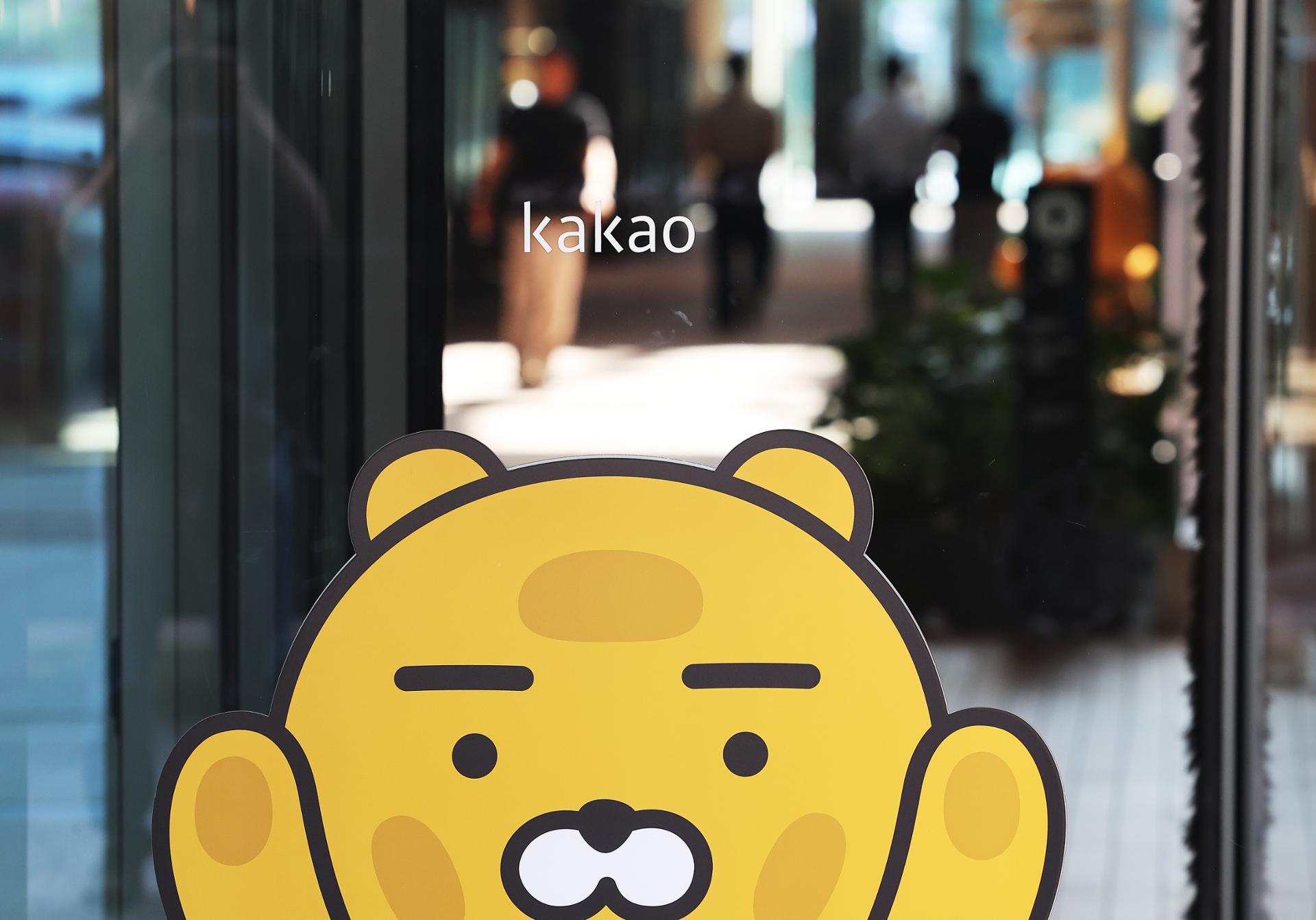
An entrace to Kakao Agit in Seongnam, Gyeonggi Province, June 9, a day ahead of its four-hour partial strike. In the wake of the partial strike, Kakao union members held a one-day walkout on June 28 over wage and bonus payment negotiations. It was the 20-year-old mobile platform company's first strike. YonhapThe labor rights of Korea's unionized workers have, over decades of growth, been the subject of a tug-of-war with management. The so-called “summer labor struggles” — as most companies begin wage negotiations around this time of the year — have been markedly dynamic. Nevertheless, management and labor have generally been able to reach a workable balance, while tenuous and volatile at times, on the path to Korea becoming an export powerhouse. This summer, the labor-management sphere faces new strife, as more unionized workers ask companies to share the unexpected excess profit generated from the country's artificial intelligence (AI) and semiconductor sectors. Recent labor negotiations have also been attributed in part to the “yellow envelope law,” which took effect in March. The law amended Korea's Trade Union and Labor Relations Adjustment Act to guarantee the bargaining rights of subcontracted workers.Calls for companies to share excess profits with workers and the expected rise of negotiations between subcontractors and principal employers are not only major labor hurdles but are also social issues that Korea must tackle in the new era. A serious public debate to forge a wise, sustainable consensus between management and labor could offer insights on how the government can alleviate the “fear of missing out” mindset among Koreans. The challenge will be how to convince people and companies, who are grappling with uncertainties from the AI boom.The bonus payments that Korea's top chipmakers Samsung Electronics and SK hynix agreed to provide to workers have invariably spurred employees at other companies to make similar requests. Unionized workers at Hyundai Motor and Kia are asking that 30 percent of net profit be paid out to employees as performance bonuses. Such labor demands are not limited to the traditionally strong manufacturing companies but are spreading to platform firms. The labor union at Kakao, the nation's most-used messenger service, staged a walkout Monday, where nearly half of the 5,000 union members at the company and its affiliates, including Kakao Pay and Kakao Enterprise, participated. The Kakao union is asking for performance bonuses equivalent to about 13 to 14 percent of the company's operating profit. How the two sides can wisely address the call for distribution of the surprise business profits will be critical to the Korean economy. Workers' labor rights, collective bargaining and collective action guaranteed under the Constitution must be upheld. Yet both sides must factor in the new economic realities or the fortuitously rebounding Korean economy on the back of a semiconductor rally in the AI paradigm, which can easily be made vulnerable. Korean companies, tailed by China while facing stiff tariff hurdles from the United States, compete in a volatile and uncertain landscape as they face stiffer competition over who primarily takes the lead in the AI era.In addition, with the implementation of the yellow envelope law, larger umbrella labor unions predict that more subcontracted workers will request direct negotiations with parent companies and will continue to do so. Since the law took effect, more subcontracted employees in the sectors ranging from carmaking, plant engineering and construction are on the move to request direct negotiations with principal employers.Invariably, the outlook is that calls for direct negotiations and payouts from excess profits will spread more widely across the board. The business community has called for a revision to the new law, a request that the government and lawmakers should ponder. The integrity of laws should be respected, but as the national economy looks to shift into higher gear, a revisit is warranted. All the more so, since the government has announced three megaprojects to build new semiconductor hubs in Korea's southwestern region, along with a physical AI hub and data center complex in other areas. The growing calls for performance bonuses should also be listened to and publicly debated. It is not time to bury our heads in the sand as the economy and labor relations in the AI paradigm shift rapidly.
[ED] Summer labor strife looms - The Korea Times
The labor rights of Korea's unionized workers have, over decades of growth, been the subject of a tug-of-war with management. The so-called “summer...
701 words~3 min read