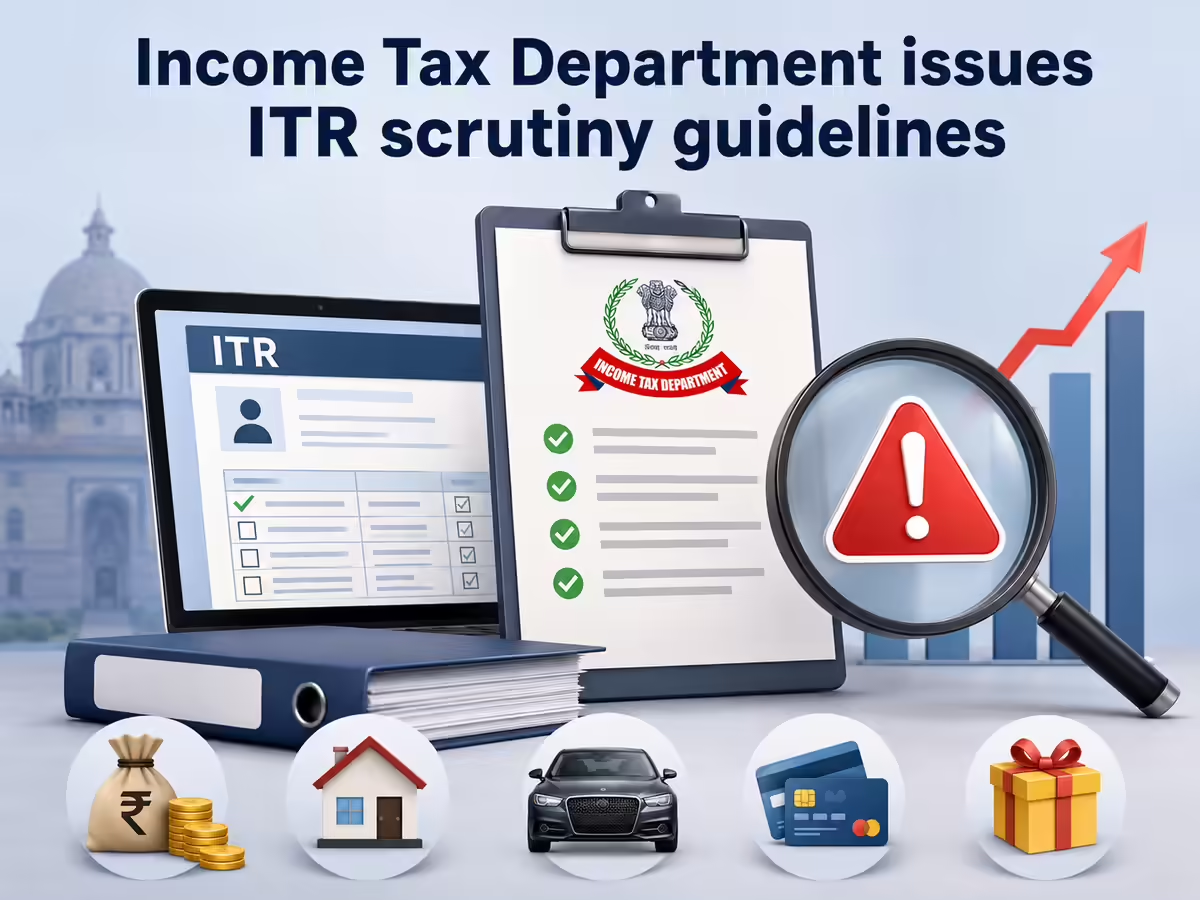
As taxpayers rush to meet the deadline for filing Income Tax Returns (ITRs) for Assessment Year (AY) 2026-27, another development has caught many by surprise. Thousands of taxpayers have recently received notices under Section 143(2) of the Income-tax Act, 1961, along with intimations under Section 144B, in respect of returns filed for AY 2025-26.For many, the immediate reaction is concern. Does the notice mean the return was incorrect? Is a tax demand on the way? Could penalties follow? Not necessarily.A scrutiny notice under Section 143(2) is often the Income Tax Department's way of seeking explanations or supporting evidence on specific issues, transactions or inconsistencies to verify the correctness of the income reported and tax benefits claimed in the return. Equally, such notices serve as a valuable learning opportunity for taxpayers who are filing, or have already filed, their returns for AY 2026-27, reminding them to carefully review income disclosures, tax benefit claims and income classification to avoid repeating mistakes that may have triggered scrutiny for AY 2025-26.Understanding the purpose of such notices, the assessment process, the potential consequences of under-reporting, and the remedies available under the law can help taxpayers respond effectively and strengthen compliance in future tax filings.ITR already processed? Then why a Section 143(2) notice?Many taxpayers are curious to know why a scrutiny notice under Section 143(2) has been issued even after their return has already been processed under Section 143(1). The answer lies in the distinct purpose of the two provisions.Processing under Section 143(1) is primarily an automated exercise involving arithmetical checks, verification of apparent inconsistencies and matching of information available in the return of income (ITR). In contrast, Section 143(2) empowers the Assessing Officer to undertake a detailed scrutiny of the return where it is considered necessary to verify that:Income has not been understated;Excessive loss has not been claimed;Tax has not been underpaid in any manner; andDeductions, exemptions and other claims made in the return are admissible and correctly reported.A notice under Section 143(2) is therefore the starting point of a scrutiny assessment that may culminate in an assessment order under Section 143(3).Why are taxpayers receiving Section 143(2) notices now?A notice under Section 143(2) is required to be served within three months from the end of the financial year in which the return is furnished. Since returns for AY 2025-26 were largely filed during FY 2025-26, June 30, 2026 is the last date for issuance of scrutiny notices under Section 143(2) in such cases.However, taxpayers should not assume that the department loses its authority once the limitation period for issuing a notice under Section 143(2) expires. Subject to the conditions, timelines and monetary thresholds prescribed under Sections 148, 148A and 149, reassessment proceedings may still be initiated where the department has information suggesting that income chargeable to tax has escaped assessment.How does the income tax department select cases for scrutiny?A common misconception among taxpayers is that scrutiny notices are issued randomly. In reality, most scrutiny cases are selected through the Computer Assisted Scrutiny Selection (CASS) system, which uses data analytics and risk-based parameters to identify returns that warrant closer examination.The selection criteria are determined by the Income Tax Department and may vary from year to year depending on emerging compliance risks and areas where instances of under-reporting of income, incorrect claims of deductions or exemptions or other tax discrepancies are commonly detected.Accordingly, returns involving mismatches with information available in Form 26AS, the Annual Information Statement (AIS) or the Taxpayer Information Summary (TIS), high-value transactions, unusual claims, or other identified risk indicators may be selected for scrutiny.Apart from CASS-based selection, a limited number of cases are also selected under the Compulsory Scrutiny Guidelines issued by the Central Board of Direct Taxes (CBDT). These generally cover specific categories of cases that the board considers necessary for mandatory examination.Accordingly, receipt of a notice under Section 143(2) does not necessarily imply any wrongdoing on the part of the taxpayer. It may simply be the outcome of the department's risk-based scrutiny selection process under CASS or the application of the CBDT's Compulsory Scrutiny Guidelines.The notice does not mention the issue. What should taxpayers do?A common concern among taxpayers is that a notice issued under Section 143(2) normally does not specify the exact issue that is proposed to be examined during scrutiny.Typically, the notice merely states that certain aspects of the return require further verification and that the case has been selected for scrutiny assessment. Since the notice is issued primarily to initiate the assessment proceedings within the statutory time limit, taxpayers should not rush to conclusions regarding the nature of the potential issues under examination.The immediate priority should be to acknowledge and comply with the notice through the e-Proceedings facility available on the Income Tax Department's e-filing portal within the prescribed time. Taxpayers should thereafter regularly monitor the portal for any questionnaire, notice under Section 142(1), or other communication seeking clarification on specific issues selected for verification.In the meantime, taxpayers should:Compile relevant information, records and supporting evidence relating to the income disclosed in the return and the deductions, exemptions or other tax benefits claimed;Reconcile the details reported in the return with information available in Form 26AS, the Annual Information Statement (AIS) and the Taxpayer Information Summary (TIS);Verify whether any information has been updated in the AIS after the return was filed, resulting in a possible mismatch;Review high-value transactions, capital gains, business receipts and other significant items that may attract departmental scrutiny; andIdentify and rectify any gaps in documentation that may be required to substantiate claims made in the return.Being adequately prepared before the department raises specific queries can significantly improve the quality of responses, facilitate a smoother assessment process, and reduce the risk of adverse inferences being drawn during scrutiny proceedings.Why have taxpayers also received an intimation under Section 144B?Along with the scrutiny notice under Section 143(2), taxpayers have also received a separate intimation under Section 144B. This has led to confusion among taxpayers, with some wondering whether it is a separate proceeding or requires an independent response. The answer is no.The intimation is issued because Section 144B prescribes the framework for faceless assessment. Under this regime, scrutiny assessments are conducted electronically through the Income Tax Department's faceless assessment system, without any physical interface between the taxpayer and the assessing authorities.The purpose of the intimation is simply to inform the taxpayer that the scrutiny proceedings initiated under Section 143(2) will be carried out in accordance with the faceless assessment procedure prescribed under Section 144B. It also informs the taxpayer that:The case has been selected for faceless assessment;All communications will be made electronically through the e-filing portal;Responses, explanations and supporting documents must be submitted online through the designated e-Proceedings facility; andFuture notices, questionnaires and communications should be monitored regularly on the portal.No separate response is required to the intimation under Section 144B. However, taxpayers should treat it as an important reminder to regularly check their e-filing account, registered email address and mobile number for further communications. Subsequent notices, particularly under Section 142(1), may seek specific information or supporting evidence, and failure to respond within the prescribed time may result in adverse consequences, including best judgment assessment proceedings.How should taxpayers respond to notices under Section 142(1)?Once scrutiny proceedings commence, taxpayers are often issued notices under Section 142(1) seeking specific information, explanations, documents or evidence in support of the income reported and claims made in the return.In the faceless assessment regime, the quality of the response assumes critical importance. Taxpayers should ensure that their replies are clear, complete and supported by relevant documentary evidence. The response should address each query raised in the notice on a point-by-point basis and explain the factual and legal position wherever necessary.This is particularly important in cases where there has been no understatement of income or wrongful claim. In the absence of a proper explanation or adequate supporting evidence, the Assessing Officer may draw adverse inferences and make additions to the taxpayer's income, even where the claim is otherwise genuine. Vague, incomplete or unsupported submissions often weaken the taxpayer's case.Accordingly, taxpayers should carefully review the notice, gather all relevant records and submit a comprehensive response within the prescribed time. Where additional time is required, an adjournment request may be made through the e-filing portal before the due date.Consequences of non-complianceFailure to respond to notices issued under Section 142(1) can have significant consequences, including:Completion of assessment to the best of the Assessing Officer's judgment under Section 144;Additions to income without considering the taxpayer's explanation or supporting evidence;Additional tax and interest liabilities; and Initiation of penalty proceedings under Section 270A;In addition, non-compliance may attract a separate penalty under Section 272A(1)(d), which currently provides for a penalty of ?10,000 for each failure to comply with notices served under Sections 143(2) and 142(1).Given these consequences, taxpayers should treat every notice under Section 142(1) seriously and ensure that responses are timely, accurate and adequately supported by documentary evidence.Under-reported income? Consider the Section 270AA optionTaxpayers who have under-reported income should carefully evaluate their options before embarking on a prolonged litigation process.Under Section 270A of the Income-Tax Act, 1961, where under-reporting is regarded as misreporting of income, the penalty may be as high as 200% of the tax payable on the under-reported income, in addition to the tax and applicable interest.In many cases, the combined impact of tax, interest and penalty can be substantial. Depending on the facts and circumstances, taxpayers may also face the possibility of prosecution proceedings under the Income-Tax Act.Recognising the need for a dispute-resolution mechanism, the Finance Act, 2026 has expanded the scope of Section 270AA with effect from 1 April 2026. Subject to fulfilment of the prescribed conditions, taxpayers may now seek immunity from penalty under Section 270A and immunity from prosecution proceedings under Sections 276C and 276CC, even in cases involving misreporting of income.To avail of this relief, the taxpayer must satisfy the statutory conditions, including payment of the tax and interest determined in the assessment order and payment of an additional amount equal to 100% of the tax payable on the under-reported income, in lieu of the otherwise applicable penalty of 200% under Section 270A.For taxpayers who wish to avoid prolonged litigation, obtain certainty and bring finality to the dispute, the immunity mechanism under Section 270AA may be a valuable option. However, the decision should be taken only after carefully evaluating the facts of the case, the sustainability of the additions made in the assessment order and the likelihood of success in appellate proceedings.Lessons from Section 143(2) notices for taxpayers filing ITR for AY 2026-27For taxpayers who have received scrutiny notices for AY 2025-26, the ongoing filing season for AY 2026-27 presents an opportunity to review their tax reporting practices and avoid similar issues in the future.Before filing the return for AY 2026-27, taxpayers should:Reconcile income reported in the ITR with Form 26AS, AIS and TIS.Review all deductions, exemptions and other tax benefits carefully before claiming them.Ensure that all taxable receipts and sources of income have been properly disclosed.Verify that income has been classified under the correct head and that the appropriate tax provisions have been applied.If the return has already been filed, review it for any omissions or errors and consider filing a revised return within the prescribed time.A notice under Section 143(2) should not be viewed as a verdict against the taxpayer. For compliant taxpayers, it provides an opportunity to substantiate the claims made in the return. For those who may have inadvertently under-reported income or claimed inadmissible tax benefits, it serves as an early warning to review and strengthen their tax compliance processes.As scrutiny notices for AY 2025-26 arrive during the filing season for AY 2026-27, taxpayers would do well to treat them not merely as a compliance requirement but also as a valuable learning opportunity. Timely responses, robust documentation, accurate reporting and proactive corrective action, wherever required, remain the most effective safeguards against future tax disputes and unnecessary tax costs.The author, O.P. Yadav, is a former IRS officer with over 36 years of experience in tax administration, education, and training. He is presently associated with Prosperr.io as a Tax Evangelist. The views expressed are personal.(Disclaimer: The opinions expressed in this column are that of the writer. The facts and opinions expressed here do not reflect the views of www.economictimes.com.)
ITR filing season AY 2026-27: Received Section 143(2) notice for AY 2025-26? What it means and how to respond - The Economic Times
As Section 143(2) scrutiny notices for AY 2025-26 reach taxpayers during the ITR filing season for AY 2026-27, this article explains why taxpayers receive scrutiny notices, how they should respond, the consequences of non-compliance and under-reporting of income, the relief available under Section 270AA, and the key compliance lessons for filing current-year returns.
2,034 words~9 min read