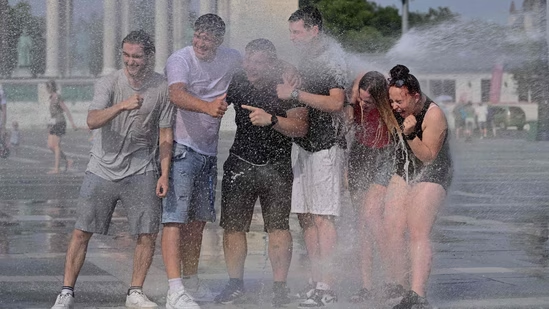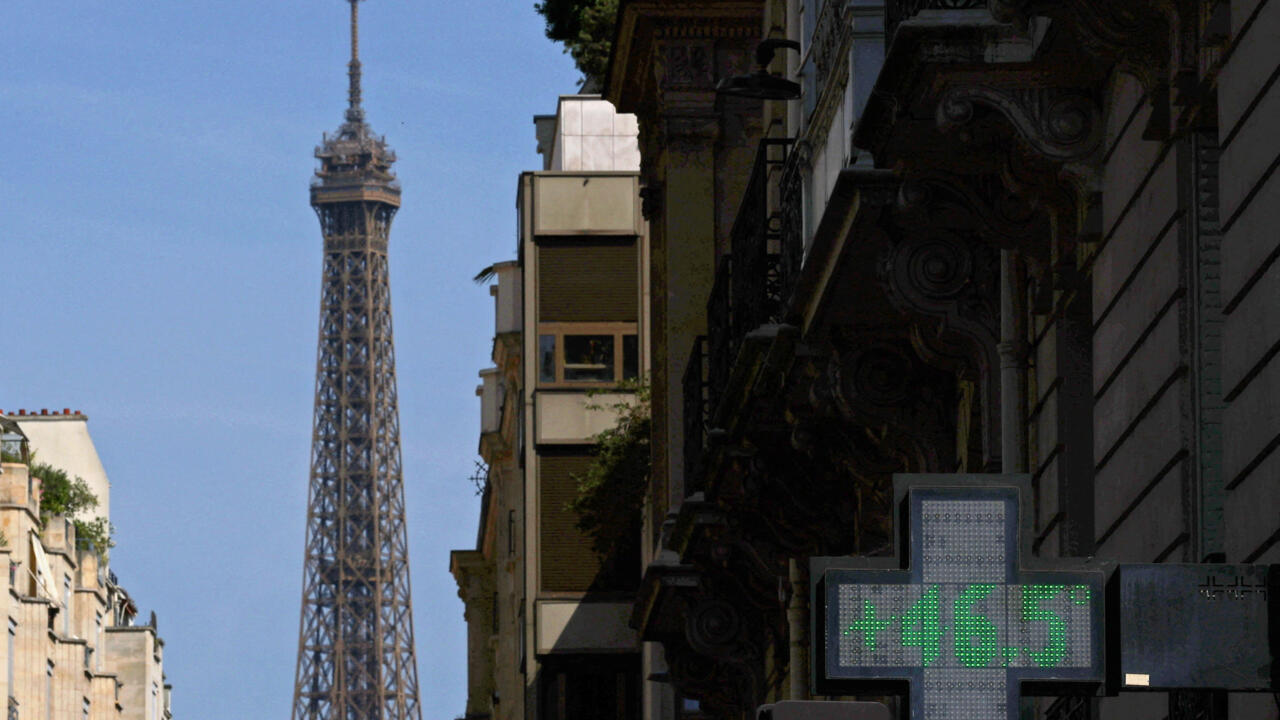
Last Thursday night I arrived at a hotel in Potsdam, outside Berlin, for a conference. It was after 10pm and the heat of the day was fading. It was still 31 degrees.Even before I had properly checked in, the man at the desk gave me a stricken look: “We have no air conditioning!” He said it as though he were announcing: “We have no water!”Over the next two days, the temperature edged up to 40 degrees. Nearly 6,000km north of the equator, the heat felt almost solid, not so much a quality as a substance, an invisible barrier you had to push yourself through. The town felt lopsided. All the sunny sides of the streets were deserted, their occupants tilted on to the shaded flanks. One of the speakers at the conference began to feel ill and had to be taken home before she could deliver her talk. And yet: seeing is no longer believing. Nor is feeling. Or sweating. Or burning. Or wildfires. Or heatstroke. At a fundamental level, we do not believe what we are experiencing: the catastrophic effects of global heating. It is the latest, and surely the deadliest, version of the unknown known.In his essay The Uncanny, Sigmund Freud wrote that “an uncanny effect often arises when the boundary between fantasy and reality is blurred, when we are faced with the reality of something that we have until now considered imaginary”. In that sense we are living in uncanny times.For most of the lifetimes of those who currently inhabit the Earth, we have been asked – even pleaded with – to imagine what was coming. Scientists have tried to make governments, policymakers and ultimately us voters pay attention to the emerging effects of our alteration of the atmosphere. The fossil fuel industries and the governments of the oil-producing states pumped out lies even faster than greenhouse gases, polluting truth as recklessly as they defiled the air. Yet at worst, surely, we could rely on reality: the climate would make its own case. The increasingly extreme weather events – the storms, floods, heatwaves, fires, droughts and rising seas – would be brutally undeniable. We would, in Freud’s terms, be faced with the actuality of what previously we had to imagine. And then we would really know.We now live in the future we were warned of. Even by the crudest measure that capitalism values, it is a ruinously expensive place to be. In the decade between 2014 and 2024, violent weather events did about $2 trillion (€1.8 trillion) worth of damage.[ A new threat visits this Spanish tourist town: the scorching sunOpens in new window ]What should matter much more is the cost in human lives. About half a million people are dying every year from the effects of extreme heat alone. The worst consequences are being visited on people in the poorest countries. But they are dramatically present in rich Europe too. Last summer about 16,500 people died from climate-change related conditions in European cities. Rome lost 835 people; Paris 409. This summer those numbers will be much higher.Last week we even had grim intimations of societal breakdown. In Britain MRI scanners, radiotherapy machines and hospital IT systems ceased to function because of the heat. In France nuclear power reactors had to be shut down because the water used to cool them, drawn from local rivers, was coming in at 28 degrees: too hot to cool anything. That grimmest of calls – “told you so!” – is screaming out from nature itself. Yet collectively we remain deaf to it. The assumption that we would acknowledge reality when we were experiencing it, often in the most dramatic and devastating ways, has turned out to be false.Some of this is, of course, due to deliberate denial. The US government’s National Centres for Environmental Information used to run a live database called Billion Dollar Weather and Climate Disasters. When last updated, it showed cumulative damage (only from those events that cost the US more than $1 billion each) between 1980 and 2024 of $2.915 trillion. Go the website now and it carries a banner: “In alignment with evolving priorities, statutory mandates and staffing changes, NOAA’s National Centers for Environmental Information (NCEI) will no longer be updating the Billion Dollar Weather and Climate Disasters product.”[ European heatwave in graphics: Why are temperatures rising faster in Europe?Opens in new window ]This denialism is murderous – but the point is that it shouldn’t matter. Of course it’s good to have data and modelling and scientific explanations. But we don’t need figures to tell us that huge areas of Los Angeles burned last year or that last week there were two wildfires raging in, for God’s sake, Greenland. Bob Dylan’s “You don’t need a weatherman to know which way the wind blows” can be updated: you don’t need a climate scientist to know that we are making our planet uninhabitable for our species.Yet we seem, if anything, stunned by the heat. Perhaps it is precisely because the scientists have been proved so awfully right that there is no sense of shock. That epitome of banality – talking about the weather – now has an edge of suppressed dread. But we carry on like Winnie in Samuel Beckett’s Happy Days, trapped under a relentless sun but twittering away to pass the time.In the 1980s, when the fear of nuclear apocalypse was rising, the peace movement in the UK took the title of a Civil Defence booklet, Protect and Survive, and turned it into Protest and Survive. The slogan cries out for revival. The red alerts issued by Europe’s met offices last week must also be issued by citizens to their governments.There is a huge and well-funded backlash against net zero policies across the European Union. Believing our own eyes is being refashioned as delusion. What we feel on our own skins must not be acknowledged. The most basic of bodily experience must somehow be unexperienced. Now that the imagined has become real, it must be shifted back into the category of the imaginary.But it is not too late to stop this madness. The sun itself is sending us its message: protest and survive.
Fintan O'Toole: Red alerts issued by Europe’s met offices must also be issued by citizens to their governments
At a fundamental level, we do not believe what we are experiencing: the catastrophic effects of global heating
1,028 words~5 min read