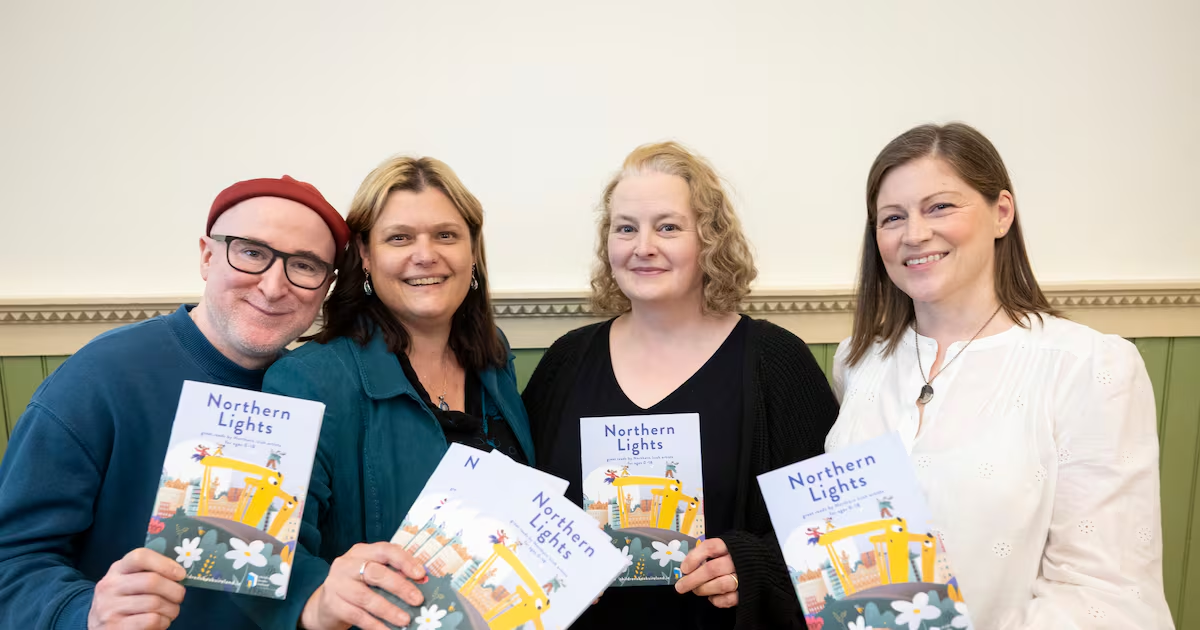
Name a Northern Irish children’s book. Until recently, there weren’t many answers to that question: CS Lewis’s Narnia books, obviously, Joan Lingard’s Kevin and Sadie series, any Oliver Jeffers, and a clued-in reader might mention Bog Child by Siobhan Dowd or Sam McBratney’s Guess How Much I Love You.Today there are many more answers, but somehow those above are the ones most people (and Google) still mention. They’re great books and we’re proud of them but, on encountering yet another list of children’s books that doesn’t look beyond 1995, it’s hard not to feel frustrated. Poor Kevin and Sadie are pushing 70 now, and must have bad backs from carrying the weight of Northern Irish children’s literature for the last 50 years. The first children’s books event I ever attended was the Children’s Books Ireland International Conference in Dublin in 2018, where I was scheduled to read from my debut Young Adult (YA) novel to what I assumed would be a handful of librarians and teachers, maybe an actual writer or two. I mean, really, I reassured myself on the bus from Belfast – how many of them could there be? I found myself in a room packed with enthusiastic attendees, and what struck me was not just how many people there were, but that they all seemed to know each other too. The sense of community left me feeling like I’d travelled through both the Border, and the looking glass. Conferences like this did not happen in the North. I went home with my personal inferiority complex compounded by a national one.Consider the evidence which shows that reading for pleasure is the single most important indicator of a child’s future success, regardless of their socioeconomic backgroundAnd yet, just eight years later, 2026 saw the inaugural Northern Irish Conference on Children’s Literature take place at Queen’s University Belfast. To say this was a milestone is an understatement. So how did we get here?I think we can be forgiven if even people who live in the North are unaware of how many children’s books we have produced in the last decade. Many factors have contributed to our invisibility.Money is a perennial problem in the arts, but since UK arts funding per capita is about half of the Republic of Ireland’s, and Northern arts funding per capita is the lowest in the UK, the situation in the North is particularly grim. And to make matters worse, children’s authors typically get lower advances than adult authors. So, we really haven’t time to be visible because we’re all at our day jobs. Then there is the fact that literature for young people often gets sidelined or forgotten altogether in review columns and festivals. The North gets a disproportionate amount of media attention, but unfortunately, they’re not talking about our children’s books. It’s been rare that people from the North have had reasons to be proud of our nationality. We’ve often cringed to see ourselves in the media or hear our accents on TV – until Derry Girls, obviously. So perhaps a reluctance to put ourselves forward has held us back as much as the limited opportunities and funding.[ Author Susannah Dickey: ‘With each book I find myself more invested in writing Ireland’Opens in new window ]At our Belfast conference, Trinity College Dublin PhD researcher Amanda Dunne educated many of us on our own literary heritage with her presentation on Co Down author Martin Waddell, who wrote more than 200 books for all ages from the 1970s to 2010s. I discovered that my own YA pregnancy novel, Little Bang, had been preceded in 1995 by Waddell’s Tango’s Baby. I was 17 in 1995. And I spent the whole of the 1980s in libraries reading anything I could get my hands on. Why had my hands never landed on any of his books? Dunne speculated that, had his teen books been better known, some of them might have been banned for their content. But you don’t have to ban books. A more effective strategy can be to quietly ignore them. When I wondered aloud to fellow Northern author Máire Zepf whether my Protestant school library might have not stocked Waddell’s books because they were “too Irish”, she said her Catholic school wouldn’t have had them either because of the subject matter. In a depressingly typical feat of self-sabotage, rather than celebrating the few authors we did have, there may have been active suppression at work. But if Northern Ireland’s challenges have held us back, they might also be an advantage of sorts. Our YA scene is having a real moment lately, and perhaps it’s because YA specialises in taking on big issues, and there are plenty in the North to choose from. There are endless miles in the Troubles, tackled beautifully by Sue Divin’s post-conflict generation characters and in Stephen Daly’s The Last Death Poet. Marriage equality is only six years old in the North and the Stormont Executive has recently supported a ban on puberty blockers, but homophobia and queer identities have been sensitively handled by Daly and in all of Shirley Anne McMillan’s books. My teen pregnancy book was written when Northern Ireland was the last place in these islands where abortion was illegal. And in a place where bilingual street signs get vandalised, we have Máire Zepf’s Irish-language work Nóinín, exploring the murky waters of internet grooming. Indeed, it seems difficult to write anything set here without encountering a political issue. When Sophie Kirtley was commissioned to write Our Wee Place, a picturebook to mark the centenary of Partition, she was so understandably wary that she reached out to other Northern writers to ask for advice about how this might be received. In every age group and genre, we are flourishing. As well as Zepf’s Rita series, published by Belfast’s own Irish-language publisher An tSnáthaid Mhór, we now have Bad Books Press, set up by award-winning illustrators Clive McFarland and Ashwin Chacko, who launched this year with their first picturebook, Moon Moon Can’t Sleep by Johnathan Sung. In middle grade we have Sophie Kirtley’s The Haunting of Fortune Farm, set in the Mourne Mountains, Judith McQuoid’s Giant, a retelling of CS Lewis’s childhood, and Sheena Wilkinson’s Fernside series set in a 1920s Belfast boarding school. [ Corpses are everywhere in Irish literatureOpens in new window ]There are too many awards to mention, but within the last decade we’ve seen Ellan Rankin and Barry Falls shortlisted for the Waterstones Children’s Book Prize, which Ciara Smyth won in 2022, Jenny Ireland winning the YA category at the Diversity Book Awards, and Sue Divin and I shortlisted for the Carnegie Medal – if either of us had won, we would have been the first Northern winner since CS Lewis in 1956. Since 2017 we also have a dedicated Children’s Writing Fellow, and the Belfast Conference on Children’s Literature was inspired by a lecture by the current Fellow, Shirley-Anne McMillan, in which she used the question at the heart of all storytelling – What if? – to ask: What if we lived in a world where children’s books were taken as seriously as adult literature? That has not traditionally been the case in the North. We have no academic research centres for children’s literature, no institutes, no centres of excellence, no North-specific book awards, and no creative writing MA. And it feels like the only time our politicians discuss children’s books is when they want to ban them from shelves or condemn their use during drag queen storytelling events in libraries. But children’s books are essential. If you’re not convinced by arguments about creativity and mental health, consider the evidence which shows that reading for pleasure is the single most important indicator of a child’s future success, regardless of their socioeconomic background. They’re also vital if we want the world of adult literature to thrive. People generally do not magically become readers as adults – it begins in childhood, and literary institutions such as conferences and festivals must recognise this and play their part to ensure their own future audiences. For me the joy in the room was also in discovering that there is a real Northern Irish children’s books community out there, all keen to celebrate stories from Northern IrelandSeeing yourself in a book is just as important. Not long ago, it was barely possible to buy your child a book featuring a character from Northern Ireland. But every book a child reads has the potential to turn them into a reader – to make them feel seen. That’s an incredible responsibility. We must ensure every child and every walk of life is represented in children’s books, because a book about people like you might just be the one that resonates. The North is lucky in that being included in both the UK and Ireland means we have two wonderful children’s laureates. A few months ago, I found myself in another room full of enthusiastic writers, artists, librarians, teachers, booksellers, publishers and readers. But this time, they were here to talk about us. Specifically, about the 44 books being profiled in Northern Lights, a Children’s Books Ireland reading guide to children’s literature from the North. It was introduced by Laureate na nÓg Patricia Forde (2023-2026) at a special lecture at Elmwood Hall in Belfast as a conclusion to her tour of the North. Forde’s lecture focused on discovering the joy of children’s books, but for me the joy in the room was also in discovering that there is a real Northern Irish children’s books community out there, all keen to celebrate stories from Northern Ireland. I left that evening with the same feeling I had at our inaugural conference – a sense of belonging and pride that I’ve rarely felt in relation to my Northern identity. [ Jan Carson: ‘It doesn’t surprise me that Northern Ireland has very high rates of violence against women’Opens in new window ] This year is the National Year of Reading in the UK, and I’m excited by how much the North has to offer young people. There’s a huge opportunity here for our existing institutions to recognise books for children and young people as a vital part of our already widely respected literary output. Considering the year so far, and the chance to pen this piece, I’m optimistic that the narrative can change. I hope that we can start to platform our present artists, inspire the next generation of homegrown readers, writers and illustrators, and that future discussions of Northern Irish children’s books might centre on more than our literary past.
Northern reading lights: There’s a real children’s books community out there to discover
There’s a huge opportunity in Northern Ireland for existing institutions to recognise books for children and young people as a vital part of our widely respected literary output
1,761 words~8 min read