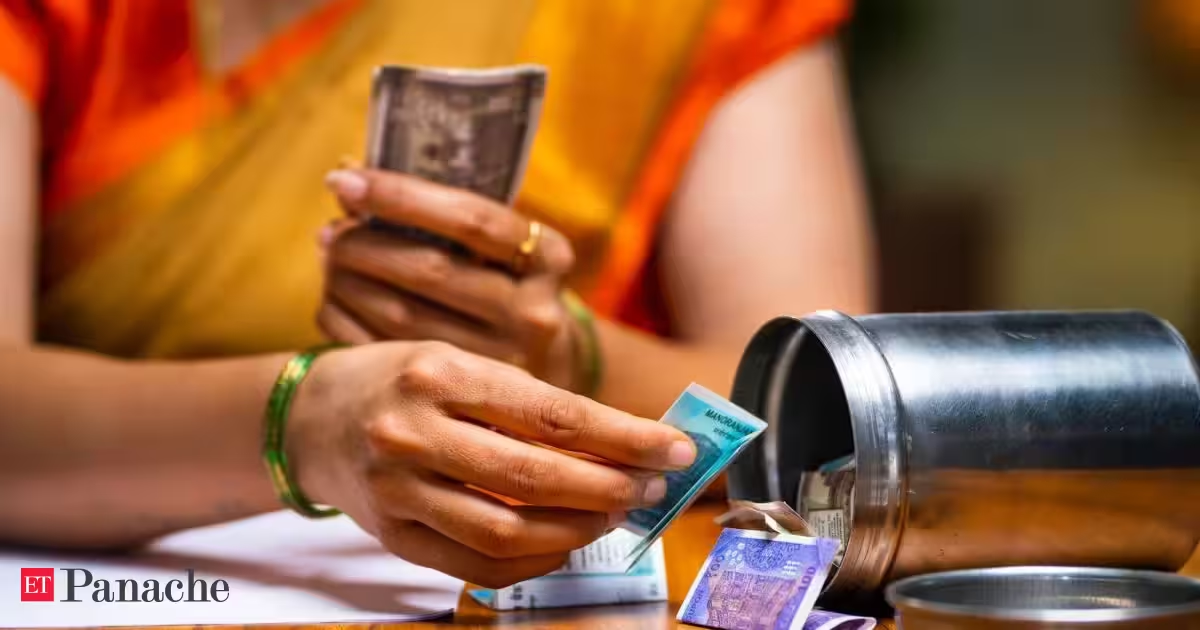
For many people, leaving a large amount of money in a savings account feels like the safest financial decision. The balance is always accessible, there is no market volatility, and the money appears to be growing through interest. But according to chartered accountant Nitin Kaushik, that sense of safety can come at a surprisingly high cost. In a recent social media post, he explained how avoiding investments altogether could quietly erode wealth over time and significantly reduce long-term purchasing power. CA Nitin Kaushik took to X to argue that keeping "massive chunks of cash" in a basic savings account is not true financial safety but "a slow financial suicide." His message focused on the hidden cost of inflation and the opportunity lost when money is left idle instead of being invested. To illustrate his point, Kaushik shared the example of someone keeping Rs 15 lakh in a standard savings account offering around 3 per cent annual interest. According to him, if that money remains untouched for eight years, it would grow to only about Rs 19 lakh. While that may appear to be a gain on paper, Kaushik pointed out that the interest earned is taxable and remains well below the pace of inflation. As a result, the actual purchasing power of the money continues to decline over time, even though the account balance increases.— Finance_Bareek (@Finance_Bareek) You Might Also Like:How to double it instead? He contrasted this with the same Rs 15 lakh being invested in a basic equity index fund delivering an average annual return of around 10 per cent. In that scenario, he said, the investment would grow to more than Rs 32 lakh over the same eight-year period. According to Kaushik, the difference between the two approaches amounts to nearly Rs 13 lakh. He described that gap as the "premium" people pay simply for the comfort of leaving their money untouched in a savings account instead of allowing it to grow through long-term investing. The chartered accountant also challenged the common belief that avoiding the stock market is the safest option. While many investors worry about market fluctuations, Kaushik argued that the greater threat lies elsewhere.CA about real risk He stressed that the "real risk" is not market volatility but the certainty that inflation steadily reduces the value of money when it is not invested. Even though a savings account protects the original capital, it may fail to generate returns that keep pace with rising prices.You Might Also Like: Kaushik's broader message was that wealth creation requires looking beyond preserving money and focusing on growing it. According to him, simply accumulating cash in a low-interest savings account can create a false sense of financial security while silently weakening long-term wealth. His post serves as a reminder that investment decisions should not be based solely on avoiding risk. They should also consider inflation, taxation, opportunity cost and the long-term impact on purchasing power. For investors with long financial horizons, Kaushik suggests that allowing money to remain idle may ultimately prove more expensive than accepting the temporary ups and downs of the market.
Keeping Rs 15 lakh in a savings account could quietly cost you lakhs, warns CA. Here's what you can do instead to double it
Chartered accountant Nitin Kaushik warns that keeping large sums in savings accounts, despite seeming safe, is a "slow financial suicide." He highlights how inflation erodes purchasing power, while investments, even with market ups and downs, can significantly grow wealth. For instance, Rs 15 lakh invested for eight years could yield Rs 32 lakh compared to just Rs 19 lakh in savings, a difference of nearly Rs 13 lakh.
515 words~2 min read