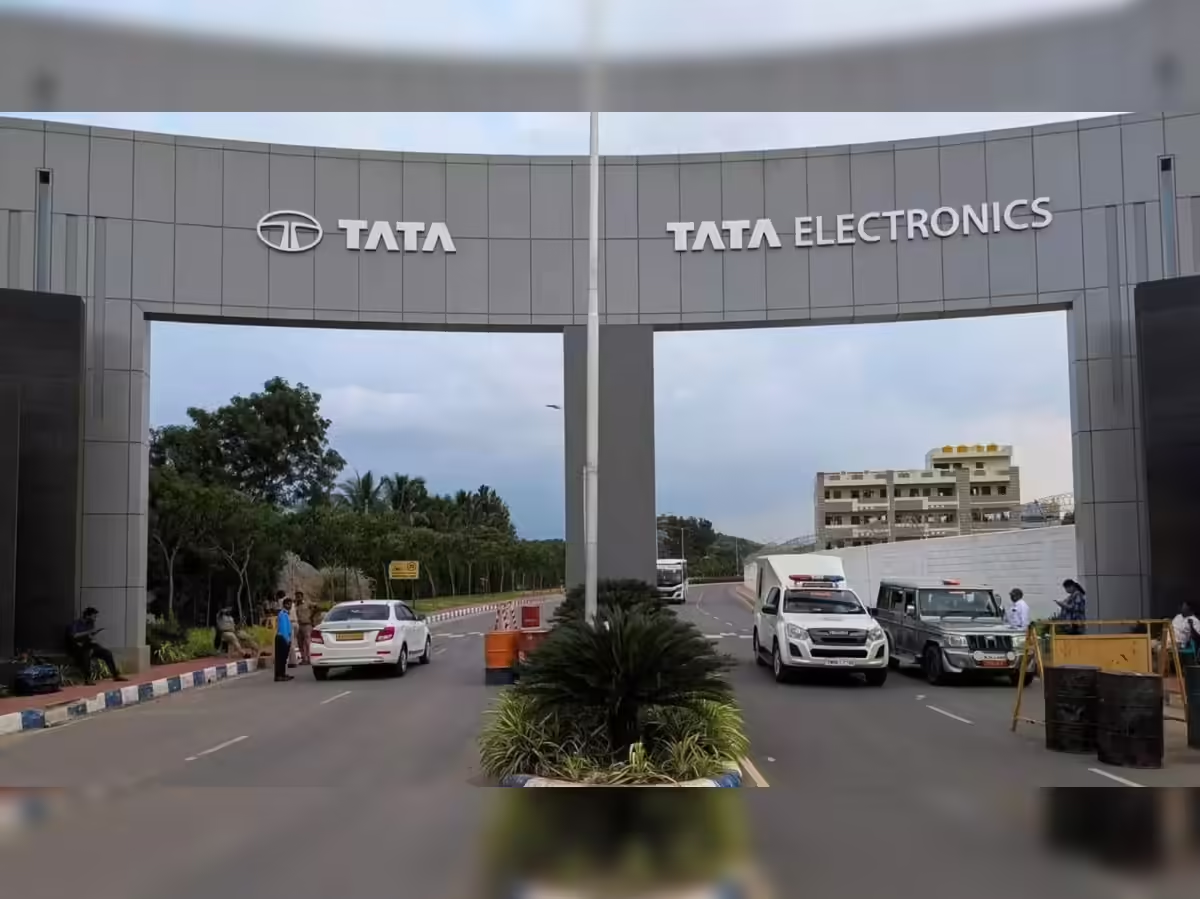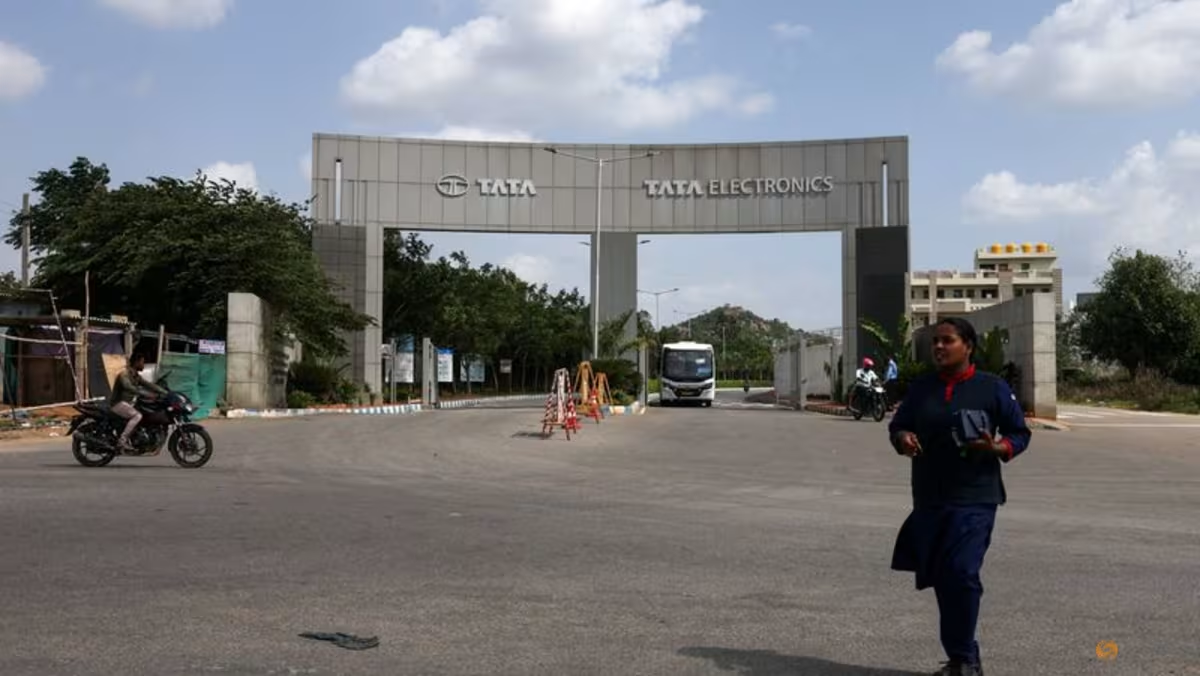
Tata Electronics has confirmed a cybersecurity breach after the extortion group World Leaks published more than 204,000 files, totalling over 630 gigabytes, that it claims were stolen from the iPhone assembler's systems. Security researchers who combed the haul found hundreds of references to Apple and Tesla, both customers of the Indian manufacturer, including folders marked proprietary and confidential. Apple is investigating. Tata insists its factories kept humming.That last point is the one to hold onto, because it splits this story in two. One story is the alarming headline: confidential files from inside Apple's supply chain, sitting on a dark-web portal for anyone to download. The other is quieter and more important. Production carried on. Hosur kept building iPhones throughout. What was stolen here is paper rather than uptime, and the damage runs along a different axis entirely: intellectual property, employee privacy, and the credibility of the country Apple has bet its manufacturing future on.What Tata Electronics confirmedTata's statement is a study in saying little. "A few weeks ago, Tata Electronics identified a cybersecurity incident on some of our systems," it said. "Our response protocols were deployed immediately, and the incident has had no impact on our operations across businesses, which remain unaffected." Beyond that, it declined to detail which systems were touched, whether customer data leaked, or how the attackers got in.What the statement left out matters more than what it gave. Security researchers who reviewed the dump found the files had been sitting on the dark web since around 10 June, roughly twelve days before Tata acknowledged anything publicly. By the time the company spoke, in other words, the material had been downloadable for the better part of a fortnight. Detection came "weeks ago," by Tata's own account, which places the actual intrusion earlier still.One caveat frames everything that follows. The breach itself is confirmed, because Tata has admitted it. The contents are a different matter. Independent reviewers have catalogued the files, yet the companies involved have yet to verify their authenticity, so every specific below carries the word "purported," and should.What was actually stolen: the Apple haulHere is the granular picture, assembled by researchers who searched the leaked database file by file. A query for "Apple" returned 181 files and folders, several of them labelled "com. apple. factorydata" and referencing "material specification." Among them sat a 52-page document carrying Apple's proprietary markings, purportedly laying out quality-inspection standards for iPhone circuit-board components. Some files closed with a familiar footer: "This document contains proprietary and confidential information of Apple Inc."Geography gives the leak away. A search for "Hosur" — the Tamil Nadu town where Tata runs its main iPhone assembly plant — surfaced 33 files and folders, anchoring the dump squarely to Apple's Indian production line rather than some distant corner of the conglomerate.One find stands above the routine factory paperwork. The cache reportedly stretches beyond Apple to documents tied to Tesla, TSMC and Qualcomm, and includes a purported document from Apple's Silicon Engineering Group that maps Apple part numbers to their corresponding TSMC components. Other files hold detailed product reliability tests and mechanical drawings. That part-number-to-component map is the item worth losing sleep over, because it edges from ordinary manufacturing process into genuine supply-chain intelligence, the kind of cross-reference a competitor or a counterfeiter would prize.One claim deserves a raised eyebrow rather than a headline. A single lower-tier outlet reported the leak exposes an iPhone 18 Pro Max motherboard design. The companies have stayed silent on it, and serious reviewers have yet to corroborate it, so treat it as an unverified flourish until it stands up.What leakedDetail found in the filesWhy it mattersiPhone component standards52-page quality-inspection doc for circuit-board parts, Apple proprietary markingsReveals Apple's manufacturing tolerances and test criteriaSupply-chain mappingApple Silicon Engineering Group file linking Apple part numbers to TSMC componentsExposes sourcing relationships rivals and counterfeiters would valuePlant-level records33 files and folders tagged "Hosur," Tata's main iPhone plantTies the breach directly to Apple's India productionEngineering dataMechanical drawings, product reliability tests, material specificationsProcess IP, useful for cloning or undercutting manufacturingEmployee dataPassport copies, including foreign nationals, plus internal emailsPersonal data exposure; phishing and identity-fraud riskSecurity materialCryptographic certificates, key files, multi-year event logsPotential live access risk if credentials remain validBeyond Apple: a whole factory's nervous systemStrip out the marquee clients and what remains is a forensic snapshot of how a modern plant runs. Reviewers catalogued emails, SAP records, and event logs stretching back years, alongside folders labelled Equipment Data, IATF Audit Documents and Maintenance Engineer reports, and dozens of standard operating procedure spreadsheets covering machine setup, inspection and assembly. There were energy bills and factory licences. There was even a folder titled "War Room documents." Some material was dated as recently as May 2026.Two categories carry risk out of proportion to their dullness. The first is the personal data: passport copies of employees, foreign nationals among them, plus internal email addresses and conversations, all of which hand attackers the raw ingredients for targeted phishing and identity fraud. The second is quieter and more dangerous. Cryptographic certificates and key files appeared in the dump, and if any of those credentials remain active, the exposure shifts from embarrassing to operational. This is why security teams treat the leaked specifications as permanently public now, rotating credentials, auditing which suppliers can still reach what, and checking whether any stolen certificate still opens a door.The Tesla half rounds out the picture. One folder was labelled "NV36 Chargeport Controller — North America," a reference to parts for an upgraded Model Y, and a 2023 file stamped "TRADE SECRET" carried drawings for project Highland, Tesla's internal codename for the revamped Model 3.How it happened, and how little anyone will sayBiggest hole in the public record: the front door. Tata and the attackers alike have stayed silent on how the breach occurred, and the company has declined to name the threat actor or specify which systems fell. What is established is the shape of the attack rather than its origin: data was quietly exfiltrated over some earlier window, the company detected an incident weeks before going public, and the files surfaced on a leak portal around 10 June.The twelve-day gap between exposure and acknowledgement is itself worth noting. For nearly a fortnight, the most sensitive documents in an Apple assembly plant were a download away, while the public stayed in the dark. That lag is increasingly common in extortion cases, and it points to the heart of why this breed of attack is so hard to fight.Why a ransom changes little hereThe nature of the attacker changes the entire meaning of the breach, so it pays to understand who World Leaks is. The group skips the old ransomware move of encrypting files and selling back the key. It runs pure data extortion: it steals files, publishes them, and demands payment to stop publishing more. The threat-intelligence firm Group-IB traced its lineage cleanly. World Leaks launched on 1 January 2025 as a direct rebrand of Hunters International, which was itself a successor to the Hive cartel that law enforcement dismantled in 2023, and the infrastructure, the exfiltration tooling and the playbook all carried across.That structural detail is the whole story, and it is brutally simple. In a classic ransomware attack, the victim holds one card: pay, and the files come back. Here, the files are already out. More than 204,000 of them have been public for weeks, and the files stay exactly there whatever cheque Tata writes. Tata received a ransom demand and has stayed silent on whether it is negotiating. It barely matters either way. The leverage is reputational and legal, since the loot is already fenced and on the street.Look at the victim list, and the motive explains itself. World Leaks has previously claimed sportswear giant Nike, and Dell confirmed a breach by the same crew in mid-2025. The pattern is deliberate: hit the IP-rich supplier, the Tier-1 contractor sitting on the secrets of several Fortune 500 clients at once, and you steal from many companies through one door. Tata, building for Apple and Tesla and dealing with TSMC and Qualcomm, was an almost perfect mark.What Apple is doingApple has stayed publicly tight-lipped, which is entirely in character, but the response behind the curtain is active. The company is investigating, with a full analysis under way to work out what, if anything, of its own crossed into the leak. Its security team is reportedly coordinating closely with Tata on both immediate containment and longer-term protective measures, and Apple has opened an internal review to assess any exposure to its products or supply chain.What Apple has pointedly avoided is confirming the scope or the authenticity of the files. That silence is deliberate and worth naming rather than glossing. The practical work, meanwhile, follows the logic of an irreversible leak: assume the specifications are public, refresh anything cryptographic that touched the breach, and tighten the gates between Apple's systems and its suppliers' so that one compromised partner stays sealed off from the others.What Tata is doingTata's containment has been more visible than Apple's. The company has tightened internal access controls across its facilities and corporate offices, and clamped down hard on staff connecting to its network from outside company premises, the classic soft entry point. It has hired an international cybersecurity consultancy to run a full forensic audit, and notified both the Government of India and its key customers. Some employees at the iPhone assembly operations were told directly.Through all of it, the company has kept one message steady: manufacturing, customer deliveries and business continuity are intact. On the operational point, that holds up, and it is the genuine bright spot. This breach cost Tata data and face. It spared the production line entirely.The regulatory bill coming dueThe legal aftermath is only beginning. India's Computer Emergency Response Team, CERT-In, is expected to examine the incident under the country's data-protection framework, while Apple and Tesla independently audit what slipped out of their supply chains. Tata, for its part, faces potential exposure across several jurisdictions if client data is confirmed compromised.The passport copies are the sharpest of these risks. Personal data of employees, foreign nationals included, falls squarely under India's Digital Personal Data Protection regime, a question entirely separate from any trade-secret dispute. A company can survive the embarrassment of leaked drawings. A pattern of mishandled personal data invites a different kind of scrutiny, and a different kind of fine.What it means for Apple's India betNow the stakes, which are larger than any single document. Tata accounts for somewhere between a quarter and a third of Apple's iPhone output in India, with Foxconn assembling the rest, and India is on track to make 26 per cent of the world's iPhones this year, up from 6 per cent four years ago, according to Counterpoint Research. Apple's escape route from its dependence on China runs straight through factories like Hosur. A breach there strikes at the credibility of the whole project.Tata's rise was fast and bought rather than built. It entered iPhone manufacturing in 2023 by acquiring Wistron's India operations, later took a 60 per cent stake in the Indian unit of Pegatron, and signed a semiconductor supply deal with Tesla in 2024. In barely three years it went from newcomer to the linchpin of Apple's India ambitions. That speed is exactly why a security stumble stings: the supplier vetting that underpins Apple's trust is the thing now under the microscope.This breach also arrives with company. Tata's iPhone-parts facility in Tamil Nadu is already fielding a local health investigation over allegations that it contaminated nearby farm water, and the data leak is the latest cyber hit on Apple's manufacturing world, following a similar ransomware attack on primary assembler Foxconn only weeks earlier. Stack the antitrust case the Competition Commission of India is pressing on top, and Apple's Indian pillar is taking fire from several sides at once.The deeper meaning sits in that pattern. This is a supply-chain problem wearing a Tata costume. Foxconn faced a claimed theft of millions of files tied to Apple, Intel, Google, Nvidia and Dell; the supplier Luxshare faced ransomware claims involving CAD models and circuit-board data and Apple repair details. As the former police officer and cybercrime specialist Triveni Singh put it, attacks on manufacturers have moved past simply locking systems, and now hunt intellectual property, product designs and supply-chain documentation to inflict financial and strategic harm at once. The factory floor has become the front line.The secrets a rival would actually wantStep back from the privacy fallout and ask a colder question: what is this material worth to someone who wants to copy Apple? More than the leaked drawings alone suggest. Quality-inspection standards, reliability tests, the standard operating procedures of an assembly line, and a map linking Apple part numbers to their chipmaker equivalents together amount to a working manual for building hardware to Apple's tolerances. For a counterfeiter, that is a shortcut. For a rival contract manufacturer, it is a window into how Apple sources and how tightly it specifies.There is an irony worth sitting with. Apple is pouring production into India partly to loosen its dependence on China's manufacturing ecosystem, and process knowledge leaking into the open could drift toward exactly the rivals Apple hoped to put at arm's length. A document that teaches a factory how Apple wants a circuit board inspected travels easily once it is public.Temper that, though, with what the haul lacks. The genuine crown jewels, the silicon designs that define an iPhone, live with Apple and its chip partner, far from a contract assembler's servers. A plant that screws iPhones together holds the recipe for assembly, rarely the formula for the chips. So the competitive damage is real and cumulative rather than fatal: each supplier leak chips a little more mortar from the wall, and this is a sizeable chip.How bad is it, really?Both of these are true at once, and the honest read lives between them. What leaked is serious: quality-inspection standards, a part-number map to a chipmaker, mechanical drawings, the operating procedures of a working plant, and the personal data of the people who run it. The exposure is real, the embarrassment acute, and the data, thanks to the kind of attacker involved, permanent.And yet the catastrophe framing outruns the evidence. On what researchers have actually verified, the haul is mostly manufacturing-process and supplier documentation rather than Apple's crown-jewel silicon designs, which the company guards far more jealously and which a contract assembler would rarely hold in the first place. Leaked iPhone blueprints make a better headline than leaked inspection checklists. The truth, so far, is closer to the second. Grave, lasting, and narrower than the panic. That is the line to hold while the forensic teams finish their work, and while World Leaks decides whether the files it has already spilled are the end of the story or merely the opening bid.FAQ: The Tata Electronics data breach, explainedWhat happened in the Tata Electronics data breach?The extortion group World Leaks published more than 204,000 files, over 630 gigabytes, that it claims were stolen from Tata Electronics, a key Apple and Tesla supplier in India. Tata has confirmed a cybersecurity incident, though the authenticity of the files is yet to be verified by the companies.What Apple data was stolen?Researchers found 181 Apple files and folders, including a 52-page document on iPhone circuit-board quality standards, files mapping Apple part numbers to TSMC components, mechanical drawings, and records tagged to Tata's Hosur iPhone plant. All of it is purported, pending verification.Was iPhone production affected?Reports point to manufacturing continuing as normal. Tata says operations, customer deliveries and business continuity remain intact. This was a data and intellectual-property breach rather than an operational one.Who is World Leaks?World Leaks is a data-extortion group that steals files and threatens to publish them, rather than encrypting systems. Threat-intelligence firm Group-IB identifies it as a January 2025 rebrand of Hunters International, a successor to the Hive cartel dismantled in 2023.Can Tata pay to delete the leaked data?Practically, paying achieves little. Because the files are already published on the dark web, a ransom payment leaves them in place, the defining weakness of extortion-only attacks compared with traditional ransomware.What is Apple doing about it?Apple is investigating with a full analysis under way, its security team is coordinating with Tata, and it has opened an internal review of any exposure to its products or supply chain. Apple has yet to confirm the scope publicly.What does it mean for Apple's manufacturing in India?Tata assembles roughly a quarter to a third of India's iPhones, central to Apple's shift away from China. The breach raises questions about supplier security and adds to a run of pressures on Apple's India operations, from antitrust scrutiny to a separate local health probe.end of article
Inside the Tata Breach: iPhone Circuit-Board Specs and Passport Scans Among Leaked Files
An extortion crew walked off with more than 200,000 files from the company that builds a chunk of India's iPhones, and dumped them on the dark web. The cruel part: the loot is already public, beyond any ransom's reach. The bigger part: this lands on the exact company Apple is leaning on to escape China.
2,786 words~13 min read