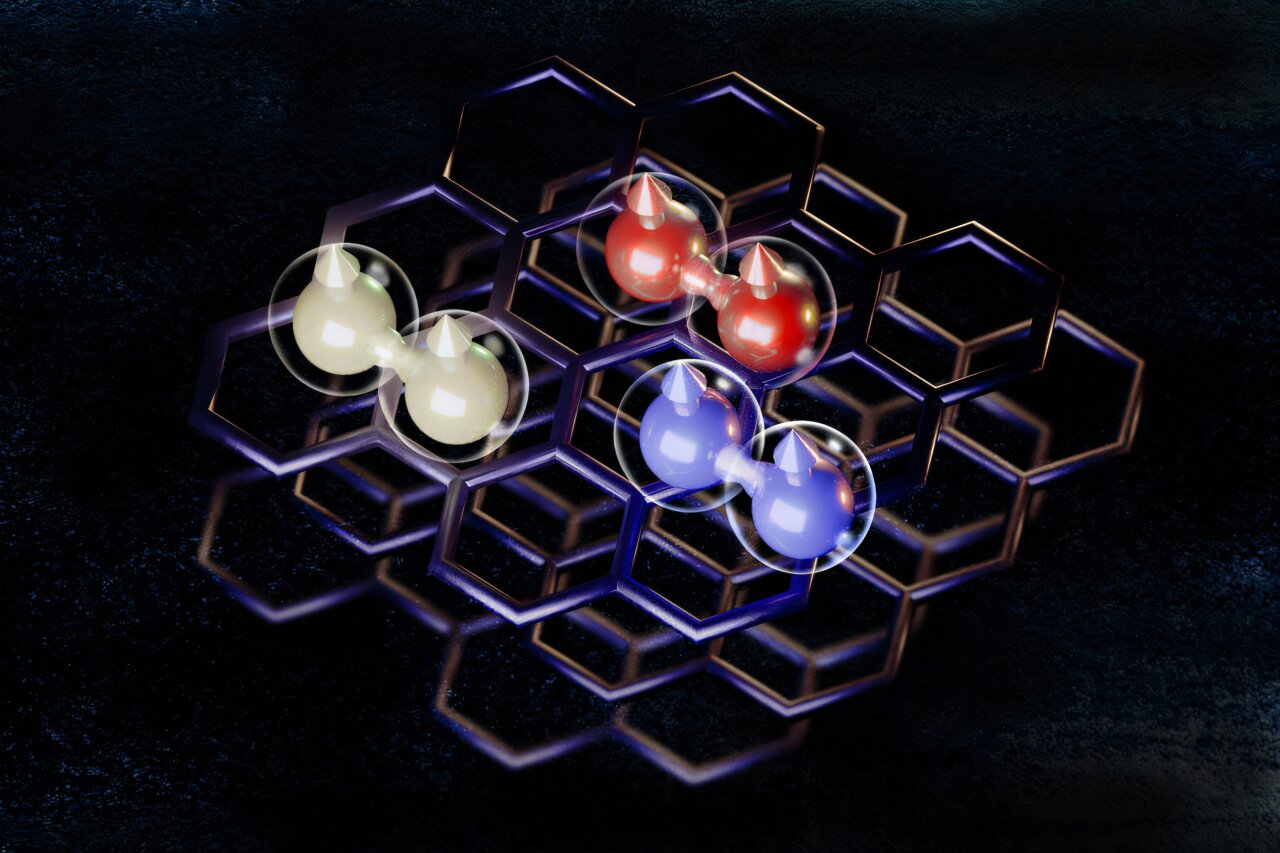
This graphic illustrates three different ways that electrons can pair up and flow through rhombohedral pentalayer graphene without resistance. The three different superconducting states (represented by different colors) surprisingly persist, and can even be boosted in a magnetic field, which normally kills superconductivity. Credit: Amy Pan, RLE
The ordinary graphite in pencil lead is proving to be surprisingly multifaceted at the microscale. In a study published in the journal Nature, MIT researchers report that a certain microscopic structure found in natural graphite can host multiple superconducting states. Superconductivity is an electronic state of matter in which electrons pair up and glide through a material with zero resistance.
While there are thousands of materials known to be superconductors, it is rare for one material to host multiple forms of superconductivity.
The researchers discovered the multiple superconducting states in atomically thin exfoliations of graphite, known as graphene. Specifically, graphene is a single-atom-thin sheet of carbon atoms arranged precisely in a microscopic lattice. The team made its discoveries in samples of rhombohedral graphene, which is a natural structure within graphite consisting of a stack of four or five graphene layers.