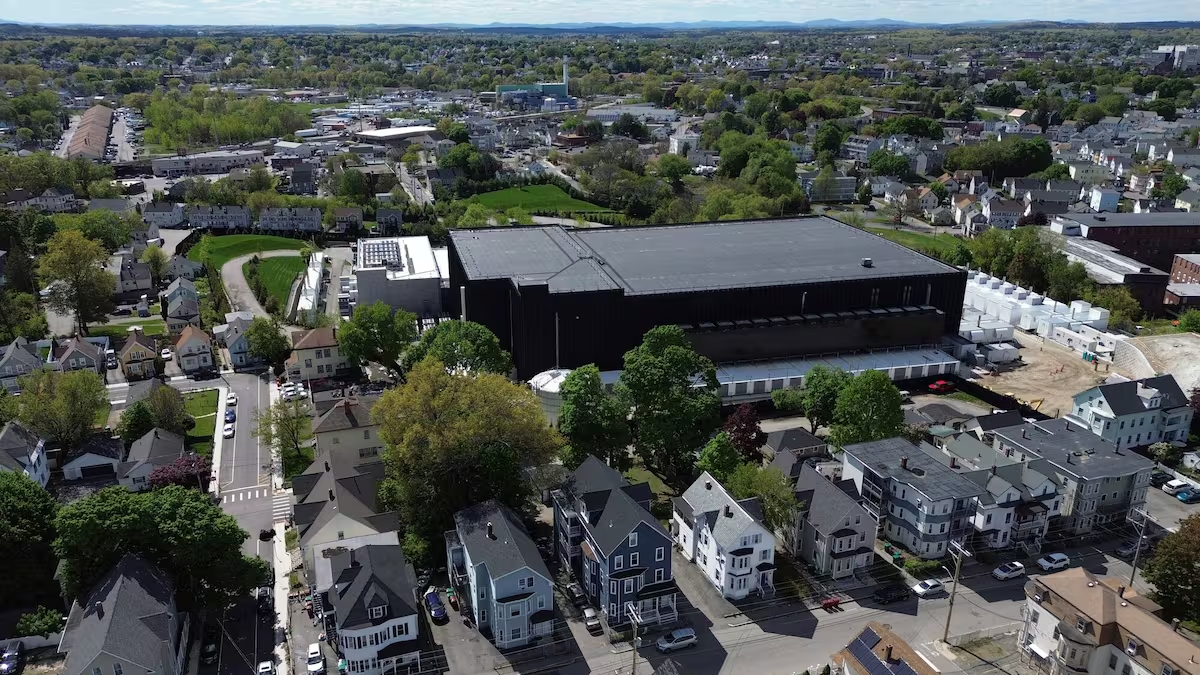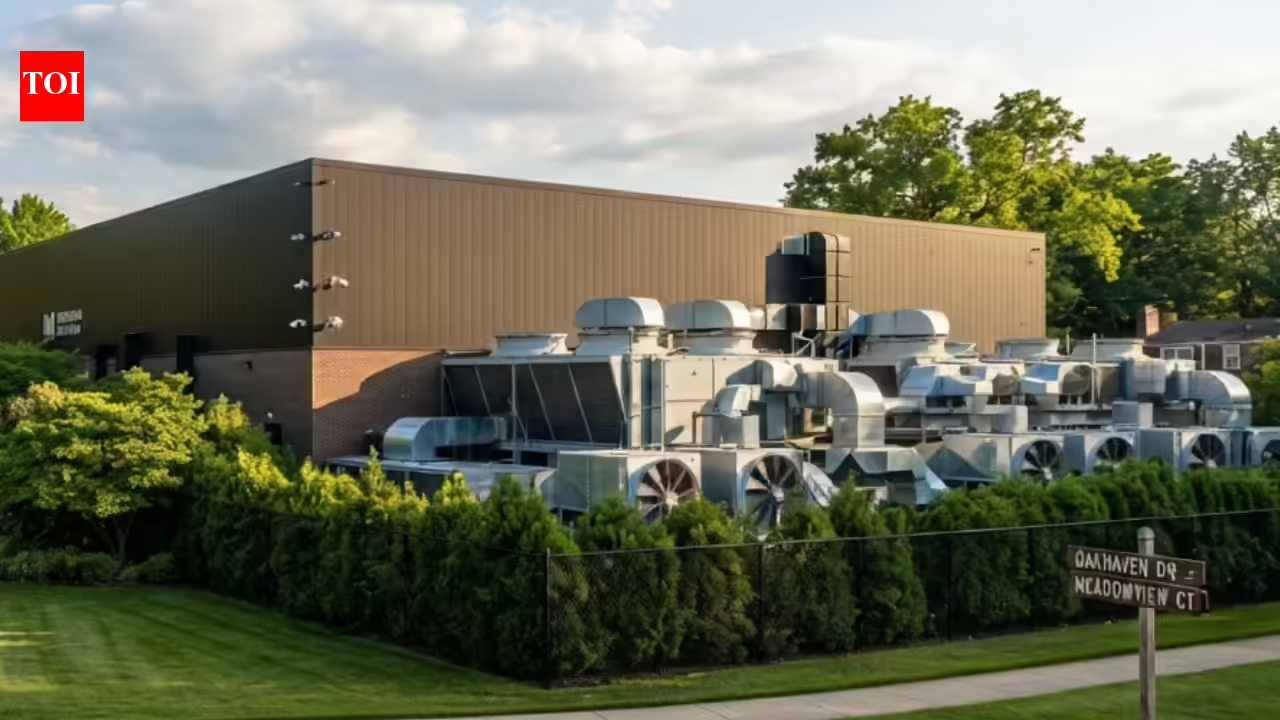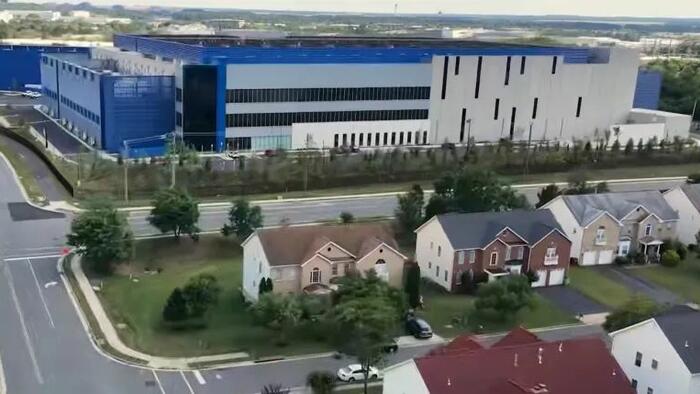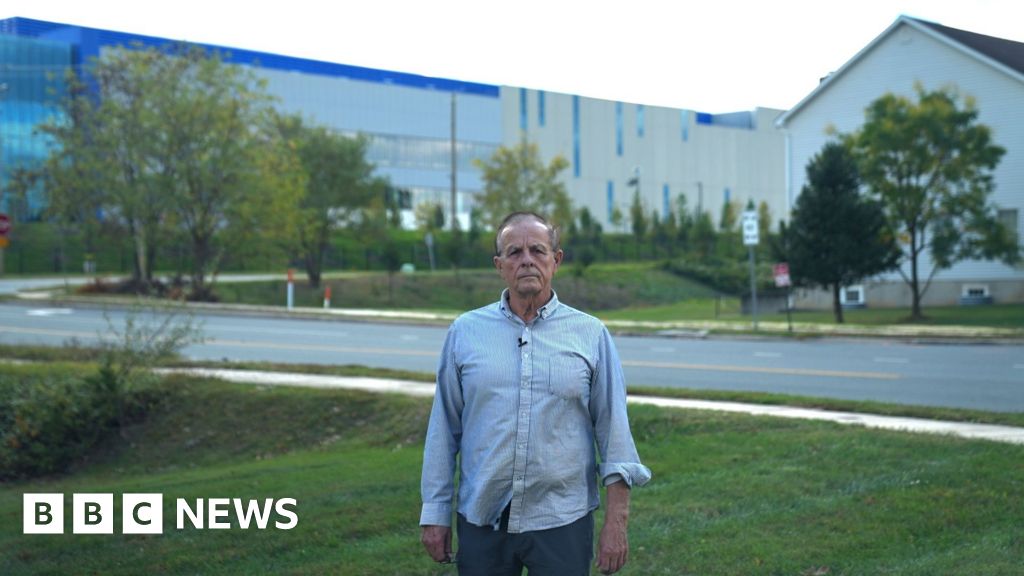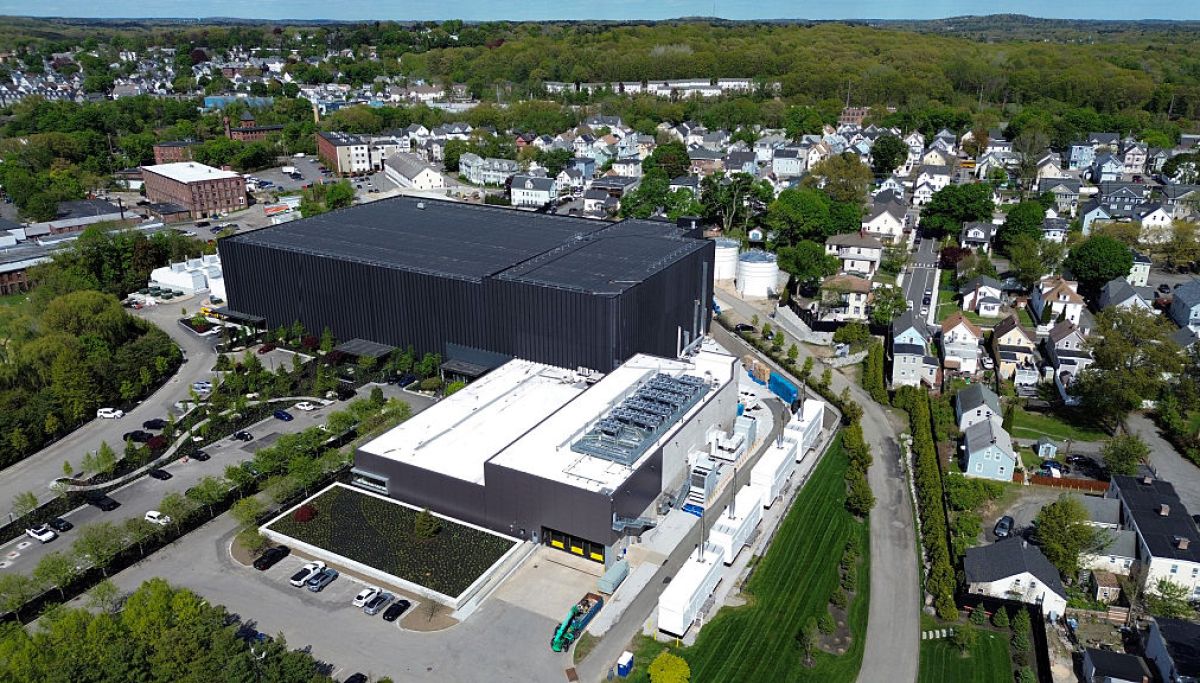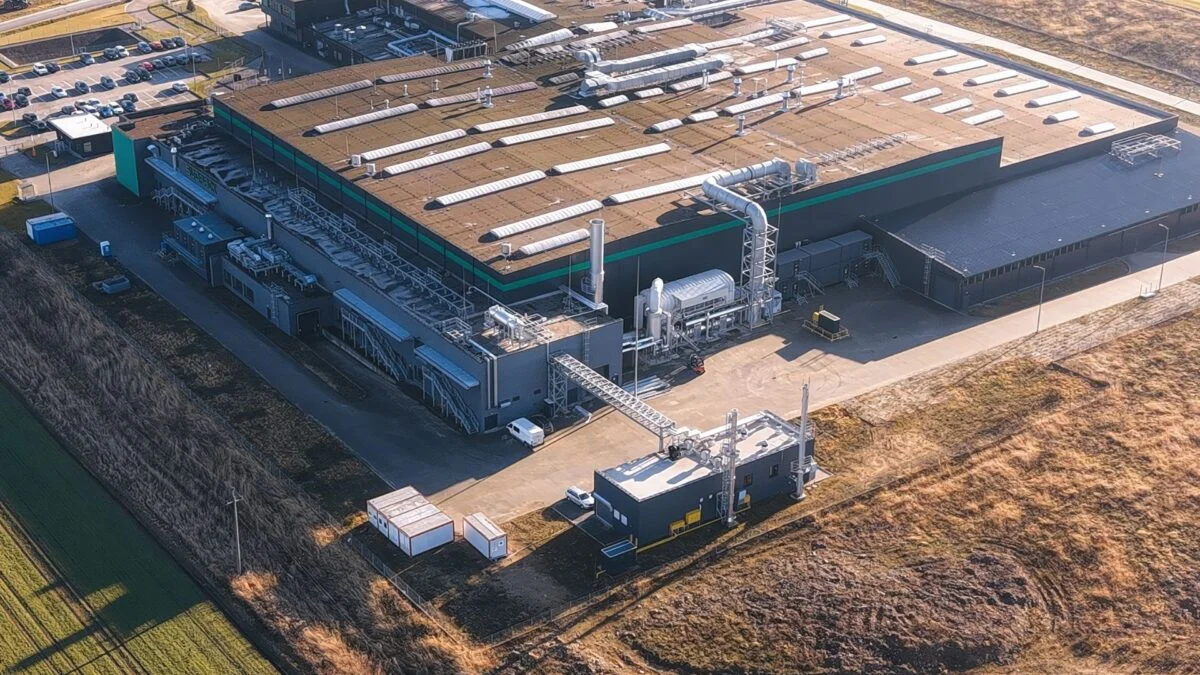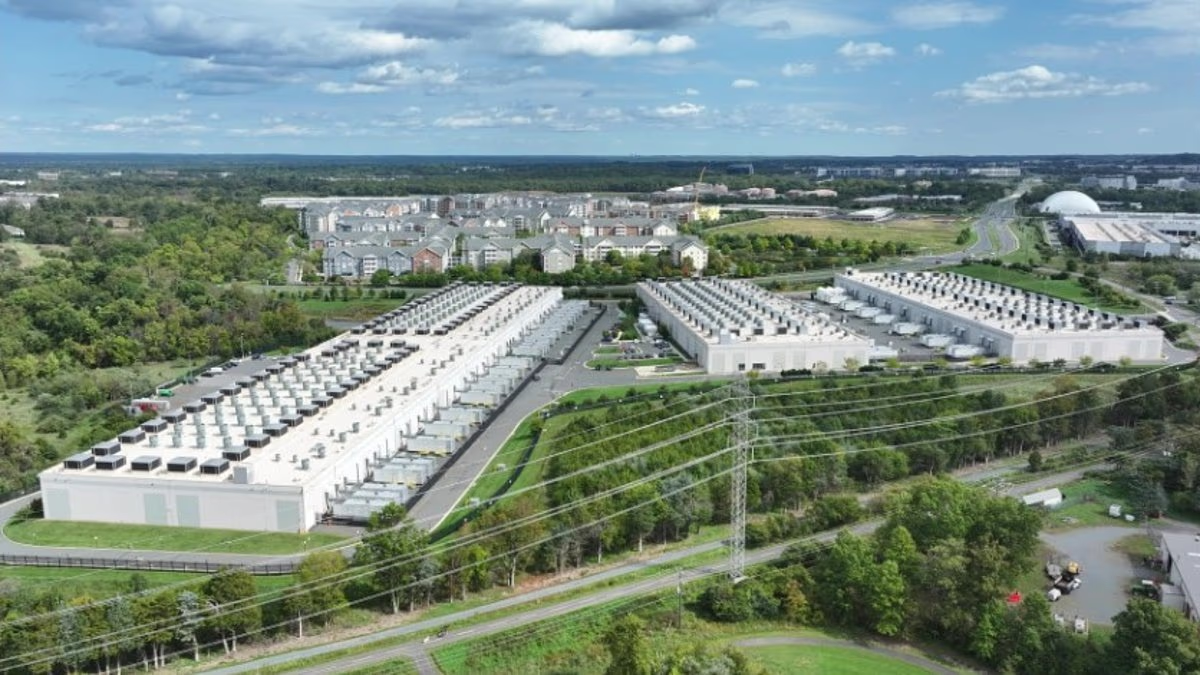
As we step out of Greg Pirio’s home, the sound of the nearby data centre can be heard even over the roar of a passenger jet descending a mile away to land at Washington DC’s Dulles Airport.The noise is so bad, says Pirio, a 75-year-old writer, that he rarely goes for a walk around his neighbourhood in Sterling, Virginia, as he gets a headache within minutes.In fact, it’s two noises: a low-pitched drone, which appears to come from the centre’s vast array of air conditioning units, and a high-pitched whine – like a jet engine – from the eight huge natural gas turbines that power it.The din varies in tone and decibel level, he says, but never lets up, carrying on throughout the night as well as day. It is even worse when data centre staff test each of the 50 back-up diesel generators, sometimes for several days.The diesel turbines also pollute the air – the particles of soot making Pirio’s eyes so dry that he says he now has to work in a darkened room.He and his neighbours could, of course, move, but selling their properties would rely on potential buyers miraculously failing to notice what they would have to live with.And the 800,000 sq ft Vantage 2 data centre, operated by a large tech company called Vantage Data Centers, is hard to miss.Pirio has lived here for 14 years, which means he can remember when Vantage’s 18-acre site – which begins some 200 yards from his front door – was woodland where deer roamed.Pretty much nothing roams the site now: its car park is virtually empty even on weekdays as, despite Big Tech’s claims that data centres will create many new jobs, once the buildings are finished only a skeleton staff is required to maintain the computer equipment inside.These are just some of the buildings that make up Virginia's 'Data Centre Alley' in Loudoun County Greg Pirio points to the decibel reading on his laptop. He says the noise is so bad that he rarely goes for a walk around his neighbourhood in Sterling, VirginiaIn April, a scientific study for an environmental group brought more bad news. Vantage 2’s emissions, it revealed, could have severe health consequences as they have been linked to asthma and cardiovascular problems, particularly among the infirm and elderly.This suburban region of Northern Virginia is known as Data Center Alley with good reason. It is home to the largest concentration of data centres on the planet, with Silicon Valley giants Amazon, Google, Microsoft and Meta – which owns Facebook, WhatsApp and Instagram – all owning servers in the area. Between them, these digital hubs handle an estimated 70 per cent of the world’s internet traffic.There have been data centres around here for 20 years, but the frantic rush to develop artificial intelligence (AI) and its insatiable demand for highly specialised computing power – a single AI query can require billions of calculations – means the buildings that house the necessary hardware now need to be so much bigger and so much more numerous.Indeed, AI data centres are becoming so vast that the length of the largest is measured in miles. One data centre planned for Utah will cover 62 square miles – more than twice the size of Manhattan – and will need more power than all of Utah currently consumes.This year, the biggest tech firms will invest nearly $1trillion (£750billion) in data centres and – if Silicon Valley and the UK Government have their way – they will be soon be coming to Britain en masse.Keir Starmer and his investment-hungry Labour colleagues are welcoming them in just as a furious backlash against AI, and especially data centres, is gathering steam across the Atlantic.They’re certainly hard to love. In the data centre capital of Virginia’s Loudoun County – home to Greg Pirio – you can drive for miles and see pretty much nothing but one vast grey concrete slab of data centre after another, covering 50million sq ft in total.Their owners sometimes install fake windows in a pointless attempt to make them easier on the eye, even as entire forests are uprooted to make way for new ones.Some communities now find themselves almost entirely surrounded by land earmarked for tech developments.The billionaire leaders of Big Tech assure us that AI will drastically improve our lives by enabling innovations such as cures for cancer and accelerating the development of new drugs. AI data centres are becoming so vast that the length of the largest is measured in miles This suburban region of Northern Virginia is known as Data Centre Alley with good reasonBut here in Northern Virginia is the grim quid pro quo. It’s a place where nearly every local will tell you they’ve paid a terrible price for the pact their politicians made with the tech companies – trading the promise of a huge tax windfall and thousands of new jobs for carte blanche to put data centres virtually wherever they want.Thanks largely to its proximity to Washington DC, and the availability of a fibre optic cable connection that provided lightning-fast internet speed, Loudoun County became a popular spot for data centres more than 20 years ago.They were encouraged by a local government that looked no further than the hundreds of millions of dollars of tax it would rake in – revenue that has helped turn it into the richest county in the US.Last year, Loudoun’s 200 data centres generated nearly $900million in tax revenue for the county. It is such a colossal amount for a region of 455,000 people that opponents say it’s no wonder that local politicians do whatever the tech companies want.Although data centres were initially confined to an industrial zone around Washington Dulles Airport, state politicians have allowed data centre construction to spread into residential areas in recent years. And this has created another problem: power shortages. The data centres are putting such a strain on electricity supplies that the grid is almost at breaking point.The Vantage 2 data centre near Greg Pirio’s home is, uniquely among those in Virginia, running on natural gas because there simply wasn’t the capacity for it to run off the grid.Many other centres lie dormant due to a lack of electricity supplies, their owners just keen to get them completed before politicians change their mind about their love affair with the industry.President Trump, who has pledged to go full throttle to help the US win its AI race with China, is encouraging data centres to create their own power, but building sub-stations will only add to the noise and air pollution.Those new power stations need to be connected to the data centres via overhead power lines – creating another environmental nightmare for local people.Loudoun County estate agent Vicky Hu is fighting plans to erect an electricity pylon up to 180ft high in her back garden to connect a nearby Amazon data centre with a new power substation.If approved, it will be just 126ft from her house and sit on her carefully maintained lawn while many of her trees near the power line will be pulled down.She told the Daily Mail that the energy company responsible could easily use an alternative route, but such a move would involve buying land that is now selling for $6million an acre. Its other option would be to bury the power line underground, but the company told her this would be too time-consuming.Instead it intends to exploit the government’s legal power of ‘eminent domain’ – seizing private property for public use and get its way for a fraction of the price.Data centre operators are also accused of sucking up vast quantities of water to cool their computers, then releasing whatever is not evaporated back into the water system, often in a polluted form. In the data centre capital of Virginia’s Loudoun County – home to Greg Pirio – you can drive for miles and see pretty much nothing but one vast grey concrete slab of data centre after another Keir Starmer and his investment-hungry Labour colleagues are welcoming them in just as a furious backlash against AI, and especially data centres, is gathering steam across the AtlanticFinally, areas such as Northern Virginia face a severe housing shortage that the data centres are making worse because they are pricing out homebuilders with the vast sums that they can pay for land.All told, it’s a mess that even a super-intelligent computer might struggle to solve.The Silicon Valley bigwigs who accompanied Trump on last year’s visit to the UK and pledged to invest £150billion in developing AI and data centres in Britain did so not because they are ardent Anglophiles but because building them in the US is getting harder.Anti-AI feeling is sweeping the US – fuelled by fears of huge job losses that have even led to tech bosses being booed while giving university graduation speeches.It’s a cause that unites Democrats and Republicans. According to a recent Gallup survey, 71 per cent of Americans now oppose the building of an AI data centre in their community.But this hasn’t stopped Starmer’s beleaguered government from going ahead with the mass construction of data centres. Indeed, Labour has designated data centres as ‘Critical National Infrastructure’ – essential services on a par with water and power companies that will be given high level prioritisation and protection.But Britons who assume that, even in a small and over-crowded country, data centres will only be built far from human habitation, might note the location of Data Centre Alley – just a 30-mile drive from the US capital in a heavily suburban region that could hardly be called remote.The chorus from Virginians when asked whether their British cousins should welcome the data centres was a resounding ‘No’.Drive down roads clogged with construction lorries to Prince William County, Loudoun’s southern neighbour and America’s fastest growing data-centre region, and you get a vivid illustration of how resistance is growing.A large coalition, composed of everyone from locals to historians, is on course to win a court battle to stop a plan to put the world’s biggest data centre development – with 38 buildings – next to the hallowed site of the Civil War’s bloody Battle of Manassas.An appeal court ruled that the county had pushed through the 2,100-acre data centre application without giving the public a fair chance to express reservations.‘This industry is out of control, and it will buy and sell us all if we don’t get a handle on it soon,’ says Kathy Kulick, a prominent data centre opponent. ‘And it’ll be the same in the UK, I’m sorry to say… It’s all about money.’At a packed and angry meeting I attended in Manassas this month, residents debated the issue with some Virginia politicians. Many speakers complained about how permission for data centres was often quietly sneaked through the planning process – often during the chaos of the pandemic – so that local people suddenly found they had them on their doorstep.It’s an all too familiar story to Sheri Sweeney. The scientist and her airline pilot husband, Chris, thought they had found the ideal family home to raise their two young children when they moved into a quiet and leafy neighbourhood in the Prince William County town of Bristow 14 years ago.Then Google built a 283-acre, $9billion data centre less than a mile away. Called Mango Farms, in line with the tech giants’ ridiculous tradition of giving their data centres cute-sounding names, it is, in fact, an intrusive eyesore.The Sweeneys say the blasting that was done to get through the rocky ground during construction caused structural damage to their $1million house.And now they not only hear their new neighbour, particularly at night and in the early morning, but the low frequency hum from its battery of air coolers, which sometimes causes their kitchen table and their beds to shake.All of them have trouble sleeping, and the children have soothing white noise machines in their bedrooms. Their eight-year-old son has been particularly badly affected, she said.‘He lies in bed at night, feels his bed shaking and just starts crying because he knows we’re going to have to move because of that,’ she says. ‘And my concern is, if we’re already hearing that from one data centre and experiencing shaking from it, what’s going to happen when there are ten more?‘My biggest concern with the youngest kids are the health effects of living next to a substation. As a scientist, there’s been no studies to show that marrying these types of operations in a residential neighbourhood is a good idea. I believe you pick a house and you pick a neighbourhood because you want to feel safe at home, but I feel like we’ve signed our family up for an experiment.’Now the Sweeneys have learnt that their community will soon be surrounded on three sides by another tech development – this time involving ten data centres and a big electricity substation.Back in Loudoun County, Vicky Hu has no confidence that AI will last the course. She asks: ‘After two or three years when the bubble’s burst, will they come to remove their structure and put the trees back?’Understandably she has little hope of ever selling her home of 21 years with a pylon as its main garden feature. She, too, had a message for Britain about data centres. She says: ‘Please learn from our mistake, because the money you guys think you’re going to make is not enough to cover what’s being destroyed.’Many insist the AI revolution is inevitable. It may even prove benign. But it certainly won’t be painless, as anyone unlucky enough to have a data centre for a neighbour is discovering.
The hell of living in Data Centre Alley: It could be you next
As we step out of Greg Pirio's home, the sound of the nearby data centre can be heard even over the roar of a passenger jet descending a mile away to land at Washington DC's Dulles airport.
2,272 words~10 min read