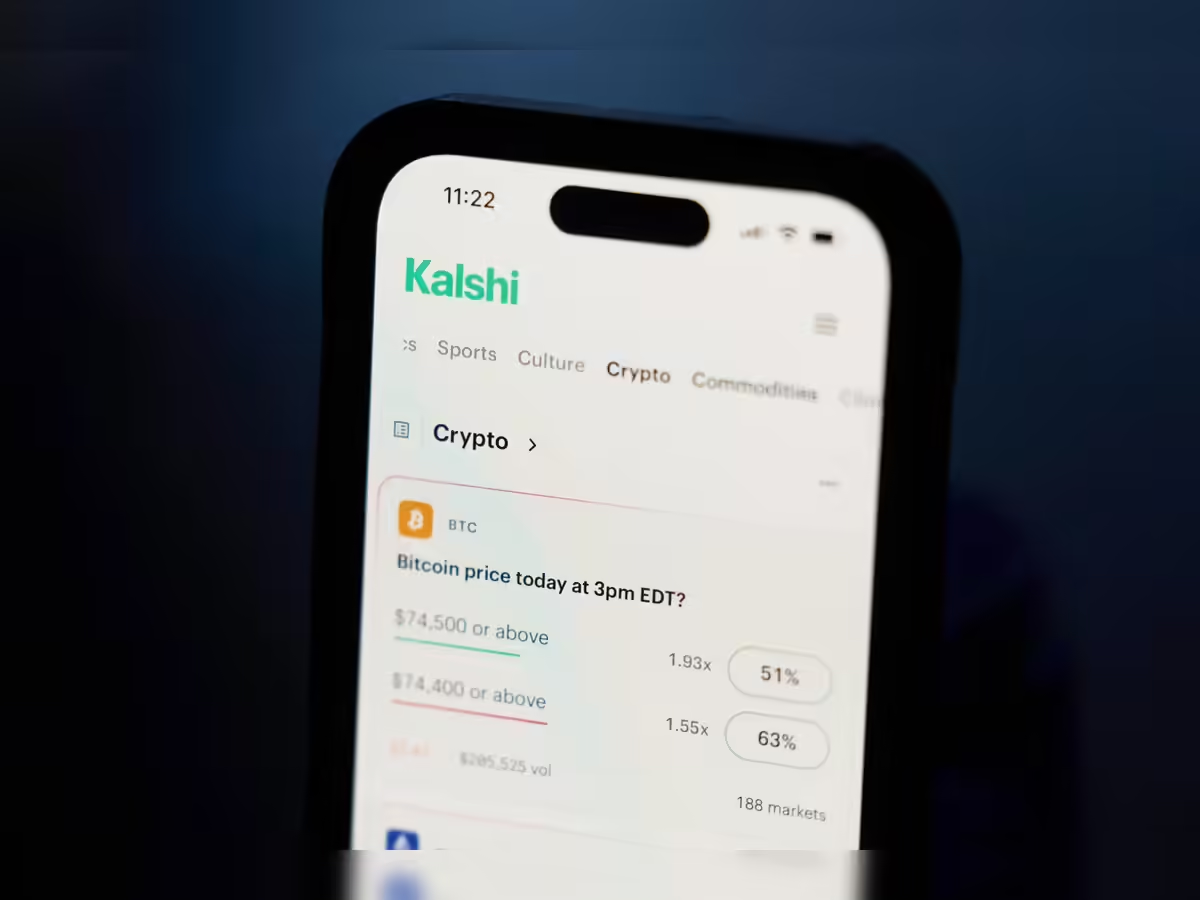
The Commodity Futures Trading Commission opened a door last month. It approved derivatives called perpetual futures on cryptocurrencies at Kalshi, let Coinbase’s US customers reach its offshore “perps” and published a path for any registered platform to list its own.
Within weeks, prediction market Kalshi Inc.’s crypto perps cleared $8.5 billion in volume. The incumbent exchanges noticed: CME Group Inc.’s shares are off about 19% since the approval and Cboe Global Markets Inc.’s are down 27%. CME has sued the CFTC, claiming the approval inflicted “textbook competitive injury.” The trade press is calling it a turf war, and it is. But the public argument over whether perps are dangerous is incoherent — waged over two questions that don’t matter and missing the one that does.“Perpetual” is a slogan, not a product. It bundles three unrelated things.
First, there’s no expiration date. A perpetual contract never matures, unlike traditional dated futures. This sounds exotic; it isn’t. Nobel laureate Robert Shiller proposed perpetual claims in 1993, as a way for ordinary people to hedge housing and other macroeconomic risks.For a financial future, delivery dates are vestigial. May wheat and November wheat are genuinely different goods, so the dated futures ladder carries real information. The June and September contracts on a stock index are not different goods. When CME built financial futures in 1972, it copied delivery dates from the grain pits, because that’s what the plumbing knew, not because index investors needed them.Removing the date simplifies things and concentrates liquidity; the funding mechanism that replaces it makes the cost of carry explicit and continuous rather than bucketed into quarterly rolls — a clear improvement.Second, perps trade around the clock. We have argued about 24-hour and after-hours trading since at least the 1987 crash, generating a library of research, regulation and litigation. There are real costs and benefits, weighed differently by reasonable people. None of it is specific to perpetuals, and there’s no reason to try and settle the debate in a hurry.That leaves the third question, the one anyone not selling something should worry about.Perps pair high leverage with automatic liquidation. In a traditional margin account, when collateral runs low, a broker calls for more; you have hours, sometimes days. In a perpetual, there is no call. When your equity slips below the maintenance margin, an engine closes your position at market — instantly. Across a crowded market, the engine sells into a falling price, which trips the next account’s threshold, which sells again.The old margin call’s human delay was a brake; auto-liquidation removes it by design.President Donald Trump’s surprise 100% tariff on China on Oct. 10 erased over $19 billion in leveraged crypto positions in a single day, mostly longs. When the cascade outruns the market, an insurance fund set up by the exchange absorbs the gap; when that’s exhausted, the exchange “auto-deleverages,” clawing back profits from solvent traders on the winning side. That’s loss socialization, and despite perps trading tens of trillions of dollars a year (most of it overseas), the first rigorous models of how it behaves under stress are appearing only now.The danger isn’t leverage or liquidation in the abstract; it’s leverage times the volatility of the underlying asset — exactly what the public debate omits.At 100x, a 1% move triggers liquidation. Bitcoin swings about 2.5% on an ordinary day, so for those accounts, liquidation isn’t the tail, it’s the base case. Leverage of 20 times is unlikely to trigger liquidation on a placid stock index, but would almost certainly do so for volatile crypto. This is why the 20x perps launched by Coinbase Global Inc. on AI, China and defense indexes are the ones to watch.High-leverage perps on volatile underlying assets, like the Coinbase examples, are engineered so liquidation is a real probability for the typical user. For the exchange, it is a feature: Early liquidation protects the insurance fund by seizing margin before it’s fully depleted by losses, and the churn generates fees and spread.For a sophisticated trader, this can also be a feature, an automated stop-loss. The trouble is a retail buyer, who thinks 100x is a leveraged directional bet, when it is a lottery ticket. For that customer, a product calibrated so that liquidation is the modal outcome is a machine for moving margin payments from the impatient to the patient.Nearly everyone I see quoted in defense of the public is, in trader-speak, talking their book — saying what’s good for their bottom line.CME’s Terry Duffy frets about people “who don’t understand products” getting blown out — while CME sells leveraged micro-futures to retail day traders. Kalshi’s Tarek Mansour says his approximately 6x perps are no riskier than ordinary futures, which is true precisely because of a leverage cap he could lift tomorrow. Intercontinental Exchange Inc.’s Stuart Williams calls perps riskier and says no customer has asked for them, even as he says his exchange is out hunting the demand. Each party’s safety concern lines up with its revenue. This is a fight over who collects the fees, conducted in the language of investor protection.The fix isn’t prohibition but calibration: cap leverage to the underlying asset’s volatility rather than a flat multiple, make venues publish their insurance-fund and deleveraging rules, and confirm they segregate customer money to the standard incumbents already meet — the one place CME’s complaints may be about more than turf.Perpetual financing is an old, good idea. Around-the-clock trading is an old, tired argument. The thing that deserves your attention is the newest and least understood: What happens when you let someone borrow a hundred times their money on an asset that swings 2.5% a day, and hand the unwinding to a machine?This column reflects the personal views of the author and does not necessarily reflect the opinion of the editorial board or Bloomberg LP and its owners.Aaron Brown is a former head of financial market research at AQR Capital Management. An active crypto investor, he has venture capital investments and advisory ties with crypto firms. He is the author of “Wrong Number.”Disclaimer: This report is auto generated from the Bloomberg news service. ThePrint holds no responsibility for its content.