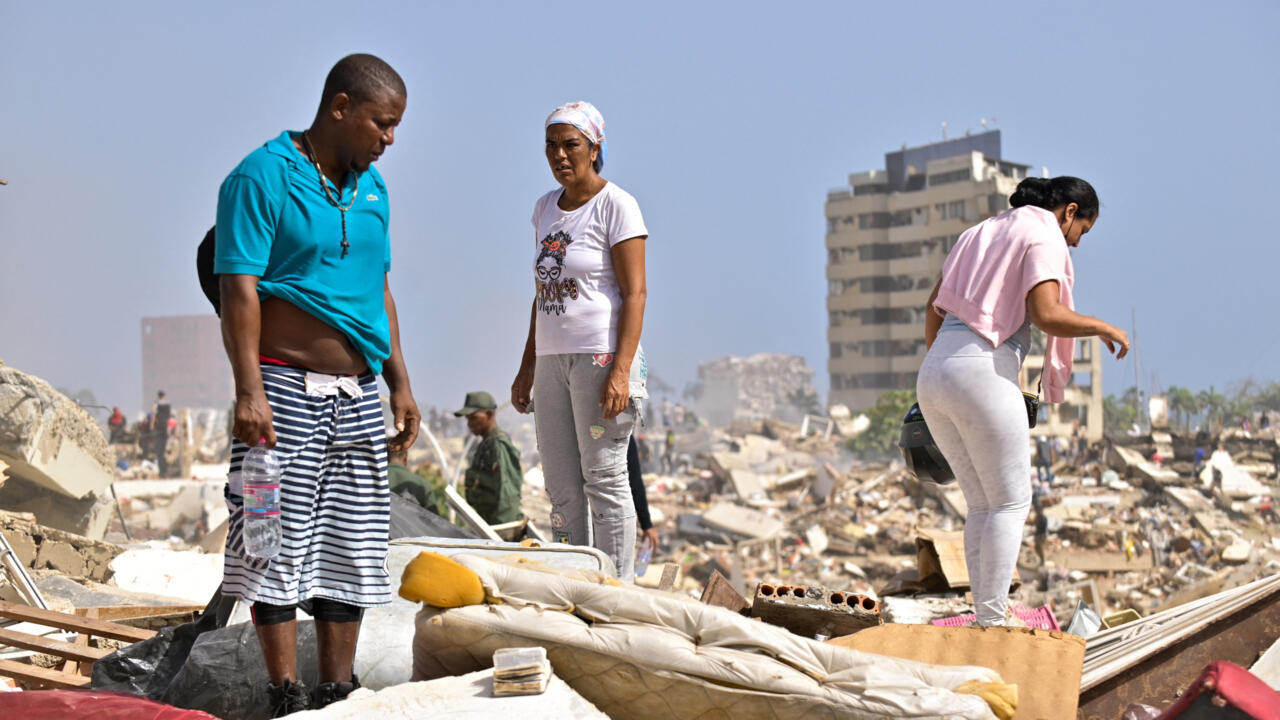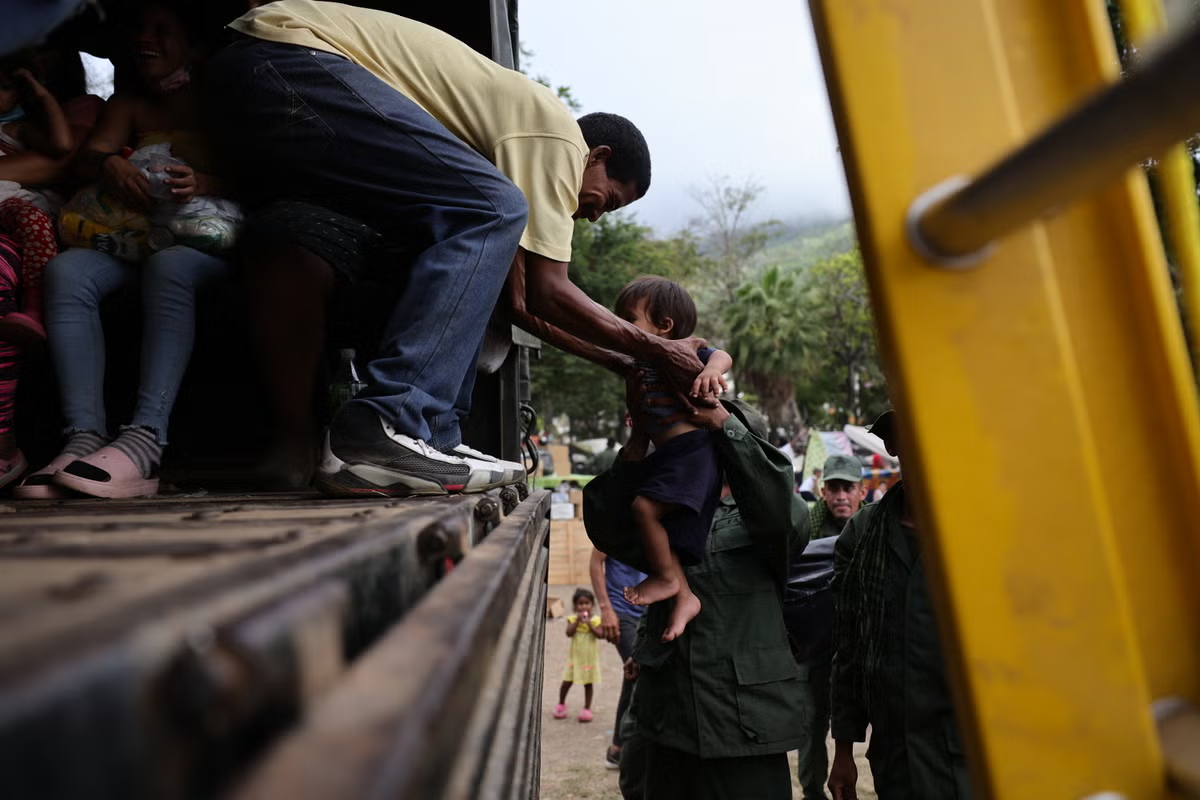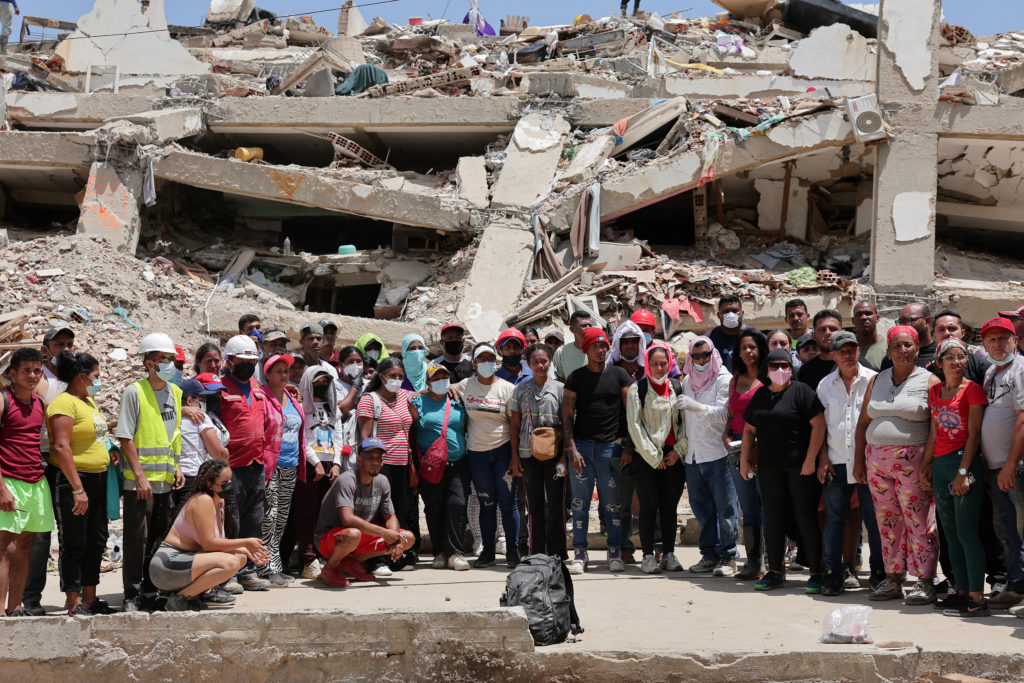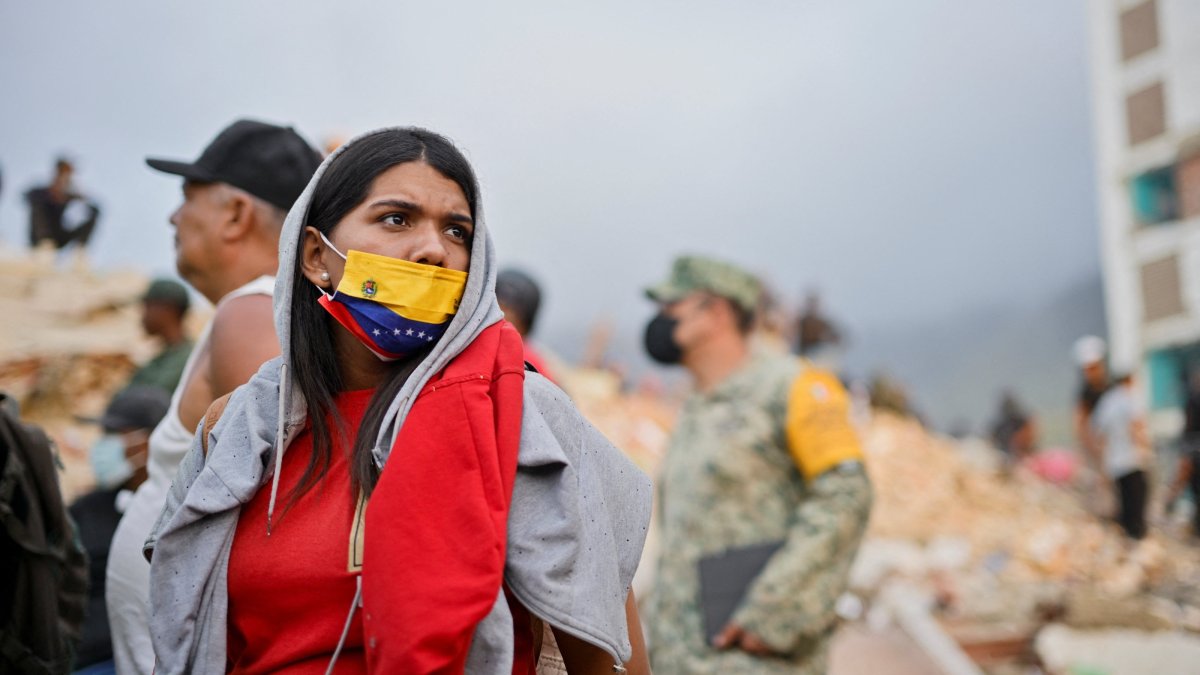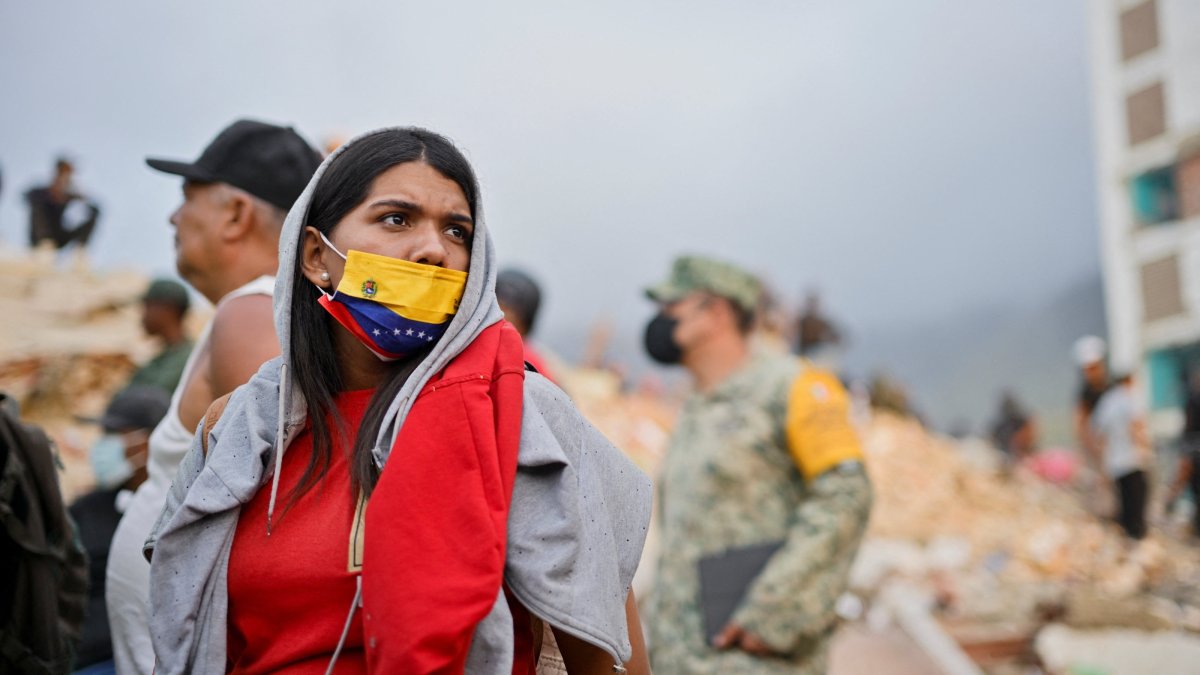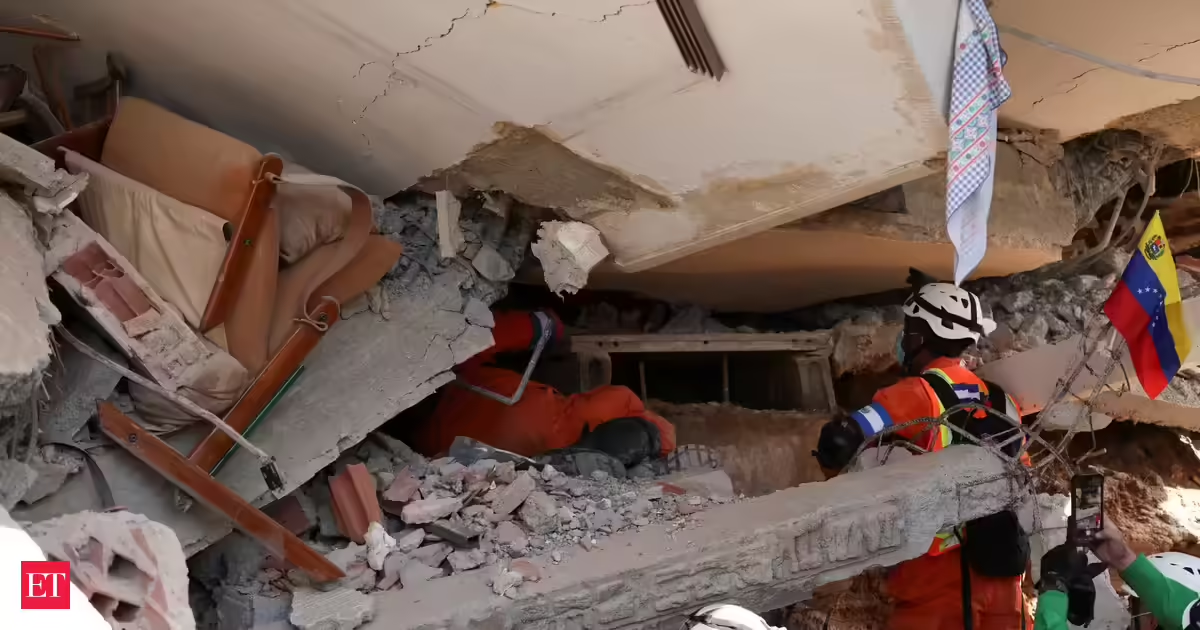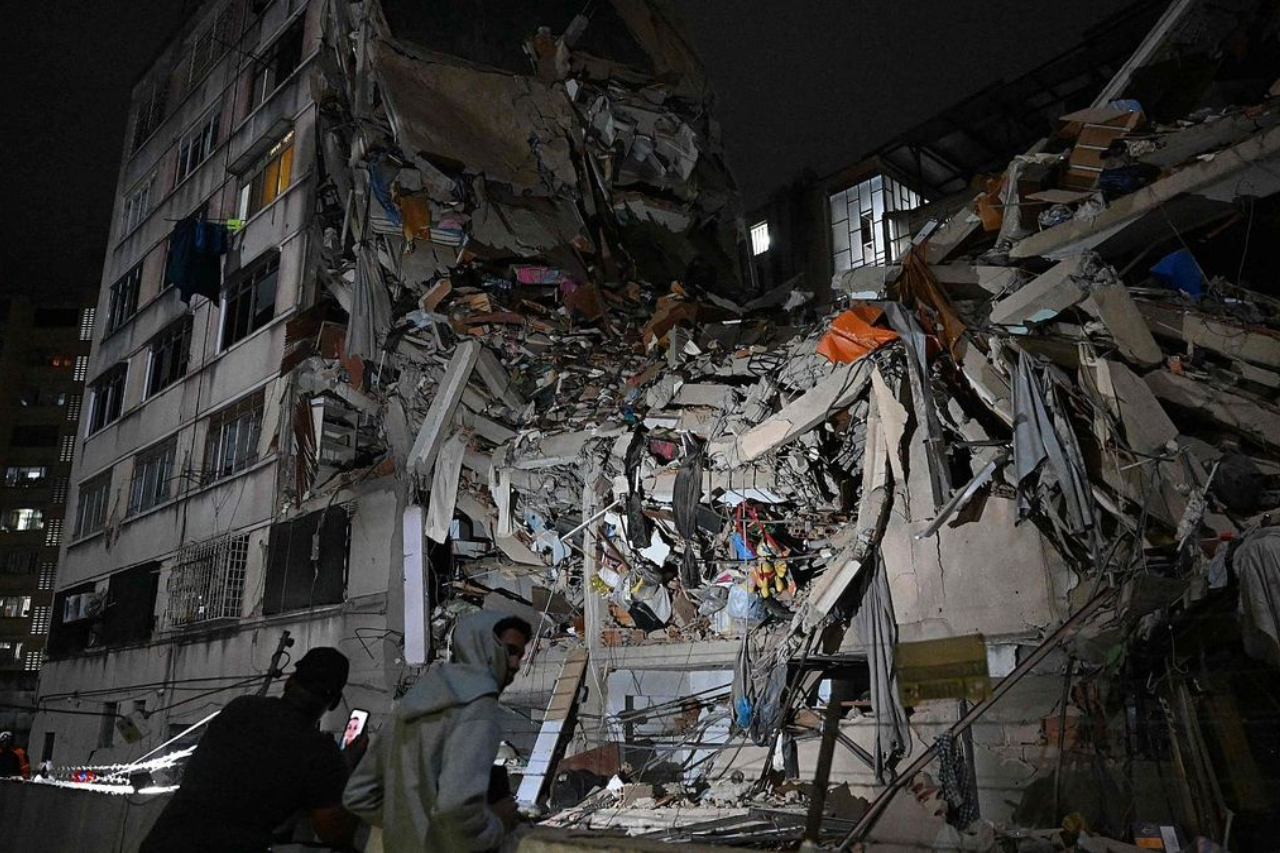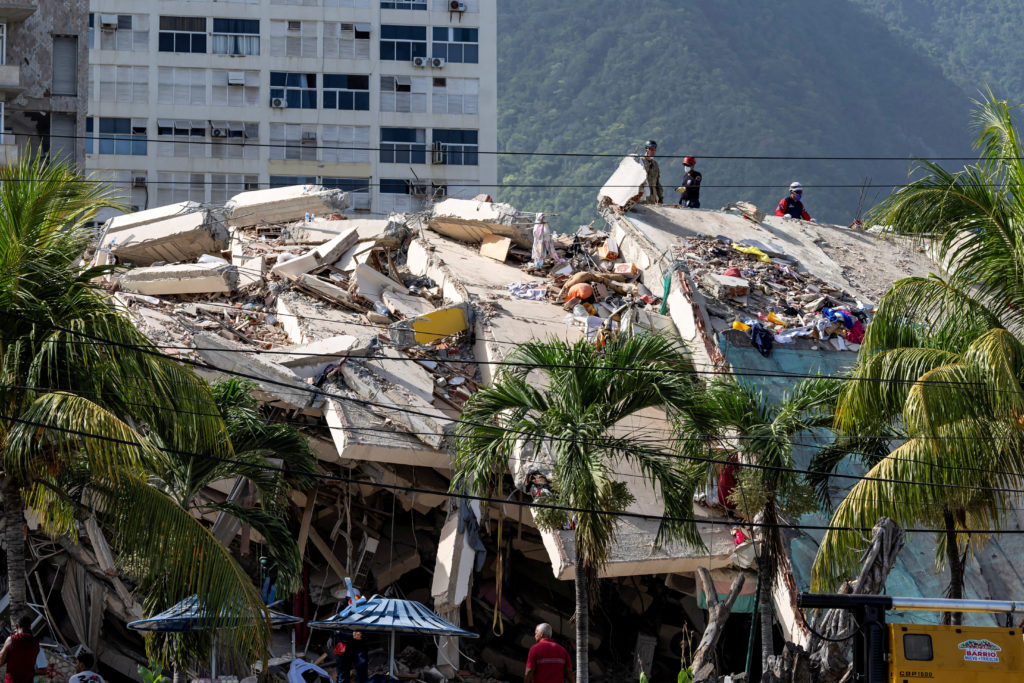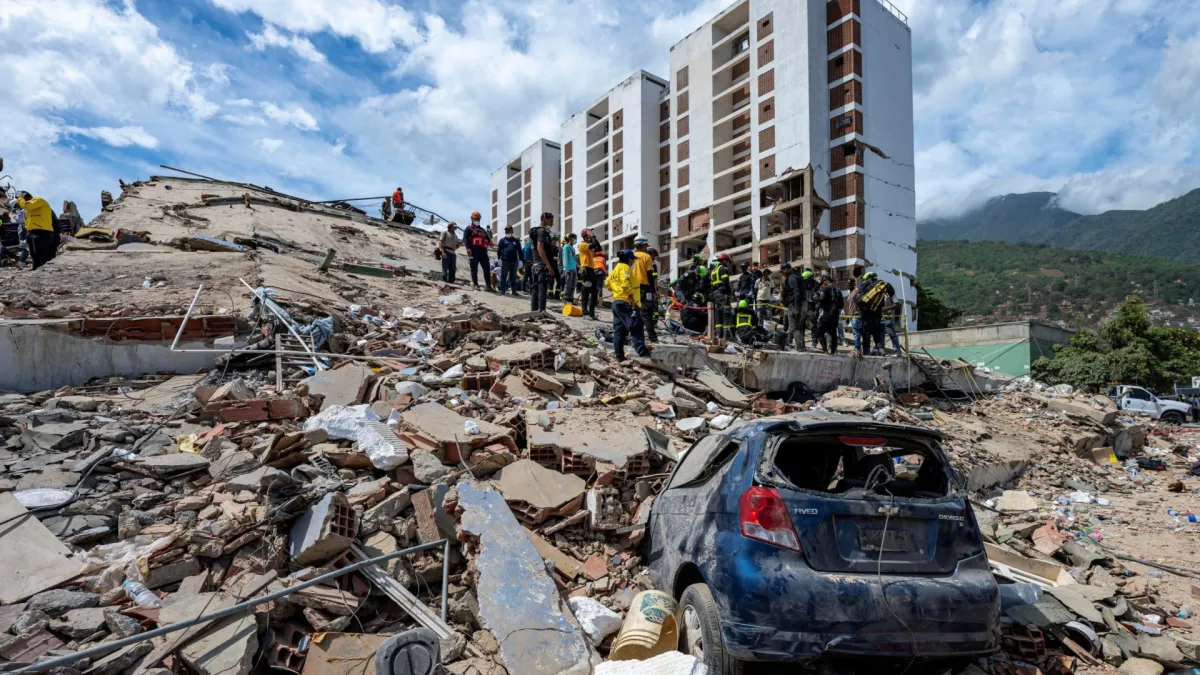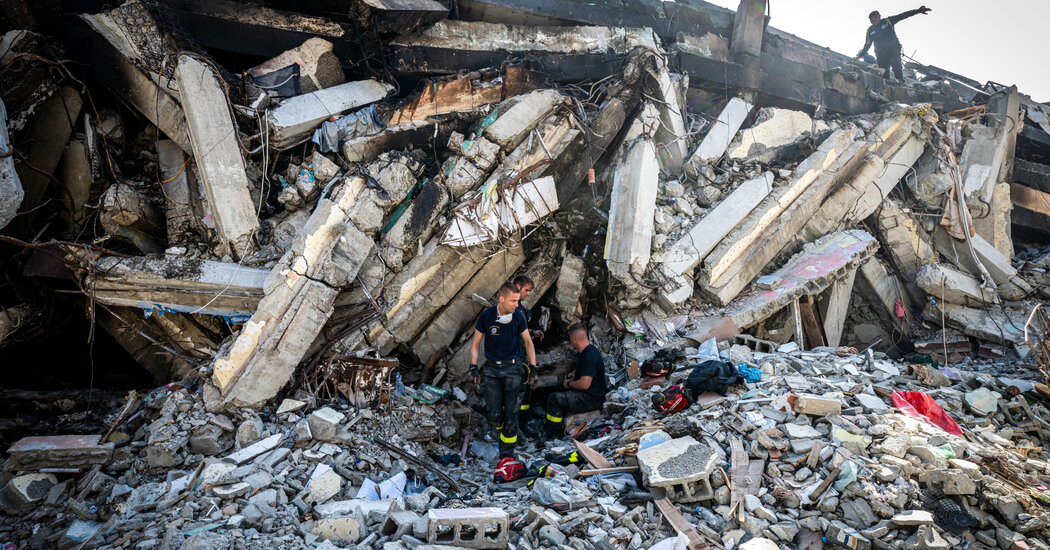
Latest PinnedUpdated Here’s the latest.The search for survivors of the devastating earthquakes in Venezuela was growing increasingly desperate as it entered its fifth day on Monday, with hopes of finding more people alive under the rubble fading as another aftershock rattled the area.The full scale of the destruction from Wednesday’s 7.2- and 7.5-magnitude quakes is still emerging. The death toll has risen to 1,450 people, with more than 3,000 injured and 12,000 displaced, according to the Venezuelan government, but the official number is probably a vast undercount. Doctors have said that in La Guaira (pronounced La-WHY-ra), the worst-hit state, officials are processing about 750 bodies each day.The United Nations coordinator in Venezuela, Gianluca Rampolla, has said that the number of collapsed buildings suggested there were many more deaths.Dozens of people gathered outside a state-run morgue in Caracas, the capital, on Sunday searching for their missing loved ones, many of whom are believed to have been in La Guaira. Power outages, blocked roads and wide devastation have made it difficult for family members to contact one other, leaving many people in a state of uncertainty amid the chaotic rescue effort.Nonetheless, emergency workers are still digging out survivors, and President Delcy Rodríguez of Venezuela vowed that rescue operations would not stop. In the early hours of Monday, Ms. Rodríguez said a 21-year-old man was pulled from the rubble after a 43-hour rescue operation. He survived despite been trapped for 106 hours, she said.The government, which has been criticized for not doing enough to help, and President Trump, who helped bring Ms. Rodríguez to power after U.S. forces seized the country’s longtime dictator, Nicolás Maduro, have been under increasing pressure. Late Sunday, she announced that the government would establish a commission to assess the integrity of roads and bridges and whether buildings were safe to return to.Here’s what else we are covering:Another aftershock: On Monday morning, weary and anxious residents of Caracas woke up to more strong shaking. The U.S. Geological Survey reported a 4.6-magnitude earthquake off the country’s north coast, the eighth aftershock with a magnitude of 4.3 or more. Jorge Rodríguez, the leader of the National Assembly, said the government had received no immediate reports of additional damage.Extraordinary rescue: As the window for finding survivors rapidly closed, rescuers on Sunday pulled an 11-year-old-boy from under nearly 10 feet of rubble in La Guaira without injury. Read more ›La Guaira: Electricity had been restored to 75 percent of the state, water service to 68 percent and road access to 90 percent, Ms. Rodríguez said on Sunday. The single highway into La Guaira had been jammed in recent days by civilian aid conveys, which trapped some aid workers in traffic. Read more ›A frantic search: The scene on Saturday night in San Bernardino, a middle-class neighborhood in Caracas, showcased both the severe shortage of heavy machinery needed to rescue survivors and the enormous community mobilization that has taken place to try to fill that gap. Read more ›The United Nations is procuring 10,000 body bags in coordination with Venezuela’s government in anticipation of the death toll rising, said Gianluca Rampolla Del Tinardo, the U.N. resident coordinator for Venezuela . He said there was no definitive number of the missing. The government has said more than 1,400 people are confirmed dead. Mr. Del Tinardo, briefing reporters remotely from Caracas, said 27 countries had mobilized more than 40 search and rescue teams with more than 2,000 rescuers.Tibisay Romero and Luis Ferré-SadurníIn Caracas, more than 1,200 people, including 300 children, who had been sleeping outdoors are being housed in a a school, Unidad Educativa Miguel Antonio Caro, according to Enilba Galindo, the director of the school. “Many completely lost their homes or their homes are so cracked that they’re not allowed back in,” she said in an interview on Monday, as doctors in blue scrubs came and went. More than 50 volunteers were providing food, distributing donated clothes, administering health checkups and holding educational activities to entertain children.AdvertisementSKIP ADVERTISEMENTAt funerals, Venezuela’s wounded families and friends unite in grief.ImageRelatives and friends mourn at a funeral in Caracas, Venezuela, on Sunday.Credit...Fabiola Ferrero for The New York TimesA young beauty pageant queen whose dream of becoming Miss Venezuela was cut short at 26 years old.A mother whose body was discovered in the rubble, covering the bodies of her two boys, ages 6 and 12.A man who had been deported to Venezuela from the United States just hours before the earthquake struck.The more than 1,400 lives lost in Venezuela’s deadliest earthquakes in more than a century began to come into focus over the weekend, as families, still disoriented and distraught, began to bury loved ones.Hundreds of relatives and friends made the pilgrimage on Sunday to a sprawling, mountainside cemetery overlooking Caracas, the capital, to lay to rest mothers and fathers, children and grandparents — Venezuelans of all ages and walks of life united by tragedy.Freshly turned earth pocked the vast rows of tombstones. The cemetery’s four chapels were packed with mourners who cycled in and out to accommodate dozens of services.The stench of death filled the air, a reminder of how long many of the victims’ bodies had remained trapped in the ruins.ImageThe coffins of Licelot Gomera Álvarez and her sons, Samuel and Diego, on Sunday in Caracas. They were among more than 1,400 people killed in last week’s earthquakes.Credit...Fabiola Ferrero for The New York Times“I don’t know whether to cry, or scream, or help, or support, because there are no words to ease this pain,” said Honny González, a teacher who taught the two boys, Samuel and Diego, who died with their mother, Licelot Gomera de Álvarez, 41.The boys’ father, Eder Álvarez, had gone on a bike ride when the two quakes struck in quick succession on Wednesday evening. Mr. Álvarez, 41, said he pedaled as hard as he could back to his home in Caracas, only to find the five-story building where the family had lived reduced to a hulking pile of debris.At first, police officers “wouldn’t let me through,” Mr. Álvarez said in an interview at the funeral. “I told them, with agony, to let me in because my family was in there and I wanted to rescue them.”He was eventually allowed in and, joined by other residents and volunteers, sifted through the wreckage with his bare hands hoping to find his wife and two children alive. Instead, he found their bodies, huddled together.ImageLicelot Gomera de Álvarez and her sons, Samuel and Diego, died from the disaster.Credit...Fabiola Ferrero for The New York TimesOn Sunday, their three caskets were lowered into the ground, one atop the other.Neighbors, teachers and young classmates of the two boys exchanged quiet hugs during the funeral service, at one point wrapping their arms around a casket.Ms. Gomera’s parents and two siblings, wiping away tears, recalled her as an accomplished accountant with an arts and crafts side hustle — but above all, a dedicated mother who radiated delight.“My sister was a joyful woman,” said her sister, Rabely Gomera. “She dedicated herself to her family, and my nephews, who were deeply loved, and were a reflection of who she was: beautiful, respectful, good-hearted, and kind children.”Nearby, mourners bid farewell to Fátima Durán, 26, a tall, black haired graphic designer who had won multiple local pageants, a cultural obsession in Venezuela, where the contests are treated like major sporting events.Her blue-crystal crown sat nestled atop the urn that held her ashes, surrounded by fashion books, photos of her and arrangements of pink roses, her favorite flower. Former pageant queens, both young and older, gathered wearing pink roses on their lapels and around their necks.ImageFamily and friends gathered for Fátima Durán, a pageant queen and fashion designer, who died while visiting her boyfriend in La Guaira.Credit...Fabiola Ferrero for The New York Times“She was an exemplary girl, with a good, noble heart,” said her mother, Carolina García, who also had competed in beauty pageants.Ms. Durán died while visiting her boyfriend in La Guaira, the city that suffered the worst damage. Her boyfriend and his father also died, Ms. García said.Ms. García sobbed as she showed her phone with Ms. Durán’s last-recorded location.“One day she grabbed my phone and set up our locations,” Ms. García said. “She told me, ‘If something ever happens to you, I’ll find you, and if something ever happens to me, you’ll find me.’”“And I found her — that was how I found her, and I brought her back,” she said.For relatives of Gustavo Adolfo Guevara Figueroa, a 22-year-old man who had been deported after five years living in Miami, an anticipated homecoming turned into an unbearable tragedy.ImageGustavo Adolfo Guevara Figueroa was deported from the United States, arriving in Venezuela hours before the died in the earthquake.Credit...via María FigueroaMr. Guevara Figueroa had landed on a deportation flight at Venezuela’s main airport on Wednesday morning along with dozens of other deportees. His family said the group was moved to a hotel in La Guaira being used temporarily to hold some recent arrivals.The earthquake struck later in the day, killing him and possibly other recently deported Venezuelans staying at the hotel, his family said.“I feel devastated, completely devastated because we were like siblings,” said his cousin, María Guevara, 27. “It was a total disaster because the government officials were denying us the phone numbers, the locations.”Unable to find her cousin, Ms. Guevara and her family searched hospitals over three grueling days, seeing thousands of bodies before they finally found his, “barely recognizable,” at the morgue of a hospital in La Guaira.“I went to so many hospitals,” she said, adding, “the smell was unbearable.”The scale of Venezuela’s death toll could take weeks to emerge.ImageRescue efforts have continued for days since the devastating earthquakes in Venezuela.Credit...Adriana Loureiro Fernandez for The New York TimesThe official death toll after Venezuela’s twin earthquakes on Wednesday has already risen to 1,450 people in the latest tally by local authorities. But this sobering figure could still be a substantial undercount.According to disaster response experts, it often takes several weeks for a full picture to emerge after disasters of this magnitude, and several signs out of Venezuela indicate that these earthquakes were particularly lethal. “Sadly, we are going to see the death toll continue to rise,” said Ilan Kelman, a professor of disasters and health at University College London, in an interview on Monday.Emily So, a professor of architectural engineering at the University of Cambridge, also predicted a significant rise in the toll over time, citing the high numbers of people reported missing, the extent of visible damage to buildings and the impeded access to the worst hit areas, which has stymied some responses. “Tragically, until they recover the bodies from underneath the rubble, the count will be low,” she said.Professor Kelman cautioned that it was difficult to project exactly how high the toll could climb, adding that there was a strong chance the full count would never be known. But a preliminary projection that the final toll could exceed 10,000 — shared by the U.S. Geological Survey based on factors including the magnitude of the earthquake, the population density and local infrastructure — remained grimly feasible, he said.The expected lengthy delay between the disaster and the final casualty toll is the result of several factors.The work of recovering bodies is painstakingly slow, and it’s not a priority for most response teams: Their focus in the initial days after a disaster is on rescuing survivors. The time it takes to comb through rubble is also magnified by the number of buildings damaged or destroyed, with estimates of the total ranging from the hundreds to the tens of thousands depending on the research method and criteria used.In addition, other victims will continue to die from their injuries, in part because of Venezuela’s already overstretched health system, Professor Kelman added. The response has been further snarled by delays to responses as a result of traffic on the main highway into the worst-hit state, La Guaira, as well as by a lack of heavy lifting machinery and inadequate medical supplies.Even in well-organized response efforts, many survivors end up being rescued by their untrained friends, family and neighbors, said Professor So.“But the extent of the damage and the complete collapses of heavy reinforced concrete buildings make this difficult without machinery,” she added.Ultimately, Professor Kelman blamed the scale of the final toll on poor building standards. According to structural engineers, many of the buildings that collapsed were made of brittle concrete without adequate steel reinforcement.“Not a single building should have collapsed in those earthquakes,” he said, comparing the impact with that of recent earthquakes in other places that resulted in lower death tolls. “We have all the knowledge, science and engineering that we need to build in a seismic zone without having a catastrophic disaster following an earthquake.”AdvertisementSKIP ADVERTISEMENTSheyla UrdanetaVenezuelan officials announced that they had temporarily shut down the subway in Caracas to inspect the system after the 4.6 magnitude quake that shook the country on Monday morning.Leo SandsA glimmer of hope emerged out of La Guaira on Monday morning. According to President Delcy Rodríguez, rescuers pulled Aaron Levi Cantillo, 21, out of the rubble where he had been trapped for 106 hours. The rescue operation lasted 43 hours, Rodríguez said. In a video she shared on X, the visibly shaken survivor is carried on a stretcher by groups of rescuers as a surrounding crowd cheers.Tras 106 horas atrapado y una operación de rescate de 43 horas, Aaron Levi Cantillo fue rescatado con vida. ¡Reconocimiento a Protección Civil y a todos los grupos internacionales involucrados! pic.twitter.com/pjsRaeiqEl— Delcy Rodríguez (@delcyrodriguezv) June 29, 2026
Venezuela Earthquake Live Updates: Search for Survivors Grows Desperate as Death Toll Rises
The death toll has risen to 1,450 people, according to the Venezuelan government, but that grim figure is likely to be a dramatic undercount.
3,864 words~18 min read