AFP, PARIS
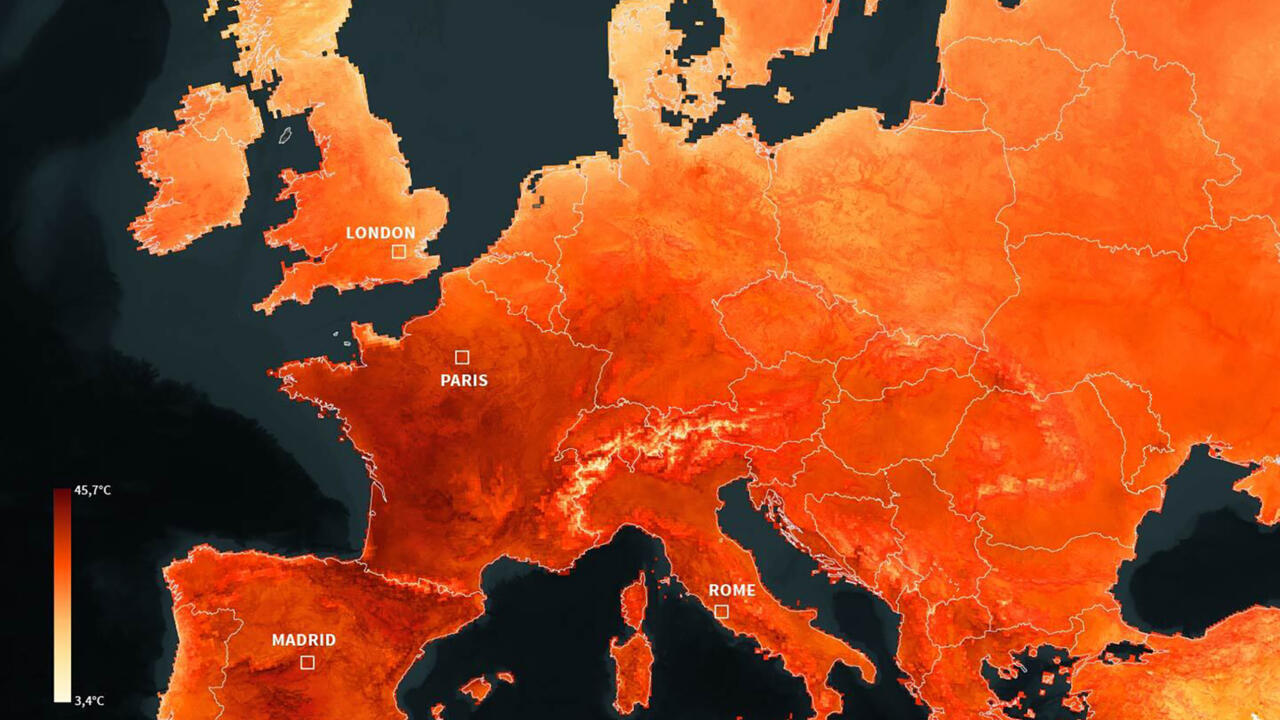
Europe’s deadly heat wave on Sunday pushed east with hundreds of millions still sweltering across the continent despite fleeting relief from overnight storms, notably in France and Belgium. The heat remained intense across central and eastern Europe, with the Czech Republic, Hungary and Poland hit hard as temperatures soared. At least 191 million Europeans were expected to face temperatures above 35°C during the day. The WHO said it had recorded more than 1,300 excess deaths in Europe since June 21. Overall, about 381 million Europeans were set to see temperatures exceed 30°C, analysis based on forecasts from the German Meteorological Service and population data showed.
A child jumps into the sea in front of the Maiden’s Tower in Istanbul, Turkey, on Sunday.
This heat wave is the most severe ever recorded in Europe, and would have been “virtually impossible” this early in the summer without climate change, the World Weather Attribution group of scientists said. All-time temperature records have been broken in Germany, Poland and the Czech Republic, as well as for the month of June in the UK and in Switzerland.
“Right now, 150 million people are living under extreme heat, hundreds have died, schools are shut, grids are buckling,” WHO Director-General Tedros Adhanom Ghebreyesus said on social media. “Europe is the fastest-warming continent on Earth, heating at twice the global average,” he said. Storms brought some respite overnight, particularly in France after several days of temperatures close to 40°C. However, they also caused damage, as a man died near Brussels when a tree fell on his car, local media reported. French authorities feared a rising death toll. The country’s national health agency on Sunday said that it had tallied about 1,000 more deaths than expected from Wednesday lats week, and warned the figure was likely to increase further. Many of those fatalities are among those aged 65 or more, it said. French Minister of the Interior Laurent Nunez rejected criticism from opposition deputies over the response, saying: “This is not a fiasco — we were prepared.” French Prime Minister Sebastien Lecornu has called a special Cabinet meeting to discuss how to learn the lessons from the recent heat waves and to prepare for the possibility of more, his office said. French weather agency France-Meteo said on Sunday evening that it was already anticipating the possibility of another heat wave next month. Temperatures soared above 40°C in several countries on Sunday as the heat wave shattered records across central and eastern Europe. Poland recorded a new all-time high of 40.5°C in the western town of Slubice, the Polish Institute of Meteorology and Water Management said. Poland’s long-distance rail operator PKP Intercity announced disruption to some of its services, with the public displays at Warsaw’s Central train station showing delays of more than four hours. Germany set a new national high of 41.7°C at Coschen, near the Polish border, surpassing a high set just a day earlier. The Berlin police used water cannons to help residents of the capital cool off for a second day running Sunday — this time at the Olympia venue where singer Bruno Mars was performing. One 32-year-old Berliner, Diane, said she had fainted from the heat once already, despite drinking 3 liters of water. The Czech Republic also broke records for a second consecutive day, with 41.1°C recorded in Doksany, north of Prague. That was later revised upwards to 41.9°C. The French National Center for Scientific Research (CNRS) said rising temperatures were clearly affecting marine life and biodiversity. Speaking from a beach at Wimereux in northern France, CNRS research director Gregory Beaugrand said that the warming of the English Channel was disrupting the food chain, as “fish that like cold waters are disappearing.” French paleoclimatologist Jean Jouzel told the Tribune newspaper he feared political attention would quickly shift once the heat wave ends. Urging people to heed scientific warnings, he said: “People are closing their eyes — but it is extremely serious.”