Freddy Kuo, Chairman of Luminys Systems Corporation and Special Office Executive Assistant at Foxlink.gettyAI video systems usually perform well in controlled demonstrations. Clean data, stable infrastructure and carefully tuned parameters can make an AI model look highly accurate before it ever reaches a real deployment. The problem starts when that system enters a physical environment.In physical security, computer vision systems need to interpret video and sensor data under changing light, weather, network and hardware conditions. Operators are not judging success by a lab accuracy score alone. They need systems that reduce false alerts, respond quickly, stay online and detect incidents reliably when conditions are messy. That is where many AI deployments break down.Why Performance Drops In Real EnvironmentsMany computer vision systems are trained using curated datasets captured under relatively controlled conditions. Real deployments introduce variables that are difficult to fully replicate during development.Lighting is one of the most common examples of this. An AI model that performs well during daylight may behave very differently at dusk, during heavy rain or under uneven artificial lighting. Reflections, shadows and motion blur can all reduce detection confidence.Weather creates additional complications. Outdoor systems must operate through fog, heat, snow, dust and vibration. These conditions affect both sensors and the quality of incoming data. Even small degradations can reduce model accuracy over time. Infrared (IR) technology commonly used in video cameras can also pose issues: Grayscale video lacks color, and the emitted IR light sometimes attracts bugs and insects that fly around, triggering false motion events.Connectivity also plays a larger role than many expect. Real-world infrastructure does not always provide the consistency of a controlled environment. Congested networks, intermittent outages or edge-device limitations can introduce delays that directly impact system responsiveness.Hardware constraints create additional trade-offs. AI models optimized for high-performance servers may not translate efficiently to edge devices with limited compute resources, power limits or thermal constraints. Teams I've worked with often discover that maintaining acceptable latency, power consumption and accuracy at the same time requires hard decisions.Real deployments introduce these variables every day. A camera placed near a loading dock may face direct afternoon sun, nighttime glare, vehicle headlights, rain, dust and constant motion. A system installed on a campus may need to manage changing crowd patterns throughout the day. A temporary deployment may need to operate with inconsistent power or limited connectivity.AI models have to be able to perform under all of these conditions from the start.Reliability Matters More Than Lab AccuracyOne of the biggest mistakes I've seen organizations make is treating AI model accuracy as the primary success metric. Accuracy matters, but once a system is deployed, reliability matters more.An AI system can perform at 98% accuracy in a test environment and still behave remarkably inconsistently in production. When alerts start to fluctuate unpredictably or systems require constant recalibration, teams often lose trust quickly. And that trust is extremely difficult to rebuild.In the lab, teams can prepare for this by using dependable operational performance over time as their North Star metric instead of accuracy. That performance should include consistent detection accuracy across changing environments, stable uptime under variable network conditions, predictable latency during peak usage, a reduction in false positives and unnecessary escalations, and a lower maintenance burden for operations teams.Scaling all of this successfully requires a measured approach. Instead of pursuing broad rollouts immediately, teams should validate performance in clearly defined environments first. They can establish baseline KPIs, measure operational impact and refine systems before expanding deployment. That discipline is often what separates sustainable AI deployments from expensive pilot programs that never mature.Edge Processing To Reduce FrictionOne practical way I've seen organizations address deployment variability is through increased edge intelligence. Processing data closer to where it is generated reduces dependence on constant cloud connectivity and allows systems to respond more consistently under constrained network conditions. In time-sensitive environments, even small reductions in latency can materially improve operational outcomes.However, edge processing is about resilience just as much as speed. When systems continue functioning during bandwidth degradation or temporary outages, operational continuity can improve. AI models deployed at the edge can also filter unnecessary data before transmission, which can reduce network load and improve scalability.For operators, the results often include faster alerts, lower bandwidth demand and more stable system performance during real-world disruptions.Edge processing doesn’t eliminate the need for careful deployment planning, though. Camera placement, power availability, environmental conditions and network design continue to be important decisions. That said, edge processing gives teams a stronger foundation for running AI in places where cloud-dependent AI models may struggle.Smaller Rollouts Create Better AI DeploymentsOrganizations often approach AI deployment as a large transformation effort. Teams that want to succeed should instead start with a clearly defined problem and measurable success criteria. They can identify one workflow where AI can improve outcomes, establish baseline metrics and validate results before expanding further.For example, an organization might start by using AI to reduce false alerts at a high-traffic entrance, improve after-hours detection in a restricted area or shorten review time for incident investigations. Those are measurable use cases. Teams can evaluate whether the system improves response time, reduces manual review or lowers the number of unnecessary escalations.This approach can reduce risk. It can also help organizations identify environmental variables early, before those issues scale across broader deployments.AI systems rarely fail for one reason. They fail when real-world conditions introduce complexity that teams did not fully account for during testing. The physical world is inconsistent. Lighting changes. Networks fluctuate. Hardware degrades. Human behavior remains unpredictable.Successful AI deployments should account for those realities from the beginning. They must start with operational outcomes, test under real conditions, measure reliability over time and scale only after the system proves it can hold up outside the lab.Forbes Technology Council is an invitation-only community for world-class CIOs, CTOs and technology executives. Do I qualify?
Why AI Models Break Outside The Lab
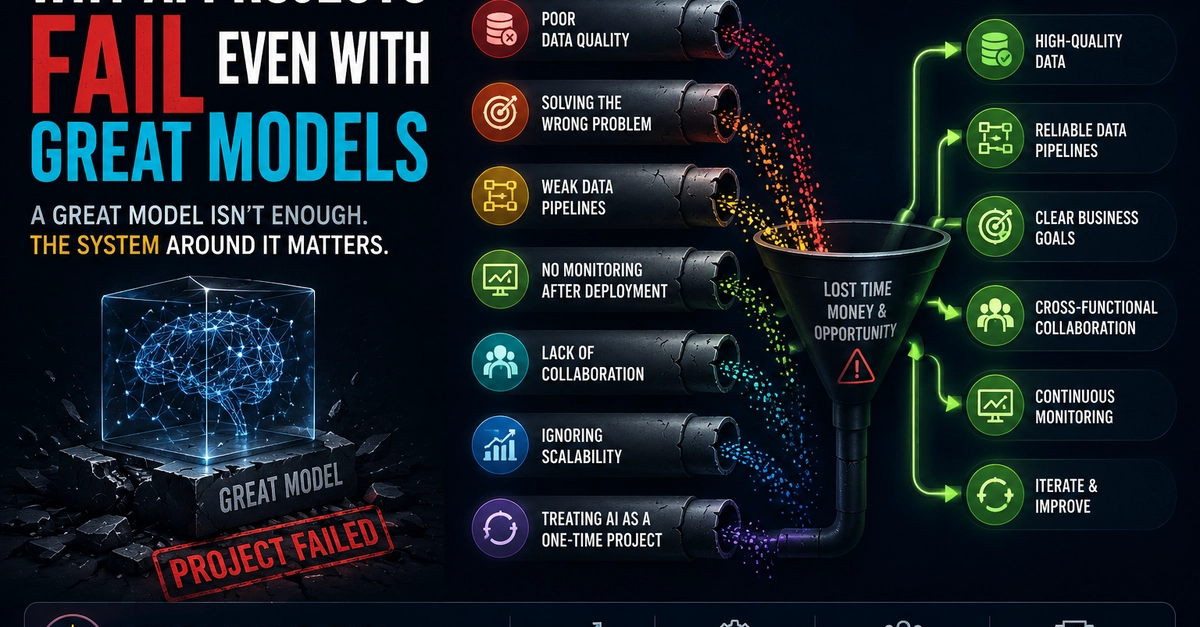
AI systems rarely fail for one reason; they fail when real-world conditions introduce complexity that teams did not fully account for during testing.
969 words~4 min read