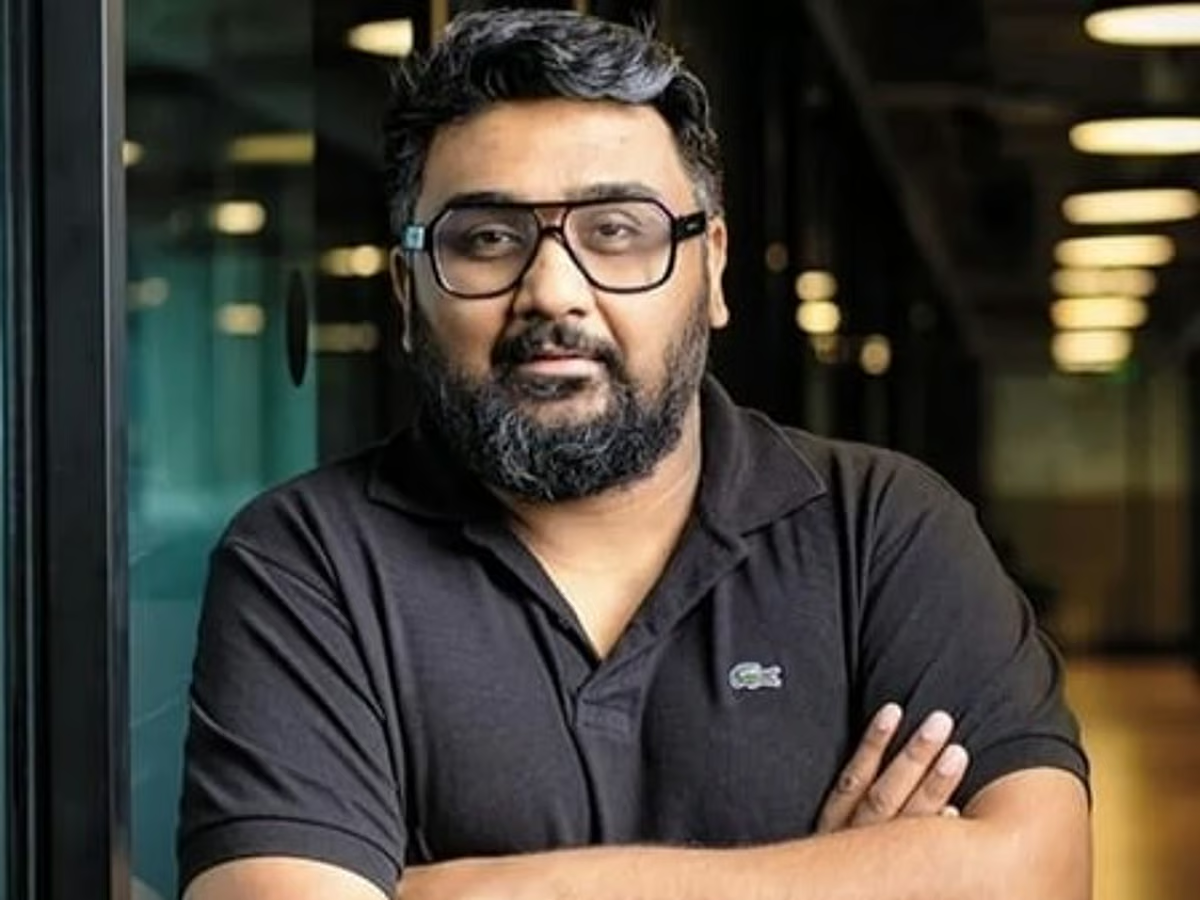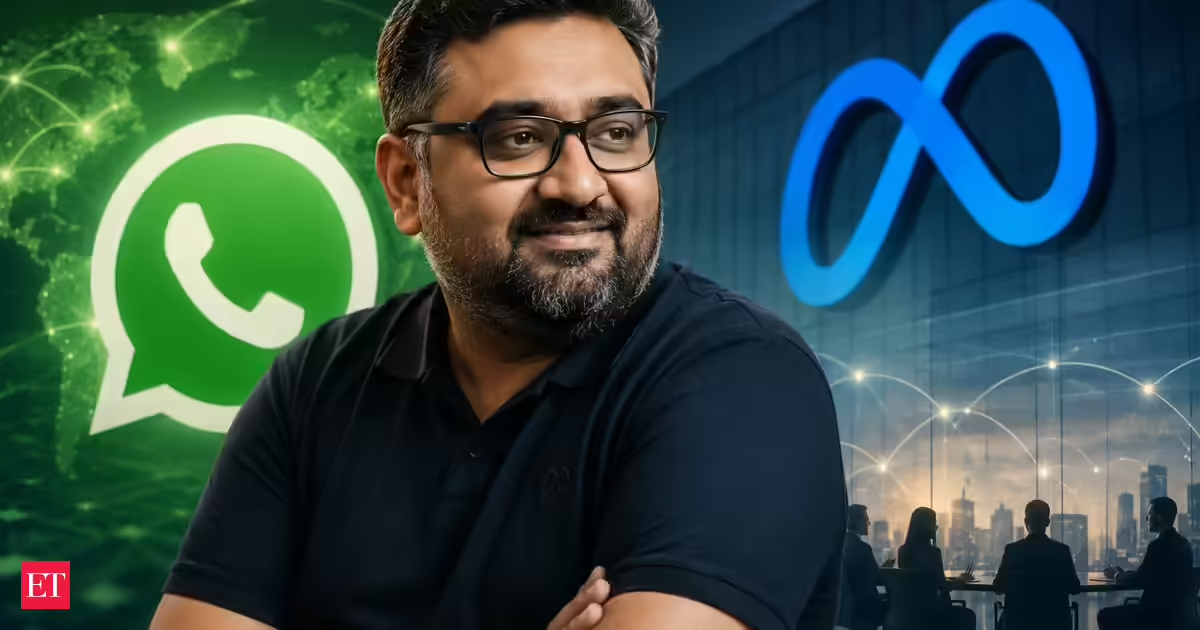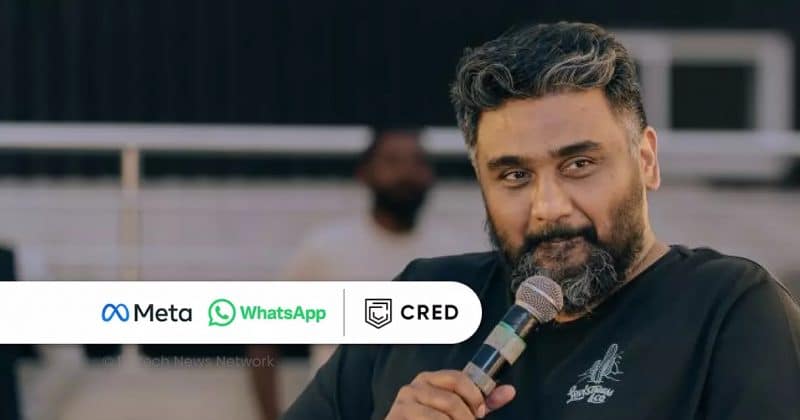
Kunal Shah runs WhatsApp now. The founder of CRED, and of FreeCharge before it, has taken the world's most-used messaging app off the hands of Will Cathcart, who spent seven years pushing it past three billion users. The handover came stapled to a cheque. Meta is putting roughly $900 million into CRED for about a fifth of the company, and in the same breath has made Shah the global head of its biggest property. Two stories run through that single sentence. One is a milestone: an Indian founder steering an app a third of the planet opens daily. The other is colder and more interesting. Meta has bought itself a payments brain to fix the one thing WhatsApp has tried and failed to do for years, which is turn conversation into commerce.Two corrections, since most accounts have fumbled both. Shah is the head of WhatsApp rather than its chief executive. The app sits inside Meta, where the role has always carried the title head of WhatsApp. And Meta has taken a minority position in CRED. It has put money in, rather than buying the company.Who Kunal Shah actually isStart with the exits, because they explain the confidence. Around 2010 Shah built FreeCharge, a mobile-recharge and payments service, and sold it to Snapdeal in a deal reported near $450 million. That was the warm-up. CRED, launched in 2018, is the company that made him a household name in Indian technology, and it began from an almost contrarian question: why should anyone reward people who already pay their bills on time? Shah's answer was a members' club for the financially responsible, wrapped in a premium, design-obsessed brand that treated a credit-card statement like a luxury good.CRED grew into something broader than rewards. CRED says it serves about 17 million monthly users, handles more than 40 per cent of India's credit-card bill payments, and manages over $2.5 billion in lending assets on behalf of partner lenders. It reported operating revenue of around Rs 2,735 crore for the 2025 financial year and says it has reached profitability. Outside CRED, Shah is one of the country's busiest angel investors, with early cheques in Razorpay, Gojek and a reported 250-plus other startups.He is also, unusually for a founder, known for how he thinks out loud. Shah's public output circles one idea above all others: trust is the scarcest asset in commerce, and a business that rewards it can compound. CRED is that thesis rendered as a company. The man and the logic are the same shape, which is exactly why Meta finds him interesting, and exactly where the risk hides.A clear-eyed account holds two facts together. Shah built a genuine brand and real transaction volume in a market where premium consumer products usually wither. He also ran CRED at a steep loss for years, drawing steady fire over whether paying people to settle their bills could ever be a durable model, and the company turned profitable only recently. Both things are true. A profile that prints only the first is a press release.How Meta ended up hiring its own adviserIt began as a favour. Chris Cox, Meta's chief product officer, emailed Shah cold in the spring of 2026, looking for advice rather than offering a job. Cox had been working the phones across India, Brazil and Mexico, markets where WhatsApp is plumbing rather than app, trying to define what the next leader of the product would need to be. Shah was one voice among many. He stayed one only briefly.What followed ran about three months: repeat visits to Meta's California campus, meetings with the leadership bench, a sit-down with Mark Zuckerberg, who later pointed to Shah's "builder mentality" as the clincher. Cox framed the appeal in a line worth keeping. Reading how WhatsApp works in a market like India, he said, is "almost like speaking a language," a fluency surveys rarely capture. By the end of it, the man brought in to help pick the leader had become the leader.Shah kept his own response dry. He wrote on X that the gap between WhatsApp today and its potential was "massive," and made a point of stressing that Meta arrives as a minority investor, with member data kept off-limits.The deal: a minority investmentLook closely, because the structure is built to read as one thing while doing another. Meta's roughly $900 million buys a stake of about 20 per cent and values CRED near $4.5 billion, up from $3.5 billion in 2025. Part of the money is fresh capital for CRED; part buys out earlier backers, with Peak XV, Coatue, DST Global, Alpha Wave, GIC and Tiger Global all trimming their holdings. Meta's stake comes free of a board seat, and CRED's customer data stays beyond its reach. Shah steps back from running the company while keeping his personal holding, and Miten Sampat, CRED's strategy and finance lead since 2020, takes the interim chief executive's chair as the firm points itself toward an eventual listing.The analyst Shanaka Anslem Perera gave the arrangement its sharpest label, calling it "an acqui-hire wearing a minority stake as a disguise." His point lands. Meta ran the same play in 2025 with Scale AI, writing a large cheque while recruiting the founder to run a new effort. Take a minority position, hire the founder, gain the talent and the proximity, and skip the regulatory bonfire that a full acquisition of an Indian fintech would light. For Shah, the practical upshot is tidy. He joins Meta outright, and CRED carries on under new hands.Why Meta wanted Shah, specificallyHere is the gap Meta has failed to close on its own. WhatsApp has about 500 million users in India and total saturation of the messaging habit, yet WhatsApp Pay has spent years as an also-ran, outrun by UPI apps that got the timing and the merchant relationships right. Distribution was always the easy part. Conversion was the wall. Shah has spent fifteen years building the exact muscle WhatsApp lacks, which is getting Indian consumers to move money inside an app they already trust for something else.From there, the logic widens. India is WhatsApp's largest and most strategically loaded market, and Meta decided it wanted that market understood from the inside rather than translated from Menlo Park. WhatsApp also throws off a thin slice of Meta's revenue next to Instagram and Facebook, even as the company hunts for income to cover an enormous AI bill. Meta wanted a builder to widen that slice, and Shah builds. Bringing an outsider's instincts into a leadership group stacked with company lifers was part of the appeal by design.What Shah could do with WhatsAppTreat everything that follows as scenario. All of it still lies ahead.Payments is the obvious first move, and the one most aligned with his record. WhatsApp Pay runs on India's UPI rails and remains underused, and Shah's CRED kit — rewards, trust mechanics, a credit layer, merchant relationships — maps almost cleanly onto the problem of converting a chat audience into a paying one. If anyone can coax Indians into treating WhatsApp as a wallet, his is the relevant CV.Against that sit constraints just as concrete, worth naming so the optimism stays honest. India's payments market is brutally competitive and barely earns a rupee on the consumer side, since UPI is largely free to use. It is also governed tightly by the Reserve Bank of India and the NPCI, whose market-share caps on any single UPI app set a hard ceiling on dominance. Reviving WhatsApp Pay is less a distribution challenge, which WhatsApp has solved, than a question of economics and regulation, where even Shah has limited leverage.Beyond payments sit the surfaces that already pay WhatsApp's way. Its real money today comes from the Business API, billed per 24-hour conversation window, and from click-to-WhatsApp ads, one of Meta's faster-growing formats. Deepening commerce and business messaging suits Shah's instincts as a consumer-product builder. Meta has also started placing ads in the Updates tab, beside Status and Channel recommendations rather than inside private chats, a boundary WhatsApp's Nikila Srinivasan has drawn firmly, alongside paid and promoted Channels and business subscriptions. Scaling that revenue while keeping users at ease becomes Shah's balancing act. Layered over all of it is AI, with WhatsApp serving as a primary home for Meta's assistants and for business agents that answer customers at scale.Read together, his strengths sit almost suspiciously well on top of Meta's wish list. Payments, commerce, the Indian consumer, the psychology of trust: that is both Shah's hand and Meta's roadmap.Shah's real test: trust against moneyThis is the contradiction the whole appointment turns on. WhatsApp's value rests on being the clean, private, unbothered inbox that billions treat as a utility. Shah's mandate is to make it earn more. The person hired to grow the revenue is therefore the person best positioned to spend down the trust that makes the revenue possible.The irony cuts deep, because for Shah trust runs deeper than a side interest. It is his entire operating thesis. CRED argued that rewarding good financial behaviour builds loyalty that compounds; WhatsApp will test whether that conviction holds when the brief flips from rewarding users to monetising them, at a scale of three billion. Early Indian commentary has already poked at a second doubt, summed up in a line that ran around the founder set: running WhatsApp, for all its prestige, "is still a job." Shah has only ever answered to himself. Whether a founder of his wiring settles into a senior seat inside Meta is a genuinely open question, and a fair one.The conflict, and the limit of the betTwo more things belong in any honest version. The first is a conflict worth watching. Meta now owns a fifth of CRED, and Shah keeps a personal stake in it while running a Meta product that operates in payments, CRED's home turf. The structure, free of a board seat and of data access, is plainly engineered to soften that. The optics, and any future brush between WhatsApp Pay and CRED's businesses, will still draw eyes, including from Indian regulators already alert to how foreign platforms expand into payments.A second point quietly punctures a lazy reading of the deal. Because Meta stays walled off from CRED's data, the value of the whole arrangement rests on Shah's judgement, rather than on bolting CRED's user information onto Meta's machine. This was Meta paying for a person and dressing the payment as an investment, rather than buying Indian fintech data through a side door. That is the distinction that should shape how the story gets told.Which leaves the question Meta is actually betting nine figures and its biggest app on: whether the man who built a company by rewarding trust can now charge rent on it, and leave the trust standing.Kunal Shah and WhatsApp FAQWho is Kunal Shah?He is an Indian entrepreneur and angel investor, founder of the fintech CRED and earlier of FreeCharge, which he sold to Snapdeal for a reported $450 million. He has backed Razorpay, Gojek and a reported 250-plus other startups.What is Kunal Shah's role at WhatsApp?He is the global head of WhatsApp, taking over from Will Cathcart. The job is head of WhatsApp rather than a separate chief executive post, though parts of the press have styled it "CEO."Did Meta buy CRED?Meta took a minority position rather than buying the company. It invested about $900 million for roughly 20 per cent, valuing CRED near $4.5 billion, with the stake structured to exclude a board seat and customer-data access.What happens to CRED now?Shah steps back from daily operations while keeping his stake. Miten Sampat, CRED's strategy and finance lead since 2020, becomes interim chief executive as the company heads toward a planned public listing.Why did Meta pick Kunal Shah?For his record building payments and consumer-finance products in India, WhatsApp's largest market, where Meta wants to turn the app's reach into payments, commerce and other revenue.How could Kunal Shah change WhatsApp?The likely focus areas are reviving WhatsApp Pay in India, growing business messaging and commerce, and scaling newer revenue such as ads in the Updates tab and Channels, while protecting user trust. These stay scenarios rather than confirmed plans.end of article
Kunal Shah Now Leads WhatsApp: What the CRED Founder Could Change
Meta paid about $900 million for a slice of CRED and walked away with its founder. The stake is the smaller story. The wager is whether one man's feel for payments, trust and the Indian wallet survives contact with three billion users.
2,027 words~9 min read