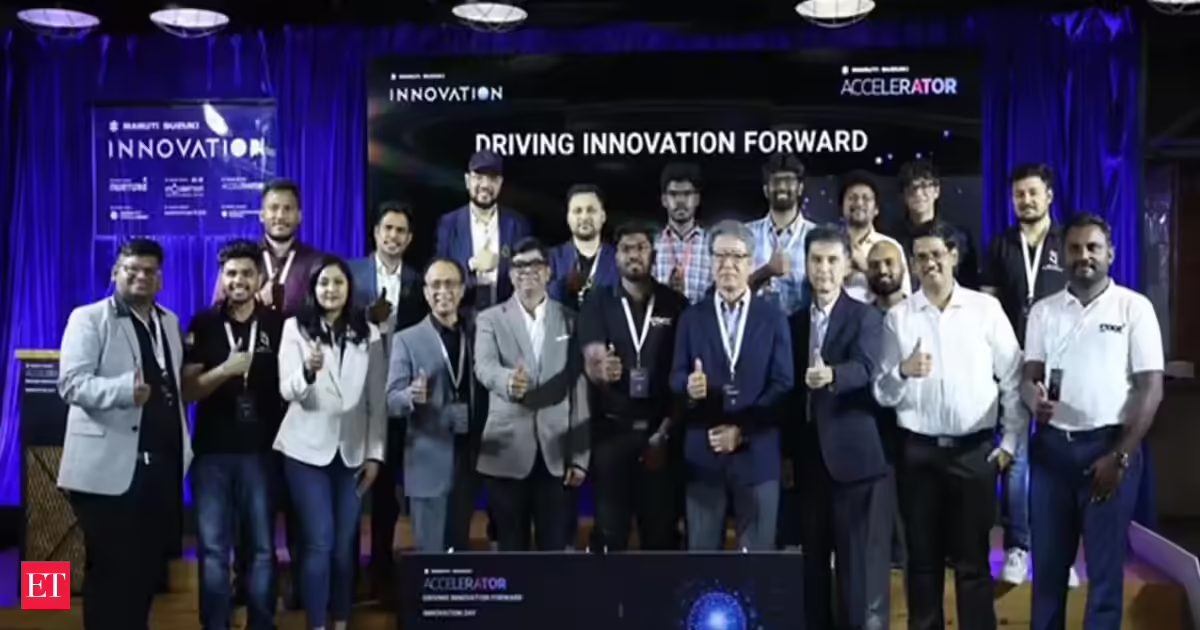
Photo credit: ackodrive.comMaruti Suzuki has partnered with five startups - MiniMines, Sarvam AI, Easework AI, Siftly and CodeMate AI - to push AI-led operations and the recycling of end-of-life electric-vehicle batteries, India's largest carmaker announced on 29 June. The five are the winning cohort of the company's Incubation Program, run with NSRCEL, the entrepreneurship hub at IIM Bangalore.On the surface, it reads like a routine corporate update: big manufacturer adopts startup software, issues a warm quote, moves on. Two of these names deserve a longer look. One is the company the Indian government chose to build the country's first sovereign large language model. The other tackles a problem Maruti is about to inherit at industrial scale - what becomes of an EV battery at the end of its life. Together they show a carmaker placing two structural bets at once: on an AI customer layer, and on the circular economy its own EVs will soon demand.Who are the five startups, and what does each one doEach startup has been handed a specific operational problem rather than a vague brief. The split is straightforward: one tackles batteries, the other four tackle software, customers and cost.StartupWhat it does for MarutiWhy it mattersMiniMinesRecycles end-of-life lithium-ion batteries and recovers critical metalsMaruti's EPR obligations as it enters the EV marketSarvam AIBuilds multilingual generative-AI agents for customer interactionIndia's chosen sovereign-LLM companyEasework AIAutomates indirect-procurement workflows with agentic AICost and cycle-time efficiency in purchasingSiftlyUses generative AI to lift brand visibilityMarketing reach and discoverabilityCodeMate AISpeeds development of internal business softwareEngineering throughputHisashi Takeuchi, managing director and chief executive, framed the spread plainly. He said MiniMines will "support us in safely recycling end-of-life batteries," while the other four help improve customer engagement and drive efficiency across operations. The phrasing splits the cohort cleanly into the green-compliance play and the productivity play.How Maruti's startup engine actually worksThe partnership runs through machinery Maruti has spent seven years building. The Incubation Program sits alongside an Accelerator, a Mobility Challenge, a pre-incubation track called Nurture, and a financing arm, FundRays - a funnel designed to move an idea from pitch to plant floor. The numbers describe its shape: across seven years, the company has screened around 7,400 startups, engaged more than 250, and onboarded 38 as business partners.The mechanics matter as much as the maths. Selected startups work on paid proof-of-concept projects inside real production, logistics and customer environments, rather than sealed-off pilots, with NSRCEL supplying mentorship and academic rigour. That structure lets Maruti audition frontier technology against live operations before committing, and lets early-stage founders pressure-test their product against the scale of a company that sells more cars in India than anyone else. For a manufacturer juggling stricter regulation, an expanding export book reaching close to 100 markets, and a first electric car, off-the-shelf tools rarely fit the brief. Co-creation fills the gap.Why Sarvam AI is the name that mattersOf the five, Sarvam AI is the headline. This is the Bengaluru company the government selected under the IndiaAI Mission to build India's first homegrown foundation model - picked first from a field of dozens of applicants, granted access to thousands of GPUs and sovereign compute. Founded in 2023 by Vivek Raghavan and Pratyush Kumar, both alumni of the AI4Bharat lab at IIT Madras, Sarvam raised roughly $41 million in seed and Series A funding in late 2023, led by Lightspeed with Peak XV and Khosla Ventures. In February 2026, it open-sourced two models, Sarvam 30B and Sarvam 105B, trained on Indian-language data and tuned for the country's 22 official languages.Place that against Maruti's actual problem and the fit becomes obvious. Maruti sells to a customer base that speaks dozens of languages and books service across thousands of workshops, call centres and apps. A generative-AI agent that handles a query in Bhojpuri or Tamil as fluently as in English, across every touchpoint, addresses a genuine operational pain rather than a demo. Sarvam's whole thesis is that AI for India needs purpose-built multilingual models rather than translated Western ones, and a mass-market carmaker is close to the ideal proving ground for it.Picture the concrete deployment. A Maruti owner in a tier-three town opens the service app and asks, in spoken Marathi, why a warning light is on, and gets a useful answer in the same language, faster than a call-centre queue. Multiply that across booking, finance queries, recalls and roadside help, and a multilingual agent stops being a novelty and starts shaving cost off a service network that spans the country. A discovery dimension rides alongside it: as shopping and search migrate toward AI answers, a brand fluent in those systems wins queries a static website would lose - the same shift Siftly is built to exploit on the marketing side.The deal cuts the other way too. India's sovereign-AI push has produced impressive models and a harder question: who actually deploys them at scale. Enterprise adoption is the missing rung, and a marquee customer of Maruti's size and visibility is precisely the validation the IndiaAI thesis has been waiting for. When the country's largest carmaker routes its customer interface through the government's chosen model-builder, the sovereign-AI story moves from the lab into the showroom.Why a battery recycler, and why nowThe MiniMines tie-up looks modest and reads as the most strategic of the five. MiniMines, founded in 2021 in Bengaluru by Arvind Bhardwaj and chief executive Anupam Kumar, runs a proprietary hybrid-hydrometallurgy process that pulls lithium, cobalt, nickel and manganese out of dead lithium-ion batteries. The company describes its method as far cleaner than the incumbents - roughly 75 per cent more energy efficient and 95 per cent more water efficient than conventional recycling, with recovery rates above 96 per cent. It bills itself as India's pioneering R4-category recycler and offers Extended Producer Responsibility services, the exact obligation an EV maker now carries by law.That law is the reason the timing reads as deliberate. Under India's Battery Waste Management Rules, every producer that puts a battery on the market - EV makers included - must collect and recycle it at end of life. The targets climb fast: recovery of EV battery material rises toward 90 per cent by 2026-27, producers must ensure 70 per cent collection by 2027-28, and from 2027-28 a slice of every new battery must use domestically recycled material, scaling to 20 per cent by 2030-31. Miss those marks and the penalty arrives as environmental compensation, calculated on the cost of the recycling left undone.Now layer in Maruti's own EV. The e Vitara, the company's first electric car, runs on 49kWh and 61kWh lithium iron-phosphate packs imported whole from China's BYD, built on a platform Suzuki developed with Toyota. Those LFP packs yield mainly lithium on recycling rather than the cobalt and nickel of older chemistries, yet the recovery problem and the compliance clock are identical. As Maruti puts EVs on Indian roads, it takes on a battery-waste liability that barely existed for a petrol-only fleet - and it does so while India faces a structural mismatch, with an estimated 150 kilotonnes of lithium-ion battery waste expected by 2030 against current recycling capacity below 2,000 tonnes a year.One detail sharpens the logic. Maruti sells the e Vitara with a Battery-as-a-Service option, where the buyer leases the pack and pays by the kilometre while the company keeps ownership of the battery itself. Under that model, the dead battery returns to Maruti by design, which turns the end-of-life pack from someone else's waste into Maruti's own asset and Maruti's own liability - and a recycling partner becomes the obvious way to close that loop.The supply-chain stakes sit higher still. India imports the overwhelming share of the lithium, cobalt and nickel its battery ambitions rely on, much of it routed through China, and the e Vitara's packs arrive from BYD as finished units. The National Critical Minerals Mission exists to blunt that exposure, and domestic recycling counts among its few near-term levers - every kilogram of lithium recovered on Indian soil is a kilogram the country avoids importing. For Maruti, a recycler like MiniMines doubles as a hedge against the same kind of supply shock that has lately rattled the wider electronics industry.The strategic read writes itself. A homegrown recycler that recovers battery-grade lithium on Indian soil helps Maruti meet EPR targets, prepares it for the recycled-content mandate landing in 2027-28, and trims its dependence on imported critical minerals at a time when that supply chain runs largely through China. Battery recycling here is compliance, supply-chain insurance and circular-economy positioning rolled into one. Calling it a green gesture undersells it.The other three: the efficiency layerThe remaining trio is quieter and aimed squarely at the back office. Easework AI applies agentic AI to automate procurement of indirect consumables, the unglamorous spend that clogs any large manufacturer's purchasing function. Siftly uses generative AI to lift brand visibility, a marketing-discoverability play in an era where search itself is being rewritten by AI answers. CodeMate AI shortens the build time for the internal software Maruti's business teams rely on. None of the three will make headlines on its own. Stacked together, they describe a company trying to wring cost and speed out of operations that scale across millions of cars and hundreds of markets.What this means - for Maruti, for the startups, and for IndiaStep back, and the cohort tells a coherent story. Maruti is hedging two bets that sit at opposite ends of its business. The AI layer - Sarvam, Easework, Siftly, CodeMate - targets the cost and experience of selling and servicing cars today. The MiniMines layer targets the obligations and economics of the electric cars it sells tomorrow. One play defends margins in the present; the other buys insurance on the future.For the startups, the prize is the proving ground. A paid project inside India's largest automaker turns a promising pilot into a reference customer, and a reference customer of that stature reshapes a young company's fortunes. For Sarvam in particular, the partnership is a data point the entire sovereign-AI programme can point to - proof that an Indian foundation model can win enterprise work against global incumbents on home turf.A customer this large cuts both ways, though. A Maruti contract can make a startup's year and define its reputation, yet leaning on a single giant for revenue and validation carries its own risk: priorities shift, pilots stall, and a founder can find a quarter's roadmap rewritten by one client's procurement calendar. The healthiest outcome treats the Maruti badge as a credential to win the next ten customers rather than a destination in itself. Sarvam, already backed by the state and by marquee venture investors, can absorb that dynamic comfortably; a thinner-funded name in the cohort has more riding on the relationship holding.For the wider ecosystem, the move fits a pattern. India's biggest manufacturers have turned open innovation into a recruiting tool, opening their factories and customer operations to outside founders rather than confining R&D to internal labs. Tata, Mahindra and Hyundai run their own variants of the same idea, and the competition to absorb the sharpest startups has quietly become its own contest. Maruti's seven-year head start and its 38 onboarded partners give it a deep bench, and each fresh cohort widens the lead.The cadence underlines the intent. This is the fifth Incubation Program cohort, and earlier 2026 intakes leaned the same way - a January batch brought in AI visual inspection, extended-reality validation and EV-logistics startups, while a spring Accelerator group added material-traceability and circular-economy specialists. AI and circularity keep recurring across cohorts, which marks them as a standing thesis rather than a single season's theme.There is a national-capability thread running underneath all of it. Sarvam advances the sovereign-AI agenda; MiniMines advances the critical-minerals and circular-economy agenda that the country's battery ambitions depend on. A single carmaker's procurement decision quietly props up two of India's most strategic technology bets at once.The sceptic's readA fair-minded counter deserves airing. Much of this remains proof-of-concept work, and the distance between a successful pilot and a deployed, profitable system is where many corporate-startup partnerships quietly expire. Press releases announcing collaboration are cheap; the test is whether these tools survive contact with Maruti's scale and show up in a customer's experience or a balance sheet. Owners who wait days for a simple service fix will judge an AI agent by whether the workshop improves, leaving the model behind it beside the point.The battery economics invite scrutiny too. Recycling LFP chemistry recovers lower-value materials than nickel-rich packs, and the margins in Indian battery recycling stay thin while volumes remain small. The 2030 waste wave is real, yet the revenue today is modest, and a single carmaker's first EV generates few dead batteries for years. The strategic logic is sound. The near-term payoff is patient money. Both things hold at once.What to watchThe signal to track is deployment rather than announcement. Watch whether Sarvam's agents reach Maruti's actual service and sales channels, and in how many languages, and watch whether the MiniMines arrangement scales from a recycling pilot into the EPR backbone Maruti will need as e Vitara volumes grow and the recycled-content mandate bites in 2027-28. The cohort that looked like a routine corporate update is, on a closer read, a map of where India's largest carmaker thinks the next decade of risk and advantage actually sits.end of article
Why Maruti Suzuki Backed 5 Startups for AI Operations and Battery Recycling
Maruti Suzuki has partnered with five startups - MiniMines, Sarvam AI, Easework AI, Siftly and CodeMate AI - to push AI-led operations and the recycling of end-of-life electric-vehicle batteries, India's largest carmaker announced on 29 June. The five are the winning cohort of the company's Incubation Program, run with NSRCEL, the entrepreneurship hub at IIM Bangalore.On the surface, it reads like a routine corporate update: big manufacturer adopts startup software, issues a warm quote, moves on.
2,217 words~10 min read