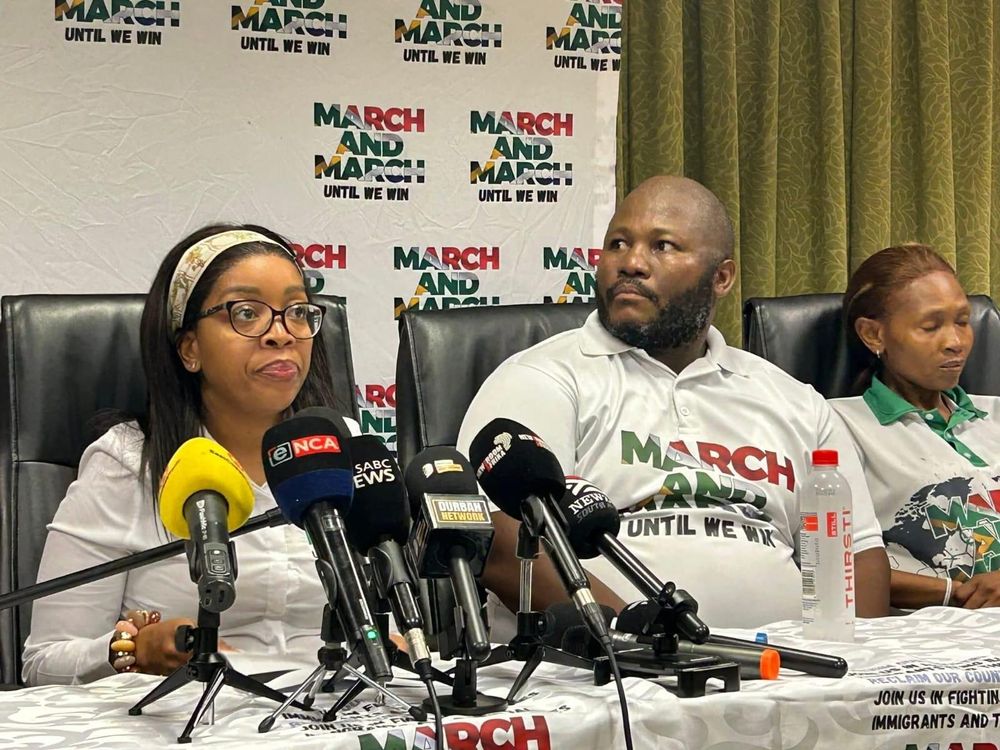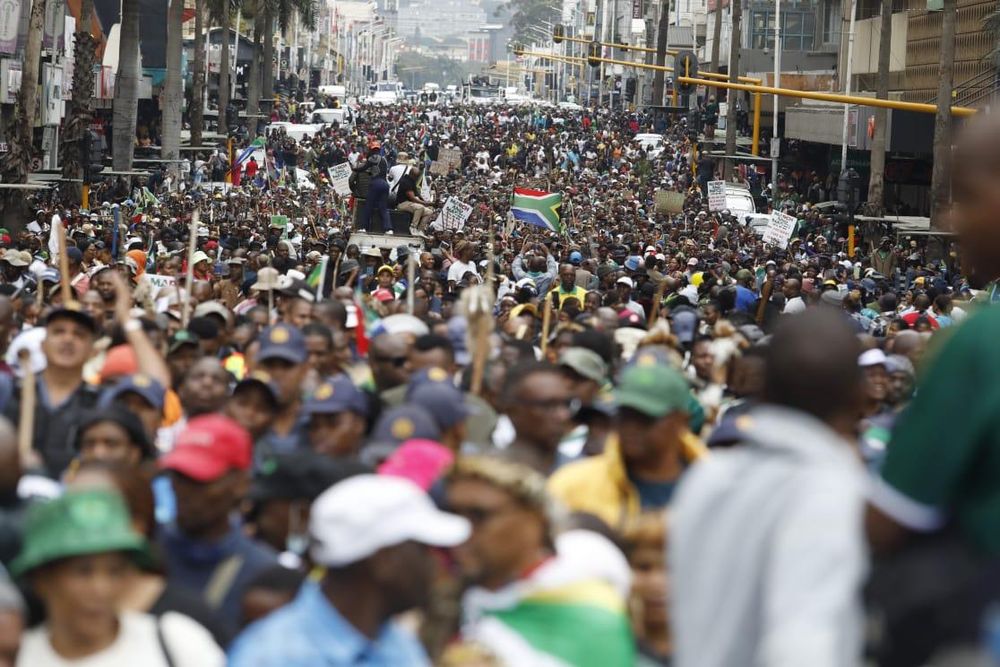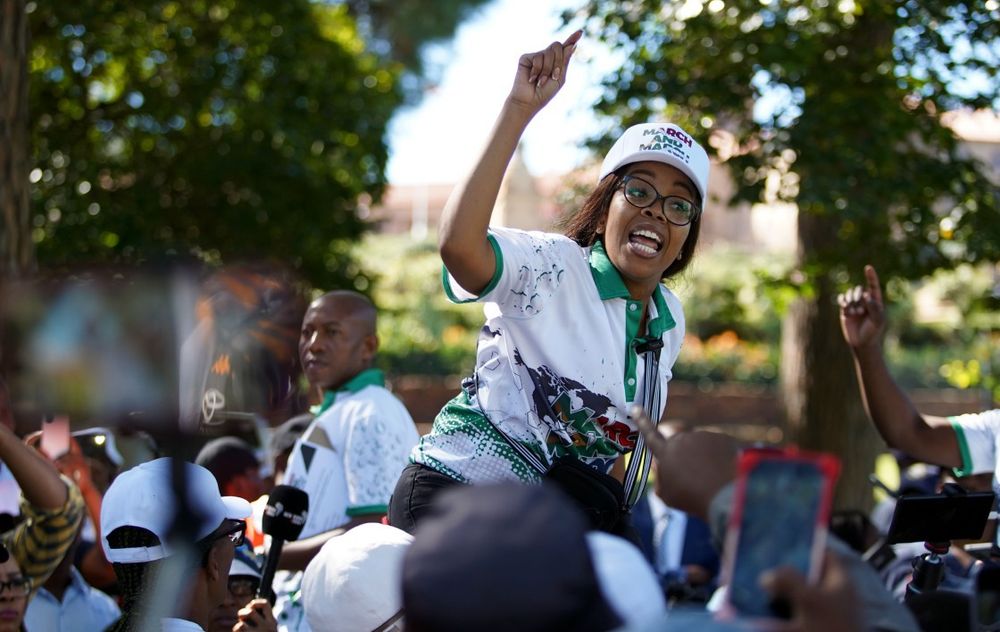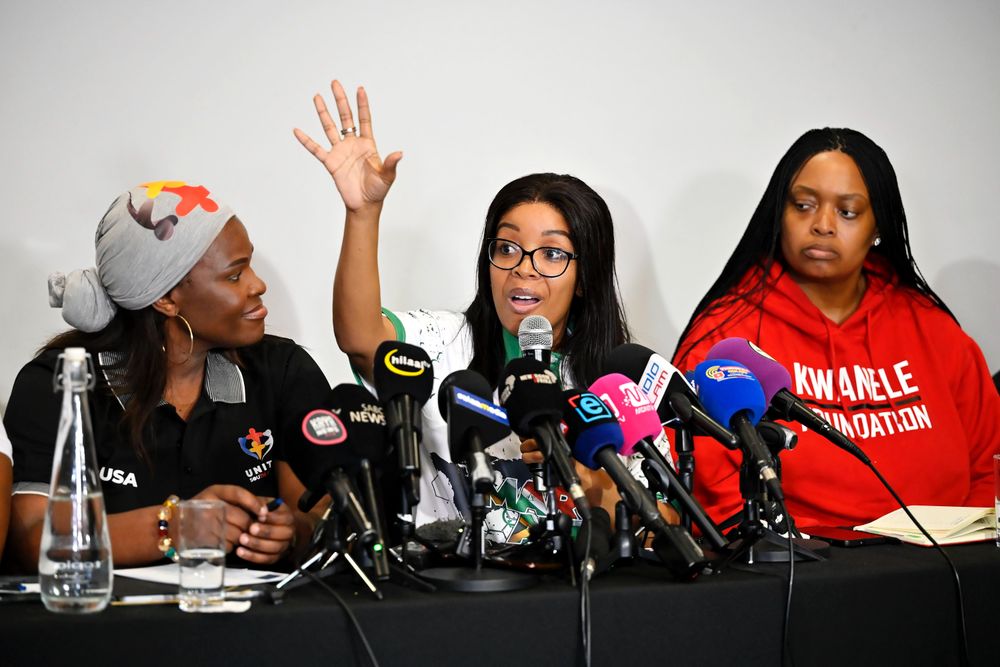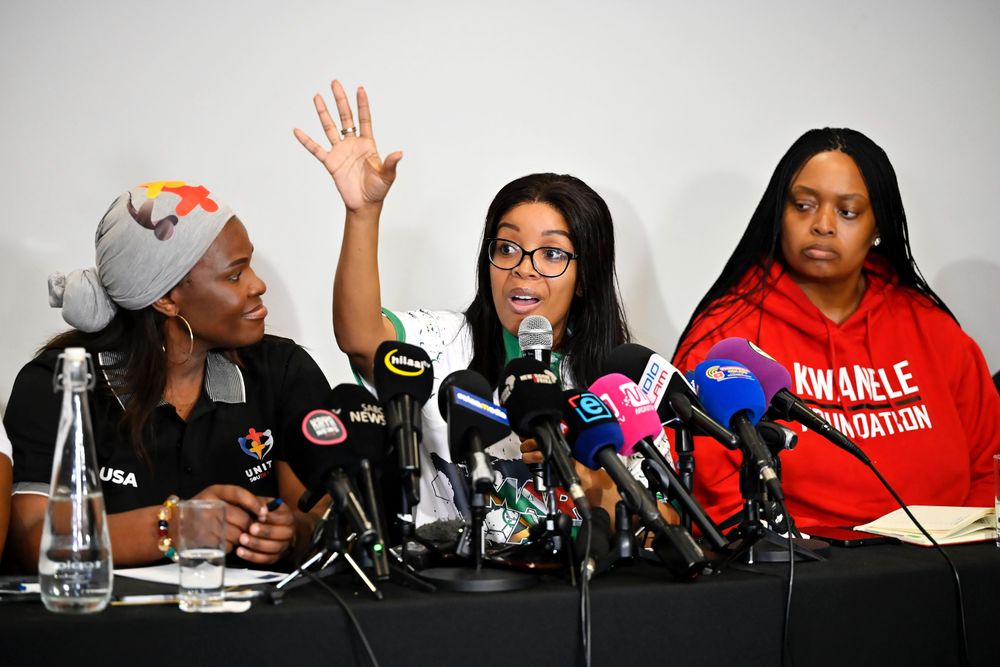
For more than a year, March and March has largely been reported in the media as a “civil society organisation” or “civic group” raising “legitimate concerns” about migration. Its leader Jacinta Ngobese-Zuma has often been treated as a celebrity and credible political actor in media interviews.March and March is neither a “civil society organisation” nor a “civic group”. Its demands for mass deportations are directly at odds with our constitutional order, and the blockades it organises against hospitals and schools are criminal acts, as is the street thuggery for which it is notorious.Of course peaceful protest is a constitutionally protected right, and no-one should be in a country illegally. March and March has not been systematically held accountable for its false claims and dangerous myth-making, the threats of violence and murder regularly made by its supporters or the violence, including at least one murder, that has accompanied its marches.This is a fundamental mistake.Calling different kinds of politics by the same name obscures what is actually happening. The distinction between a genuine civic organisation and an organisation engaging in open intimidation is one of the essential distinctions on which constitutional democracy depends. Trade unions, churches, neighbourhood associations and genuine social movements seek to persuade, organise and mobilise. Organisations that rely on threats, coercion and the systematic targeting of vulnerable minorities are a fundamentally different kind of politics. Treating them as simply another voice in civil society grants legitimacy to methods and politics that are fundamentally at odds with constitutional democracy.March and March is a classic “astroturfed” pseudo-social movement created from above with celebrity leaders, slick marketing and a paid-for social media campaign. For months the obvious question of who was funding March and March, and why, was left unasked. Now that the question is being asked, it has not yet been satisfactorily answered, though there is clear evidence of links to traditional authority, extortion networks and the milieu in and around Jacob Zuma’s MK party.Astroturf organisations manufacture the appearance of spontaneous public mobilisation while concealing the interests that organise, finance and ultimately benefit from that mobilisation. Their purpose is not only to influence public opinion but also to shift the political centre of gravity, making previously extreme positions appear ordinary and legitimate. Once that happens, established parties begin adapting themselves to the new political terrain rather than challenging it. South Africa has already travelled some distance down this path. The political question is no longer whether xenophobia will shape mainstream politics. It already does. The question is whether democratic politics will contest this or continue to accommodate it.While March and March has attracted the support of Herman Mashaba, a populist politician, and his ActionSA party, which also supports Operation Dudula, it is deeply aligned to a dangerous resurgence of the kind of Zulu nationalism that led to a civil war in KwaZulu-Natal in the late 1980s and early 1990s. Just like in the period of Inkatha’s violence, the amabutho have been called out of the hostels, and it has been made clear to Tsonga and Mpondo people that they can only expect, at best, a second-class citizenship in Durban. Some Indian people fear they will be next.Both the IFP and the MK party have publicly associated themselves with March and March and its Zulu nationalism, but it is the MK party that is so entangled with March and March that some analysts consider it a front organisation for the party.The ANC and the state have failed to engage effectively with March and March and have seemed to think pandering to it would take the wind out of its sails. This is how Keir Starmer responded to Nigel Farage and Reform in the UK with the same results. Pandering to the far-right only legitimates it.This strategy has become familiar internationally. Faced with growing support for the far-right, established parties often conclude they can neutralise it by adopting some of its language and some of its policy agenda. The assumption is that voters attracted to anti-migrant politics will return once their concerns appear to have been recognised. Time and again that calculation has proved mistaken. Rather than marginalising the far-right, accommodating it legitimises its central claims and shifts the boundaries of acceptable public debate.Across Europe, established parties have repeatedly assumed borrowing elements of the far-right’s language on migration would weaken it. The opposite invariably frequently happens. When mainstream politicians accept the central premise of the far-right — that migrants are chiefly responsible for social and economic decline — they strengthen rather than diminish the movements that first advanced those claims. Voters looking for that political stance generally prefer the original to the imitation.In the UK, Jeremy Corbyn and Zack Polanski have shown how to deal with far-right mobilisation around migration. Mayor Zohran Mamdani has done the same in New York City. The strategy is clear. First, the myths of the far-right must be directly contested. Second, people must be offered an inclusive vision of social progress.Today the country’s attention is on what may or may not happen tomorrow. This is unsurprising. Many of the same actors who were involved in the 2021 riots, including the extortion networks and March and March leader Nkosikhona Ndabandaba, popularly known as “Phakel’ umthakathi”, are involved.We don’t know what will happen tomorrow, and perhaps the R600m that acting police minister Firoz Cachalia has allocated to a policing strategy will be effective. There are signs some actors are scaling back their rhetoric in advance of the “deadline” for migrants to leave, and the Zulu king has significantly moderated his discourse. The March and March leaders will probably want to avoid a confrontation.The question that is not being asked in the media, though, is what happens after tomorrow. The MK party is set to be the biggest winner in the local government elections across KwaZulu-Natal and will rule many of the municipalities across the province. It may also play a part in a coalition with the ANC’s own right-wing populists in Johannesburg and Ekurhuleni.What happens if organisations built around ethnic mobilisation become embedded within local government? Municipalities control procurement, housing, land use, informal trading and many of the everyday points at which citizens encounter the state. If political authority and vigilante networks begin to overlap, constitutional rights can be eroded long before they are formally abolished. Selective policing, intimidation and discrimination can become routine administrative practice rather than exceptional acts of violence.What happens when a party directly opposed to the values of the constitution, linked to extortion networks, brazenly organised around ethnic politics and arguably running a front organisation that has become notorious for unlawful actions and protests accompanied by thuggery and, in at least one case, a murder, begins exercising municipal power? How will MK party local governments and associated networks be policed by national government? Will KwaZulu-Natal effectively become a province outside the constitutional order? That is the question that will remain long after June 30 has passed.Dr Buccus is a senior research associate at ASRi and at the University of Johannesburg.Business Day
IMRAAN BUCCUS | What happens after tomorrow’s ‘deadline’?
Rise of March and March signals new threats to constitutional democracy
1,165 words~5 min read