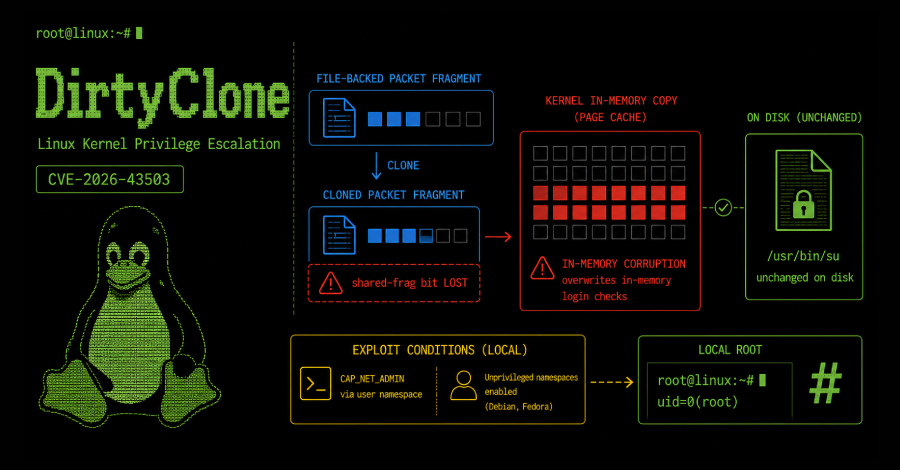
JFrog has published technical details and a proof of concept (PoC) targeting a recent high-severity Linux kernel vulnerability that could allow any local user to gain root privileges.
Tracked as CVE-2026-43503 (CVSS score of 8.8) and referred to as DirtyClone, the local privilege escalation bug was resolved on May 24, shortly after being reported to the Linux kernel maintainers.
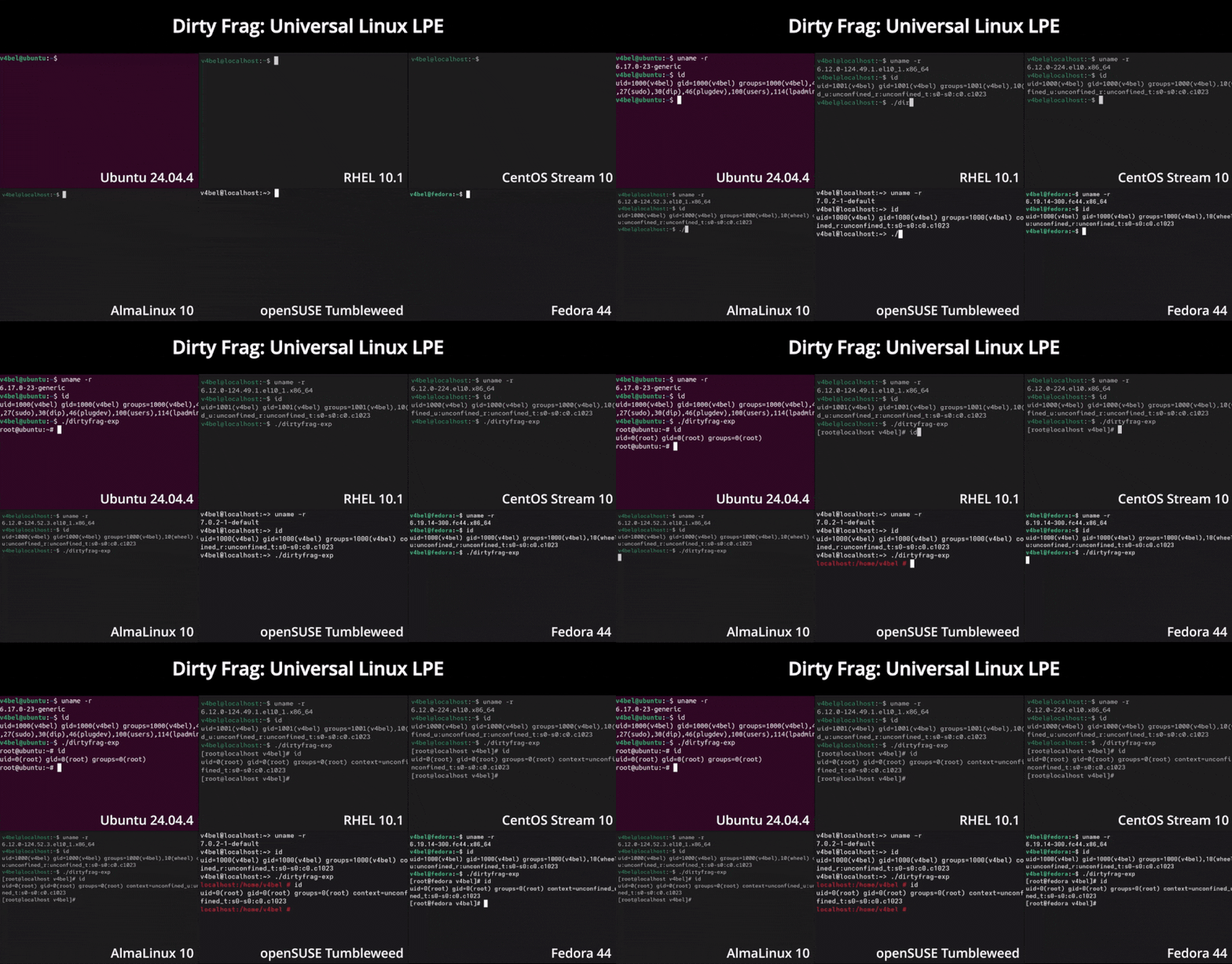
Now, JFrog explains that the flaw is a variant of DirtyFrag (also known as Copy Fail 2) and Fragnesia, which were addressed in mid-May. They share similarities with Dirty Pipe, a Linux kernel defect disclosed in 2022.
These memory corruption security defects affecting the Linux kernel’s core networking stack are rooted in how socket buffers (skb) reference shared page-cache memory, and can be weaponized using in-place cryptographic transformations in various subsystems.
The flaws demonstrate “a broader exploitation pattern affecting multiple skb (socket buffer) processing paths, showing that the underlying attack primitive is not limited to a single vulnerable code path”, JFrog says.