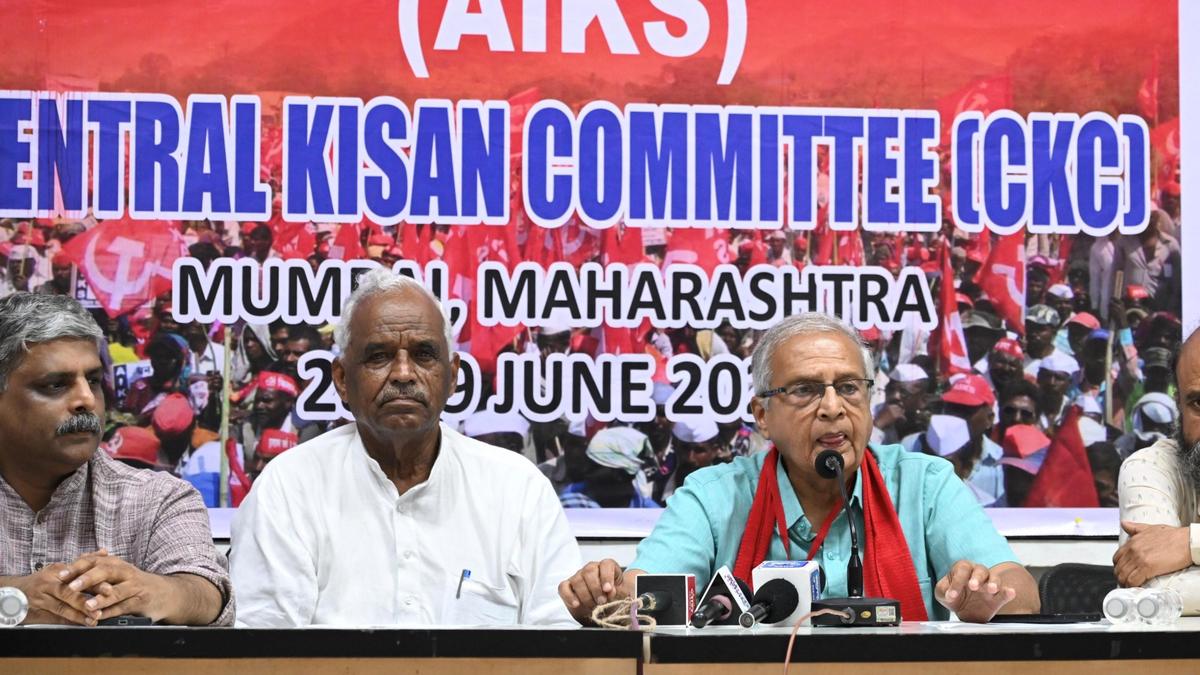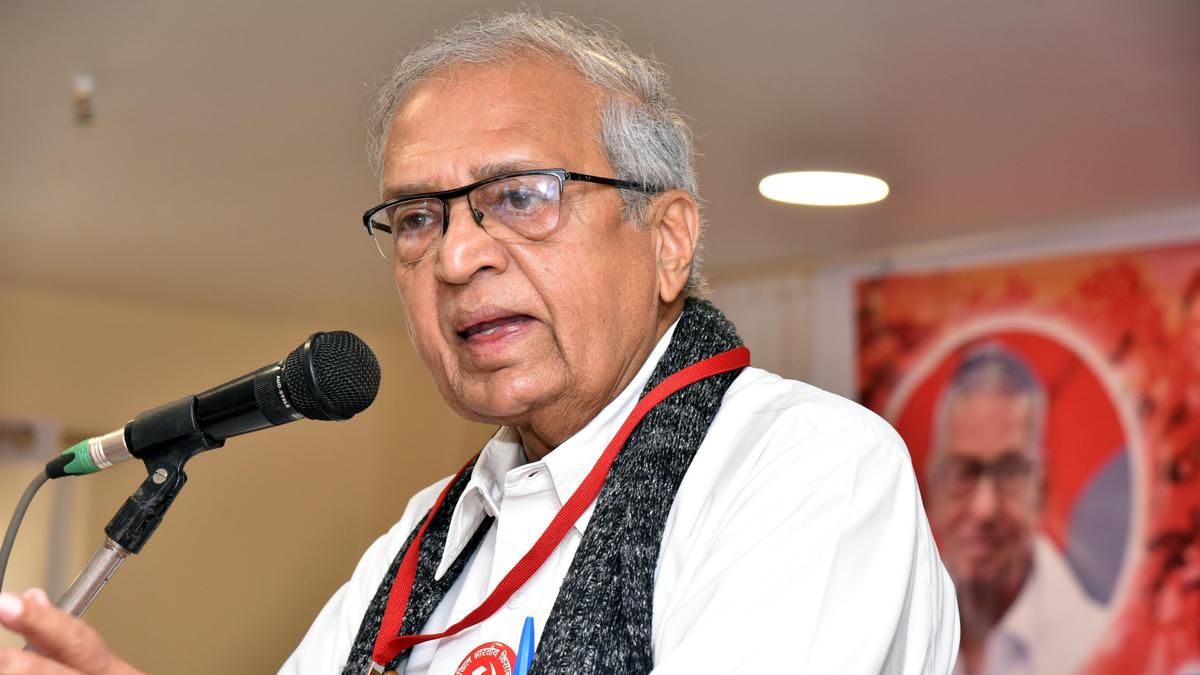
India-U.S. Free Trade Agreements (FTA), MSP for kharif 2026, increasing farm distress and suicides, and diversion of rice for ethanol production were a few of the issues highlighted during the meeting of the All India Kisan Sabha (AIKS)’s Central Kisan Committee (CKC) on Sunday (June 29, 2026).“The policies of the Prime Minister Narendra Modi-led government have intensified the attacks of a pro-imperialist corporate-communal regime affecting farmers. The decisions of the government are anti-government and need to be opposed,” AIKS president Ashok Dhawale said.Also Read: Why has India-U.S. trade deal been delayed? | ExplainedHe called the India-U.S. FTA and the India-New Zealand FTA a red carpet for imperialism, with the government surrendering the interests of farmers before the demands of global finance.“The allocation for the Common Agricultural Programme is the largest item on the EU Budget - it was around 38% of the total expenditure between 2014 and 2020, totalling 408.31 billion euros (₹43.8 lakh crores); the amount earmarked for 2021 to 2027 is about 387 billion euros (₹41.5 lakh crores) or 31% of the total budget. In India, the latest Union Budget saw ₹1.37 lakh crores, merely 2.7% of the Budget being allocated to Agriculture and Allied Sectors,” Mr. Dhawale said in his address to the members of AIKS from across the country, who attended the CKC meeting.Explaining the U.S. subsidies and FTA, he pointed out that Indian farmers, with rapidly depleting state support, will be put in direct competition with highly subsidised, wealthy farmers and agribusinesses from the U.S.“U.S. Federal Government pay-outs for farm programmes in 2026 are forecasted at $44.3 billion (₹4,02,132 crores) for about 18.65 lakh farmers. This would imply per capita subsidies of $23,753, or about ₹21,56,000,” the general meeting document of AIKS stated.“In India, farm subsidies amount to about $57.5 billion (around 5 lakh crores), and there are about 14.6 crore farmers (146 million). The per capita subsidy for an Indian farmer will be around $373, or about ₹34,000. The average farm size in the USA is 469 acres. In the USA, ‘Small Farms’ with less than $3,50,000 or around ₹3.18 crores in gross cash farm income represent about 85% of all operations. In India, the average farm size is about 2.67 acres. 86% farmers own less than 5 acres of land, earning less than ₹1,64,000 or about $1807, taking the Government claims to be true,” it said.1.33 crore members are associated with AIKS spanning across 29 States. AIKS, the peasant and farmers’ organisation, was established in 1936 by Swami Sahajanand Saraswati, working on agricultural reforms, fair crop prices, and land redistribution. AIKS holds such a meeting every six months and discusses the strategy on agricultural issues pertaining to government policies.Slew of accusationsCiting the example of Nicobar Island, Mr. Dhawale accused the Union Government of land grab for facilitating corporate accumulation and claimed that India is witnessing 1,095 ongoing land conflicts, affecting nearly 1.42 crore people and covering 47.7 lakh hectares of land.“Over the last year, we have recorded nearly 300 cases of land acquisition, eviction, demolition, forest diversion and displacement-related conflicts. Bulldozer-led eviction drives across states have displaced thousands of families across India. ‘Anti-encroachment’ has become a language to erase the poor, landless, forest dwellers, minorities, informal workers and communities with long-standing ties to land,” he said.The proposed Great Nicobar mega project includes a trans-shipment port, airport, township and allied infrastructure, requiring diversion of more than 130 sq. km of rainforest and Tribal Reserve land.In the last decade, over a lakh farmers ended their lives, with major reasons being unable to pay loans or get loans from the government and climate change. “We need to create a movement to address the problem,” Comrade Dr. Tapti Mukhopadhya said at the meeting.According to the AIKS, India’s ethanol-blended petrol programme aims to use excess rice stocks of the Food Corporation of India (FCI) for ethanol production at a reduced reserve price with the target to produce over 1,000 crore litres of ethanol annually, up from around 545 crore litres in 2023-24.The year 2025 saw two upward revisions in the quantity ceiling for shifting rice to ethanol, first from the original 24 lakh metric tonnes (LMT) to 54 LMT and now finally 72 LMT in November.“The first alarming point is that the FCI rice has been supplied to private distilleries for ethanol production at prices significantly lower than those charged to state governments for food distribution programmes. Secondly, India’s grain surplus – particularly in wheat and rice – is a structural feature, rather than an anomaly, with FCI stocks consistently breaching buffer norms,” as per the AIKS.Assistance for overcoming suicidal thoughts is available on these 24x7 helplines: KIRAN 1800-599-0019, Aasra 9820466726Those in distress or having suicidal tendencies could seek help and counselling by calling the numbers provided in this link.
AIKS meet focuses on India-U.S. FTA, rice-ethanol blending, and farmer deaths
AIKS meeting addresses India-U.S. FTA, rice ethanol blending, and rising farmer suicides amid increasing agricultural distress.
792 words~4 min read