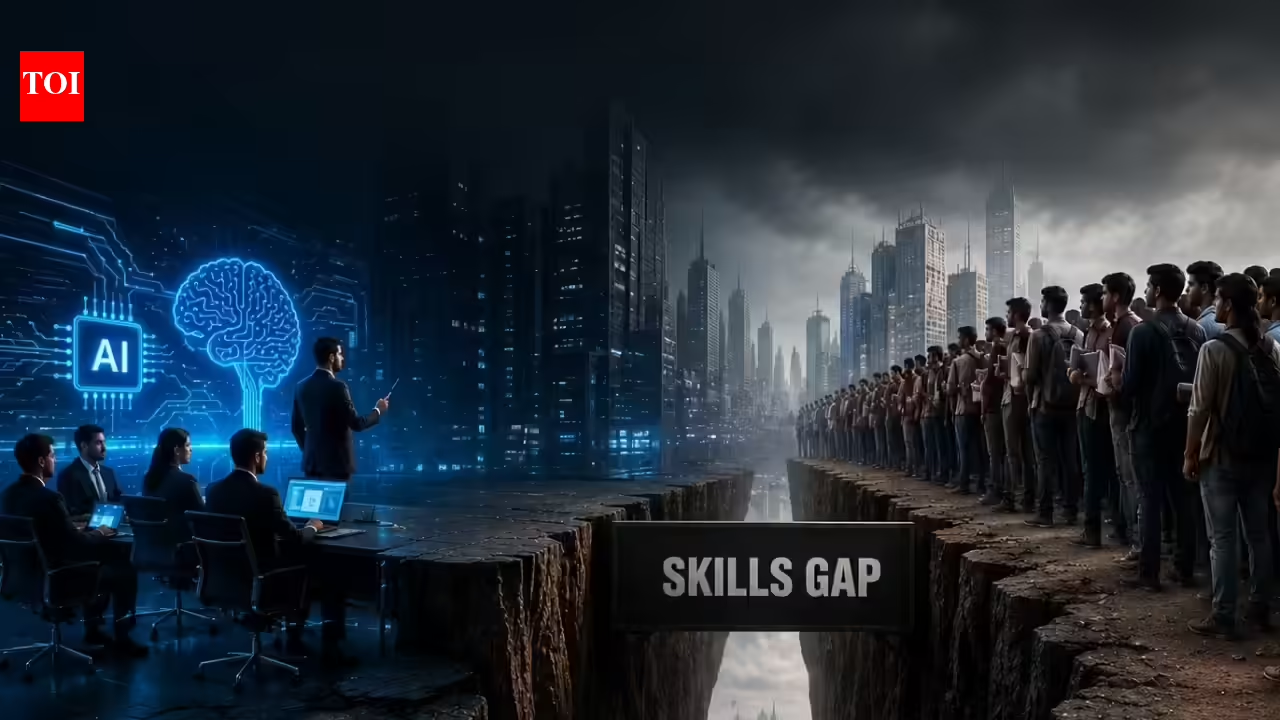
A high-AIQ organisation treats workforce AI capability as a strategic asset to be built. (AI image)In 2024, India had approximately 420,000 AI professionals. The immediate industry requirement was 600,000, representing a talent shortfall of close to 50 per cent. By 2026, a joint report by NASSCOM and McKinsey & Company projected this gap would exceed 1.4 million AI professionals if the pace of upskilling was not dramatically accelerated.This is not primarily a recruitment problem. It is an organisational capability problem. The companies that will navigate this talent constraint successfully are not those that hire the most machine learning engineers. They are those that systematically build AI fluency across their entire workforce — creating organisations where AI is a shared capability, not the preserve of a specialist team.The Scope of the ChallengeA joint NASSCOM-Deloitte report released in August 2024 projected that AI talent demand in India will grow from 600,000-650,000 to more than 1.25 million between 2022 and 2027, driven by a 25-35 per cent compound annual growth rate in the AI market. Yet as of 2024, only approximately 16 per cent of Indian IT professionals were AI-skilled, according to data from the Ministry of Electronics and Information Technology.The challenge is compounded by the nature of AI skill requirements. The talent gap is not uniform. Demand is concentrated in specific high-skill roles — machine learning engineers, data scientists, AI product managers, and professionals who can bridge the gap between AI capability and business application. Supply, meanwhile, is constrained by university curricula that have not kept pace with industry requirements and a corporate training ecosystem that is only beginning to scale.What Leading Indian Companies Are DoingIndia’s largest technology companies have recognised the urgency. During 2023-24, TCS trained 350,000 employees on AI and related technologies. Wipro trained 220,000. Infosys launched customised in-house AI training programmes and collaborated with academic institutions through its ‘Infosys Springboard’ digital literacy initiative. Microsoft committed to providing AI skilling opportunities to 2 million people in India by 2025.These are significant numbers. But they also illustrate the scale of what is required. Two million people skilled in AI against a workforce of over 500 million is a beginning, not a solution. The companies that will build a durable talent advantage are those that treat AI skilling not as a one-time programme but as a continuous, embedded part of their operating model.The Impact on Entry-Level RolesA 2026 analysis by NASSCOM and Deloitte estimates that 37 per cent of entry-level IT jobs will be impacted by AI. The impact is not primarily job elimination — it is role redefinition. Roles such as software testing, basic coding, customer service scripting, and data entry are being transformed by AI tools, with the human role shifting from execution to oversight, exception management, and quality assurance.For Indian businesses, this creates both a risk and an opportunity. The risk is a cohort of entry-level talent whose skills are being commoditised faster than they can upskill. The opportunity is to build organisations where human capability and AI capability are genuinely complementary — where AI handles the routine and humans handle the complex.The Democratisation of AI in the WorkforceGartner’s 2026 research found that 88 per cent of employees with enterprise AI access also use personal AI tools for business tasks, often to save time. This convergence of enterprise and personal AI usage is creating an environment where AI fluency is rapidly becoming a baseline professional skill, not a specialist capability.The Deloitte-NASSCOM report found that over the past year, 43 per cent of the Indian workforce across sectors have used AI in their organisations. About 60 per cent of workers and 71 per cent of Gen Z employees recognise that acquiring AI skills can enhance their career prospects. Two of three Indians plan to learn at least one digital skill, with AI and machine learning topping the list.What a High-AIQ Approach to Talent Looks LikeA high-AIQ organisation treats workforce AI capability as a strategic asset to be built, measured, and continuously developed. It identifies AI skill requirements by function — not just in technology but in finance, operations, marketing, and customer service. It creates learning pathways tailored to different roles and experience levels. It measures AI proficiency as a performance dimension. And it designs its hiring, onboarding, and development processes around the assumption that AI fluency is a core competency, not an optional enhancement.The TOI AI Quotient Awards recognises organisations and leaders who have built this kind of AI-fluent workforce — not as a training exercise, but as a competitive strategy.
India’s AI talent gap is real, growing, and a business crisis in the making
In 2024, India had approximately 420,000 AI professionals. The immediate industry requirement was 600,000, representing a talent shortfall of close to 50 per cent.
751 words~3 min read