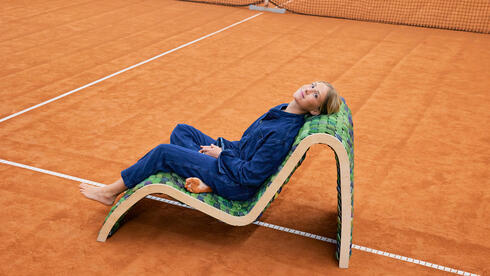
As Wimbledon opens in London, Belgian designer Mathilde Wittock is reimagining one of tennis’ biggest waste problems, turning discarded balls into benches, armchairs, acoustic panels and sculptural furniture that preserve the marks of the gameThere is no shortage of unusual materials in contemporary design, but every so often a raw material appears that manages to surprise even those who thought they had seen it all. In recent years, used tennis balls have joined that list. Usually discarded shortly after a match, they are being transformed, in the right hands, into raw material for furniture and design elements with a distinctive presence.The choice of this unconventional material takes on added meaning ahead of the Wimbledon tennis tournament in London, one of the world’s biggest sporting events, where about 55,000 tennis balls are used and replaced throughout the competition, which runs from June 29 to July 12. Beyond aesthetics, the use of discarded balls reflects a broader trend in design: the search for new ways to think about waste, materials and the relationship between sustainability and contemporary creation.GalleryArmchair by Belgian studio MWO (Photo: Rodolphe de Brabandere)In recent years, a new approach has been gaining ground in the design world, one that seeks not only to recycle materials but also to preserve their identity, signs of use and original qualities as an integral part of the new product. Instead of breaking the material down completely or erasing its past, more and more designers are choosing to highlight the story it carries: the wear, texture, color and material memory accumulated over time.In this way, ordinary objects that may seem worthless are transformed into raw materials with a distinct character and a unique visual language. Tennis balls stand out within this trend. Their recognizable color, rough outer surface and elastic structure allow them to combine visual, tactile and acoustic qualities with a broader environmental statement.Mathilde Wittock, founder of MWO Studio, Belgium(Photo: Rodolphe de Brabandere)Armchairs and acoustic partitions made from a common material: worn-out tennis balls(Photo: Rodolphe de Brabandere)Among the designers working in this spirit is Mathilde Wittock, a young Belgian designer and graduate of the prestigious Central Saint Martins design school in London, who completed a bachelor’s degree in product design and a master’s degree in bio-design in 2021.After graduating, she founded MWO Design, where she develops work focused on the study of unexpected materials and the search for new uses for everyday waste. At the center of one of her best-known projects are used tennis balls, which she collects from courts and turns into furniture such as benches, chairs and partitions, as well as acoustic elements in a range of colors, including yellow, orange, green, blue and burgundy.Instead of shredding the material or concealing its origin, she chooses to preserve the balls’ shape, texture and original qualities, making them a central element in the visual language of her work. And the price? From 500 euros per piece.In an interview, Wittock said the project was also born out of a desire to address the enormous amount of waste generated by the global tennis industry. According to her, about 400 million tennis balls are thrown away worldwide every year, while only around 1% are recycled.
400 million tennis balls trashed each year, then turned into luxury furniture
As Wimbledon opens in London, Belgian designer Mathilde Wittock is reimagining one of tennis’ biggest waste problems, turning discarded balls into benches, armchairs, acoustic panels and sculptural furniture that preserve the marks of the game
1,353 words~6 min read