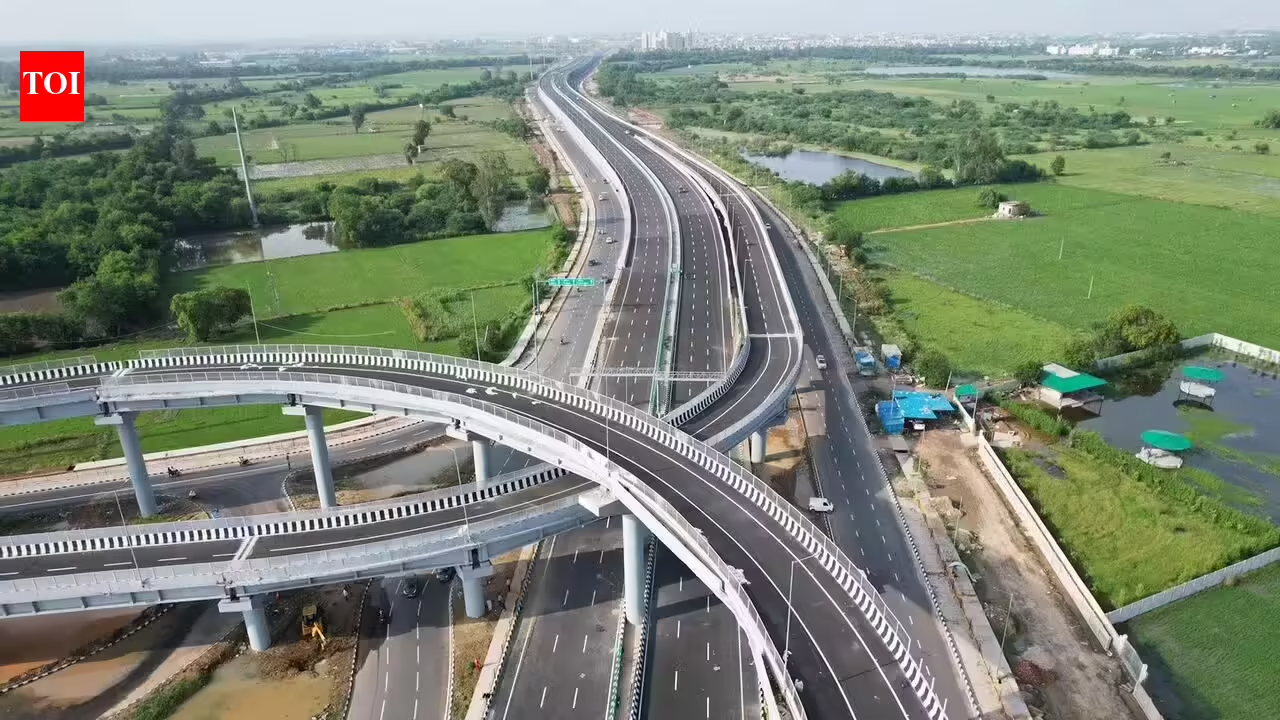
NHAI’s financial discipline slows highway awards, leaving developers with a thinner project pipeline.
The National Highways Authority of India (NHAI) has reduced its debt by 43 per cent from its FY22 peak to below ₹2 lakh crore, marking a major milestone in its balance-sheet clean-up. However, this financial turnaround has coincided with a sharp slowdown in highway project awards, with recent brokerage reports pointing to virtually no new NHAI project awards in April, after the pace of contract awards fell to a seven-year low in FY26.According to various brokerage reports, NHAI’s emphasis on deleveraging, tighter project-readiness norms and slower land acquisition has materially reduced the flow of new highway contracts. The result is a structural shift in India’s road-building cycle: while the country’s largest highway agency strengthens its finances, road developers are contending with a shrinking project pipeline, intensifying competition and weaker revenue visibility.Asset monetisation becomes key to fiscal strategyThe improvement in NHAI’s finances reflects a broader shift in how it funds highway development. Instead of relying heavily on fresh borrowings, the authority has increasingly turned to asset monetisation through Toll-Operate-Transfer (TOT) bundles and Infrastructure Investment Trusts (InvITs), recycling completed highway assets to unlock capital.The proceeds are increasingly being used to strengthen the balance sheet by reducing legacy debt and interest costs, while supporting the government’s broader fiscal consolidation strategy. NHAI mobilised about ₹28,300 crore through asset monetisation in FY26 and plans to raise ₹30,000–35,000 crore in FY27, as it works towards its goal of becoming debt-free by FY30.India’s highway construction cycle is entering a markedly different phase. After years of rapid expansion driven by aggressive project awarding, the focus is shifting towards financial discipline, execution readiness and balance-sheet repair.NHAI awarded contracts for 3,124 km of highway projects worth about ₹42,300 crore in FY26. While this was higher than the unusually weak FY25 base of 2,170 km, it was nearly half the 6,300 km awarded in FY23, when the authority handed out projects worth nearly ₹1.3 lakh crore. In FY22, the value of projects awarded was even higher at around ₹1.5 lakh crore, highlighting how sharply the order pipeline has moderated since the post-pandemic infrastructure push.Highway awards hit seven-year lowThe broader picture tells a similar story. Including projects awarded by the Ministry of Road Transport and Highways (MoRTH), total highway awards stood at around 7,000 km in FY26, down from 7,538 km a year earlier and well below the more than 12,000 km awarded annually during FY22 and FY23, making FY26 the weakest year for highway awards in seven years. Highway construction also declined 12 per cent year on year in FY26 after falling 14 per cent in FY25, according to brokerage estimates.Brokerages attribute the slowdown to a combination of slower land acquisition, stricter project-readiness requirements before tenders are floated and NHAI’s increasing emphasis on execution discipline. The authority now requires a much higher proportion of land acquisition and statutory clearances to be completed before projects are awarded, reducing execution risks but also slowing the pace at which new contracts enter the market.Capital allocation shifts towards disciplineThe slowdown has come even though spending on highways has remained broadly stable. NHAI’s capital expenditure stood at around ₹2.4 lakh crore in FY26, but its own construction output declined about 5 per cent to 5,313 km, suggesting the change is less about funding availability and more about how capital is being deployed.The authority prepaid more than ₹31,000 crore of borrowings during FY26, helping reduce its debt-to-equity ratio to 0.17 times from 0.26 times a year earlier. Outstanding debt has fallen to below ₹1.96 lakh crore from a peak of about ₹3.48 lakh crore in FY22, lowering future interest costs and strengthening NHAI’s financial position.For the government, the strategy marks a shift from debt-funded expansion towards asset recycling and fiscal discipline. For the industry, however, it also means a leaner pipeline of new projects than during the post-pandemic highway building boom.Road developers face shrinking order pipelineFor road developers, the shift in capital allocation has translated into a much thinner order pipeline. Listed infrastructure companies’ share of NHAI project awards has steadily declined over the past decade as smaller, unlisted contractors have captured a larger share of available work.With fewer EPC and Hybrid Annuity Model (HAM) projects coming to market, competition for contracts has intensified, putting pressure on bidding discipline and margins. Brokerages expect developers to increasingly diversify into adjacent infrastructure segments as opportunities in roads remain constrained.A modest increase in highway allocations in the Union Budget for FY27, coupled with NHAI’s continued focus on deleveraging, suggests a sharp revival in project awards is unlikely in the near term.The changing trajectory reflects a new phase in India’s highway development programme. The challenge for policymakers is no longer just building more roads, but balancing fiscal discipline with the momentum of infrastructure. As NHAI repairs its balance sheet, maintaining a steady pipeline of new projects will be critical to preserving construction capacity for the country’s next investment cycle.Published on June 29, 2026