When students have never been asked to examine the ethical dimensions of a joke, they will mistake shock for substance and vulgarity for the avant-garde.
| Photo Credit: Getty Images/iStockPhoto
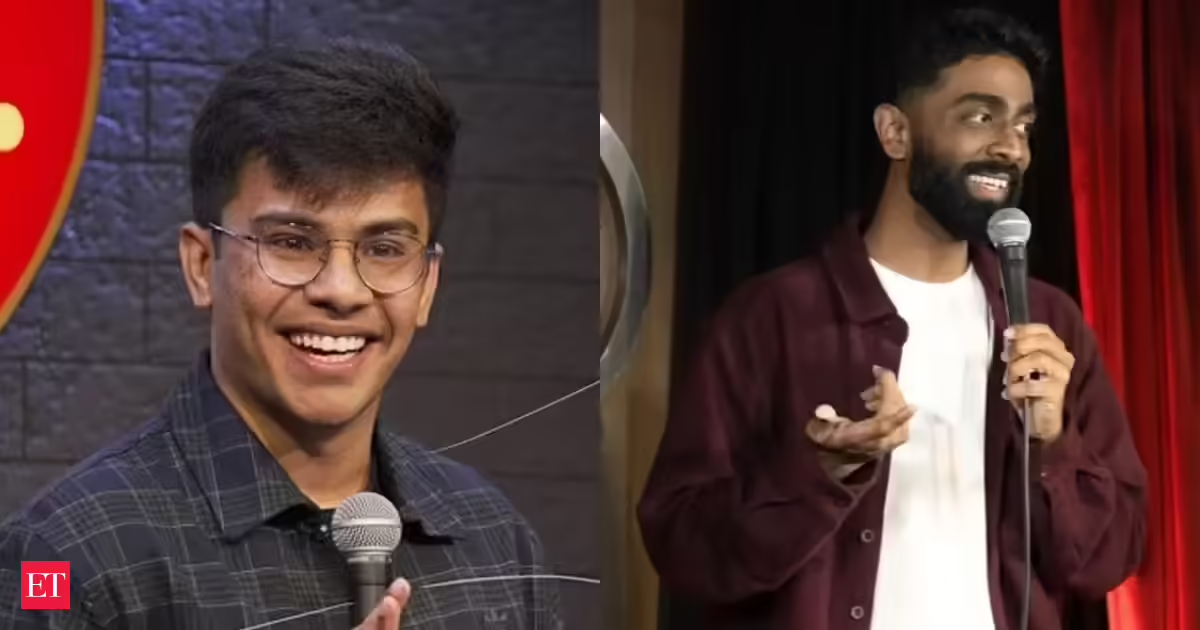
Three viral moments. Three educated young Indians. Three public failures of ethical imagination.In Gurugram, an audience member at a stand-up comedy show declared that spending a modest sum on a dinner date entitled him to something in return — transactionalising intimacy with the breezy confidence of someone mistaking expenditure for entitlement. In Mumbai, another audience member made an anatomical remark about a cadaver’s genitalia during a crowd-work segment, apparently unaware — or indifferent to — the elementary ethics of bodily dignity and posthumous donor respect. Last year, a panelist on a popular YouTube talent show posed an explicit “Would you rather” question to a contestant about their parents’ intimate lives, rupturing the boundary between provocation and violation. All three incidents have been widely reported and documented across media.These incidents do not establish the character of the individuals involved; a single public moment rarely defines a person. They do, however, raise an uncomfortable question about what our educational institutions encourage or neglect. What is most unsettling is not the vulgarity itself. It is the shared profile of its authors: young, well-credentialed, articulate, and sheltering behind the language of artistic freedom with the false confidence of the unchallenged. All three are products of India’s most aspirationally pursued educational pathways: Engineering and Medicine. The problem is not what they learned. It is what they were never taught.India’s professional education system has, with great efficiency, produced technically competent graduates who are emotionally and ethically underdeveloped. When a young person has never been given the tools to encounter literature seriously — to sit with ambiguity, moral complexity, and the interiority of others — he/she has no reliable means of distinguishing between transgression and revelation. They mistake the breaking of taboos for the breaking of new ground. They confuse audacity with insight. They are, in the deepest sense, impoverished: not financially, but humanistically.Beyond grammarLiterature is not ornamental. It is the technology by which a civilisation transmits its ethical grammar across generations. I recall my mother placing Ponniyin Selvan in my hands in Class 7, and the conversations that followed about whether a woman who destroys a dynasty for revenge is a villain or a tragic heroine. Those exchanges did not teach me facts. But they taught me how to think about people. That kind of formation cannot be simulated by a communication skills module or a technical report-writing workshop.Yet, that is precisely what professional curricula offer in place of literature. The Humanities, when they appear at all in Engineering syllabi, function as service courses: grammar drills, email templates, and LSRW competencies. While these are not without value, reducing language education to functional literacy is analogous to standing before the Himalayas and seeing only a granite quarry: a failure of proportion so radical as to constitute a moral choice.The consequences are visible in our public culture. When students have never encountered a serious poem, they will accept mass-produced cinematic lyrics as the highest form of verbal art. When they have never inhabited the interior monologue of a morally compromised fictional character, they will elevate expletive-laden web-series dialogue as authentic storytelling. When they have never been asked to examine the ethical dimensions of a joke, they will mistake shock for substance and vulgarity for the avant-garde.Literature is no guarantee of moral goodness. History offers no shortage of highly cultured people capable of great brutality. But when the curriculum abandons humanistic formation entirely, it leaves that vacancy to be filled by algorithms that reward cruelty and shock value with clout. The question is not whether literature alone can save us. It is whether we can afford to keep removing it.The All India Council for Technical Education (AICTE) and its affiliated institutions must treat humanistic sensibility not as peripheral to Engineering education but as a foundational professional competency, constitutive of what it means to be an educated person in a civilisational democracy as old and complex as India’s.A student who has never been taught to tell a bougainvillea from a rose will, with great confidence, offer you the former and call it love. Our universities are graduating thousands of them every year.Views expressed are personalThe writer is Assistant Professor of English (Grade-II), Velammal Engineering College, Chennai. Published - June 29, 2026 10:00 am IST