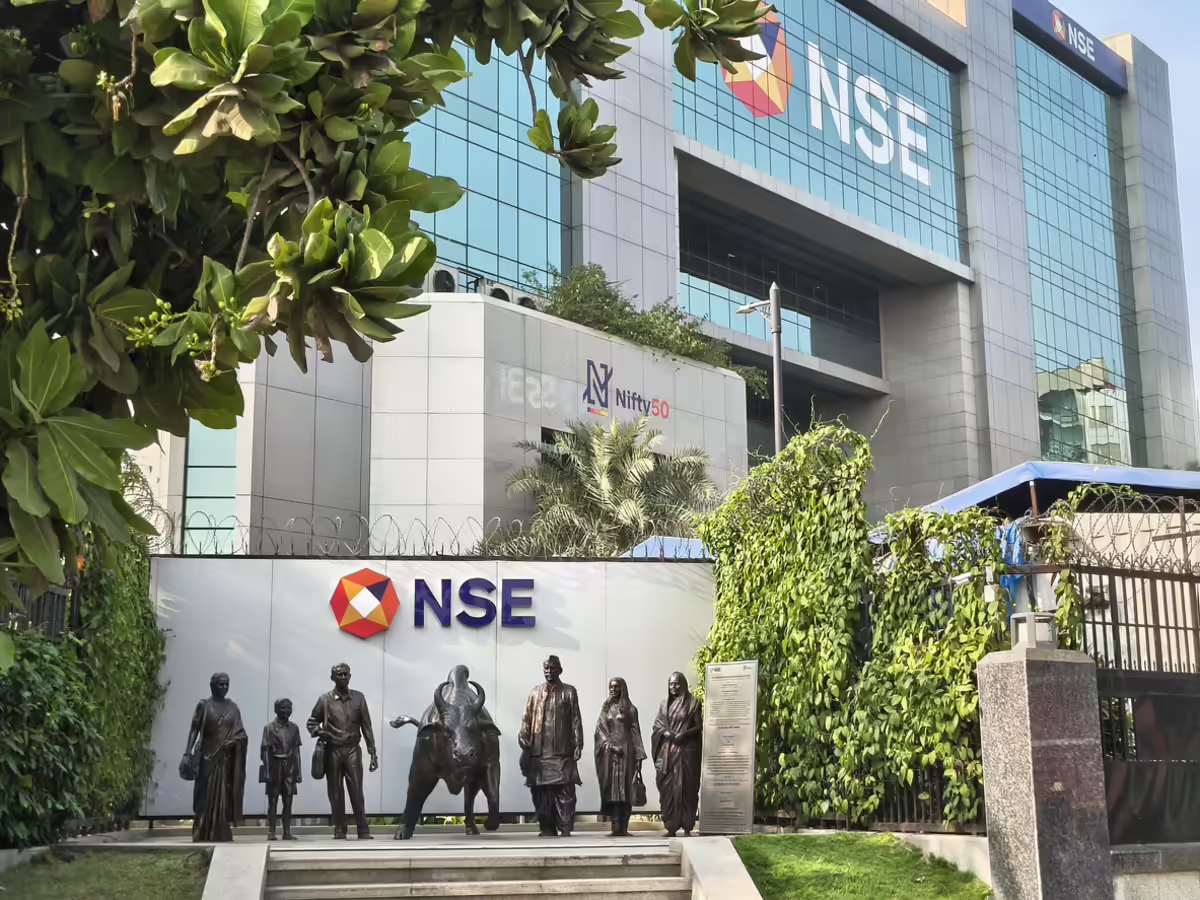
Every time you buy or sell a share, you think about the company you’re investing in. Its revenues, its margins, its management. Rarely do you stop to think about the platform you’re trading on.The National Stock Exchange— the plumbing through which nearly every trade in India passes—is now preparing to list itself. Which raises an interesting question: what makes the exchange itself tick? What drives its revenues, who pays it, and what could dent its earnings?Unlike a bank that lends money or a company that makes something, NSE is a platform business. It doesn’t take a risk on capital. It doesn’t manufacture a product. It simply matches buyers with sellers, and earns a fee every time that happens. The more India trades, the more NSE makes. And with only 13.5% of India’s adults currently participating in equities, the runway is long. But platform businesses have their own quirks. And before you decide whether to own a slice of the exchange, it helps to understand exactly how it makes its money— and where the risks lie.Stock exchanges operate on a distinct business model from sectors such as banking, manufacturing, or technology. They neither lend nor manufacture. Instead, exchanges function as platforms that facilitate transactions between buyers and sellers. Every stock market transaction passes through multiple intermediaries— brokers, clearing corporations, and depositories—but the exchange sits at the centre of this ecosystem. It matches buy and sell orders and executes trades. While investors pay brokerage fees to intermediaries, exchanges earn transaction charges from brokers for using their platform.What makes exchange businesses particularly attractive is their ability to benefit directly from rising financialisation. As savings shift from physical assets like gold and real estate to financial instruments, trading activity increases, driving exchange revenues. With BSE already listed and the NSE IPO (Initial Public Offering) drawing strong investor interest, the spotlight is back on exchange businesses. However, before subscribing, a key question remains: what drives NSE’s revenue model, and what risks are there?What drives NSE’s earnings?Transaction charges:key driver This contributes around 79% of operating revenue, as per its Financial Year (FY) 2025-26 numbers. The NSE charges fees for trading in equities, Futures and Options (Fundefined cash equities contribute 11.9%.What you should know:Earnings remain highly sensitive to derivatives activity, especially options.Any regulatory tightening in F&O can significantly impact profitability.Market data & connectivity feeThis includes fees that NSE collects for market data feeds and trading infrastructure access, from brokers, institutions, and traders. It contributes around 10% of operating revenue (FY 2025-26). This income stream is less volatile than trading-linked revenues.What you should know:Provides recurring income.Acts as a stability buffer.Treasury & investment incomeLike any other company or investor, the NSE invests its own income too. This is called treasury money or propriety desk, in finance parlance. This contributes around 15% of total income (FY 2025-26). What you should know:Offers downside protection during weak market cycles.Enhances overall earnings stability.Other revenue streamsAside from transaction charges and providing market infrastructure to brokerages, the NSE also earns every time a company lists.Listing fees have two components. When a company lists on the NSE, it charges a onetime fee. But every listed company also pays an annual fee to stay on the exchange. This is structured on a slab basis linked to its paid-up capital. So even in a slow IPO year, NSE keeps earning from its large existing base of listed companies.Listing fee constitutes 2% of NSE’s operating revenue.NSE creates indices—way beyond the basic Nifty 50 and Nifty 100—which many mutual fund houses and other portfolio managers use to benchmark their schemes against. Every time they use any of NSE’s indices, they must pay a fee to NSE, called the index licensing fee. Around 1% of NSE’s revenues comes from here. This has a high growth potential given the rise in passive investing.Finally, clearing and settlement contribute around 1.5% of NSE’s operating revenue. This is the infrastructure that ensures every trade you execute actually settles; the buyer gets the shares, the seller gets the money. NSE’s clearing corporation acts as the counter-party to both sides of every trade, taking on and managing the risk of default by either side. It’s critical plumbing, even if it doesn’t move the revenue needle much. Brokers pay these fees to NSE’s clearing corporation. Of course, brokers typically pass this cost on to clients as part of their overall charge structure.How NSE spends its moneyNSE’s single biggest cost is technology: networks, data centres, and trading systems. It’s largely a fixed cost, so it doesn’t balloon as volume grows. That’s actually good news for investors: once the infrastructure is in place, every additional trade that flows through it adds to the margin.Cybersecurity and regulatory compliance sit alongside this. NSE runs surveillance systems and monitoring infrastructure that regulators require. There’s no cutting corners here. In a business built entirely on market trust, this is a non-negotiable expense. Then there’s clearing and risk management, the financial buffers NSE maintains to guarantee trade settlement. These can weigh on short-term profits, but they’re what make NSE the backbone of Indian markets. The stronger the risk framework, the harder it is for any competitor to credibly replicate what NSE does.
NSE IPO: Why investors should look beyond trading volumes before buying the stock - The Economic Times
NSE IPO: Stock exchanges operate on a distinct business model from sectors such as banking, manufacturing, or technology. They neither lend nor manufacture. Instead, exchanges function as platforms that facilitate transactions between buyers and sellers. Meanwhile, NSE’s biggest earnings risk is its dependence on derivatives.
TL;DRAI
NSE IPO: options comprise 77% of transaction revenue amid F&O regulatory risk; 13.5% equity participation suggests long growth runway. Platform benefits from India's financialisation but profitability highly exposed to derivatives regulation.
1,266 words~6 min read