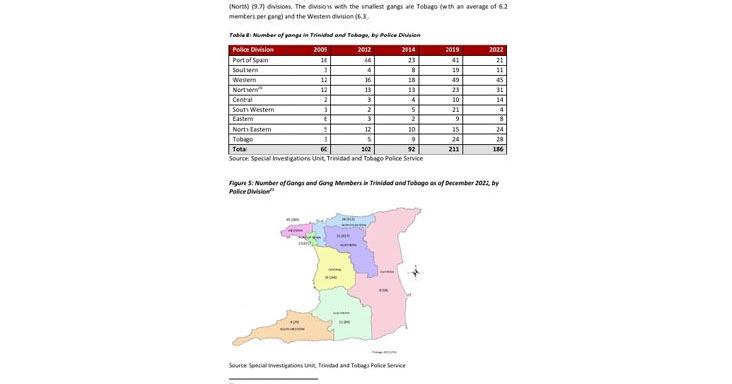
TRINIDAD and Tobago’s gang population was tallied at 186 groups and 1,750 members across the country in a February 2024 report commissioned by the United States Agency for International Development (USAID).According to the “Eastern and Southern Caribbean (ESC) Criminal Dynamics Study”, a survey at the time of 777 Form 4 and 5 students in public secondary schools in Tobago, or 68.9% of all registered Form 4 and 5 students in Tobago, also showed that 3.7% of respondents were current gang members.
criminologist:Dr Randy Seepersad
The report, authored by criminologist Dr Randy Seepersad, and funded through the USAID General Development Office, was mirrored in statistics cited in a June 2026 United Kingdom Visas and Immigration assessment, as influencing that Government’s policy changes for T&T nationals seeking asylum due to gang-related threats.Homeland Security Minister Roger Alexander last week questioned the accuracy of the UK’s data, stating that “the figures are very different to what we have presently”. Alexander did not disclose any statistics but said the UK had presented figures which were “higher”.However, various commentaries and publications by Seepersad were referenced in the UK Home Office assessment, as well as information gleaned from local media reports.The Seepersad-led report, which was “sensitive but unclassified”, stated that according to data from the Special Investigations Unit (SIU) of the Trinidad and Tobago Police Service (TTPS), there was a “general increase in the number of gangs”, with a total of 60 gangs in 2009, compared to 102 in 2012, and 92 in 2014.In 2020 there were 130 gangs and 1,014 gang members, while in 2022 the country had 186 gangs and 1,750 gang members, the report added.The survey of students in Tobago showed that 2.4% of Form 4 students and 5.5% of Form 5 students were gang members or gang affiliated.USAID was unable to gather statistics from Trinidad’s public secondary school system as permission was not received, the report noted.History of gangsThe study on gangs in T&T was part of a larger USAID-funded study of gangs in 11 Caribbean countries, including Antigua & Barbuda, The Bahamas, Barbados, Dominica, Grenada, Guyana, St Kitts & Nevis, St Lucia, St Vincent & the Grenadines, and Suriname.The report cites a range of studies in the past two decades, and noted that T&T presented the highest figures for gangs and gang-related crime including murders.The report said data from the TTPS showed that 33.3% of murders from 2000 to 2022 were gang-related.There was an increase in gang-related murders from 2000, where 3.3% of murders were gang-related, to 2007 when gang-related murders peaked at 52.7%. From 2007 to 2010 there was a decline, where 15.9% of all murders in the latter year were gang-related, followed by a fluctuating but increasing trend in gang-related murders. In 2022, 40.3% of all murders were gang-related, the report stated.The study also noted the history of gangs in T&T, the impact of the Jamaat-al Muslimeen, reductions in crime statistics during the Covid-19 pandemic, the funding of gang activity through State contracts and the evolution of “gangland” into current factions around the country.The report noted that there are several “non-affiliated gangs”, which are not aligned with any of the “major gangs” cited in the document.At the time of the study, notable gangs like Sixx, Rasta City and Muslim factions were minimal, but appeared to be increasing.West PoS: Highestnumber of gangsDemographic data from 2022 showed that the highest number of gangs, according to TTPS division, was recorded in the Western region of Port of Spain at 45.The Northern Division presented 31 gangs, while 28 factions were recorded in Tobago.PoS North Eastern Division recorded 24 gangs, with 21 in Port of Spain and 14 in Central.The Port of Spain Southern Division showed 11 gangs, with eight in the Eastern Division and four in the SouthWest.In 2023, a Latin American Popular Opinion (LAPOP) survey found that 24% of respondents reported gangs in their neighbourhoods, the USAID report said.The report, which also tracked gang behaviour and the constitution governing each faction, stated that “gang involvement in crime is, in part, a function of gang-alignment as well as the location of each gang....as such, the area of control for each gang in part determines its engagement in crime”.While “some gangs control the coastal area and are more prone to narcotic and firearm trafficking”, others that have “assumed control inland are notably more violent, and are more inclined to commit crimes such as shootings, woundings, and homicides....crimes are also due to turf wars for control of territory and the narcotic trade,” the report stated.It said overall, gangs in T&T have engaged in homicides, larceny of motor vehicles, robberies, narcotics trafficking and illegal quarrying, among other offences. Gangs in Tobago have been noted to facilitate criminals from Trinidad who seek places to hide from law enforcement and rival gangs, the report noted.Gangs in Tobago typically involved narcotics trafficking, and while there was an increase in shootings and murders among gang members, incidents of violence against tourists were rarely linked to gang activity.Besson Street Police Station records most gang murdersThe report said from 2000 to 2022, the divisions with the largest proportion of gang-related murders were Port of Spain, where 61.1% of murders were gang-related, North (Central) at 50.9%, Western Division at 49.2%, and the North Eastern Division at 41%.Besson Street Police Station recorded the most gang-related murders at 156 or 16.6% of all gang-related murders; St James showed 68 or 7.2%, and Arima and Morvant each showed 64 or 6.8% of all gang-related murders.The West End followed with 54% or 5.8% of all gang-related murders.The report said for every five gang members in a police district, the number of homicides increased by 2% and 100 additional gang members in a police district resulted in homicides increasing by 49.1%.The report also stated that “gangs were an integral part of criminal operations in prisons”.Gangs also “now also have an influence in schools”, while collusion with law enforcement was “inconsistent and sporadic” but “appears to have increased”.The report said “prisons continue to operate as safe havens for gang leaders and members who use these spaces as recruitment centres, and who are able to control gang activities and crimes” despite the efforts of law enforcers.