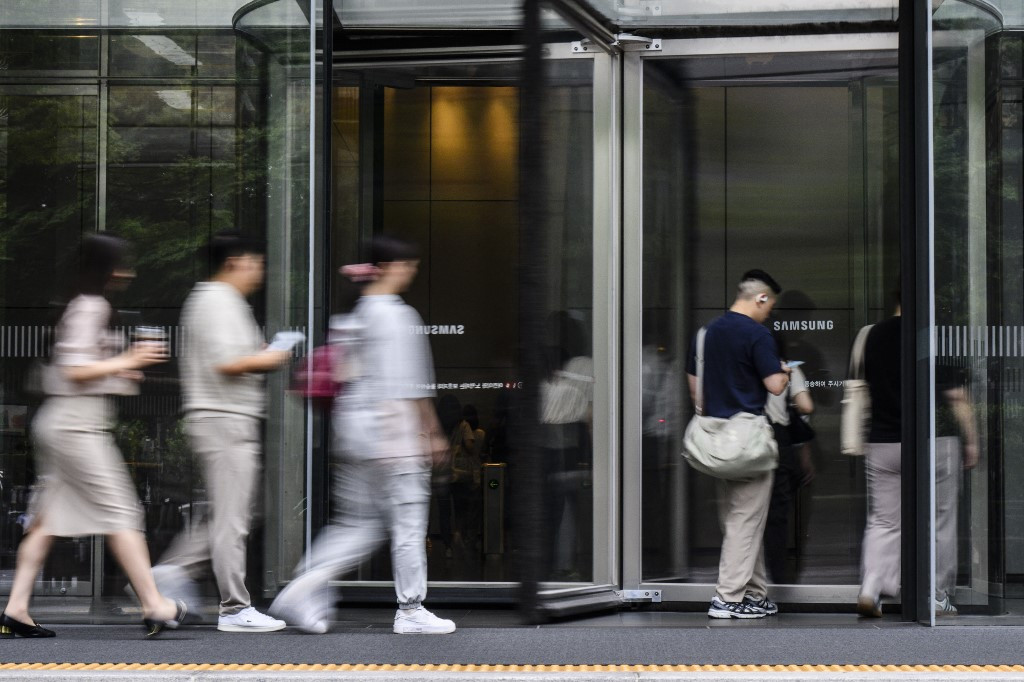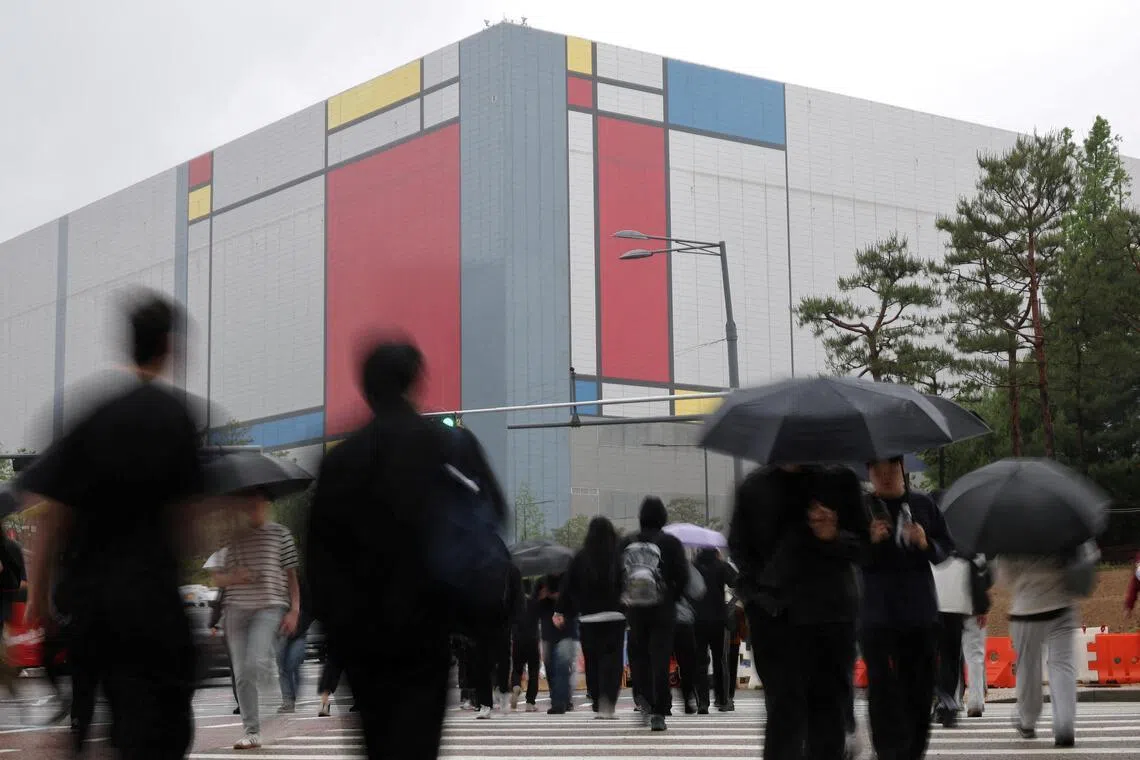
Samsung's display, battery, component, biotech units set to join nationwide build-out Samsung Electronics' chip campus in Hwaseong , Gyeonggi Province part of the company's existing semiconductor belt south of Seoul, on May 21 (Im Se-jun/The Korea Herald) Samsung is expected to lay out an investment plan on Monday that reaches well beyond the much-discussed chip cluster in the country's southwest, drawing in its display, battery, component and bio affiliates in what would be the largest commitment ever made by a Korean company, according to government and industry sources Sunday.The reach is as notable as the size. The plan is reported to span four regions: Honam in the southwest, Chungcheong in the central provinces, Yeongnam in the southeast and Incheon, just west of Seoul. Together they cover most of Korea's industrial map outside the capital.Local media reports have put the upper end of the package at 1,000 trillion won ($651 billion) over a decade, a figure larger than this year's national budget of 728 trillion won. Whether that reflects Samsung alone or a wider public-private tally remains unclear, and the company has confirmed none of the figures.The plan is set to be presented when President Lee Jae Myung chairs a public-private briefing at the presidential office on the government's "three megaprojects," a strategy built around semiconductors, gigawatt-scale artificial intelligence data centers and physical AI and robotics. Samsung Display's existing Asan Campus 1 in South Chungcheong Province, a center of the company's OLED production (Samsung Display) What separates this from a conventional chip announcement is its breadth.Samsung Electronics would build the southwestern cluster, while Samsung Display, Samsung SDI and Samsung Electro-Mechanics expand display, battery, packaging and substrate work in Chungcheong. Manufacturing AI, capacitors and energy storage would grow across Yeongnam, and Samsung Biologics would push ahead in Incheon, in line with Chairman Lee Jae-yong's aim of building biotech into "a second semiconductor."The most concrete figure so far sits with Samsung Display, reported to be readying some 100 trillion won over a decade at its Asan and Cheonan sites in South Chungcheong Province for organic light-emitting diode and next-generation displays.The Honam cluster is both the centerpiece and the least settled part.Sites under review are said to lie in and around Gwangju and South Jeolla Province, and the project has reportedly shifted from back-end packaging toward front-end fabrication, where circuits are etched onto wafers. That distinction matters because a front-end fab is not an assembly hall. It requires stable power, vast volumes of water, waste treatment and thousands of engineers. Securing those inputs will decide whether large-scale chipmaking can take root in a region that has never hosted it.The timing also gives the move its edge. Samsung is no longer the unquestioned face of Korean chips. SK hynix, propelled by its lead in high-bandwidth memory, briefly overtook Samsung Electronics earlier this month to become Korea's most valuable listed company, and last week disclosed plans to raise up to 45.45 trillion won through a Nasdaq listing to fund new capacity. Kim Yong-beom, presidential chief of staff for policy, answers questions at a discussion hosted by a senior Korean journalists' association in central Seoul on Wednesday. (Lee Sang-sub/The Korea Herald) The whole package fits Lee's push to loosen Seoul's grip on the economy. Greater Seoul accounted for 52.8 percent of national output in 2024, and the administration wants to build up a handful of self-sustaining industrial hubs in the provinces to pull growth, jobs and talent away from the capital.That plan has not gone unchallenged. Opposition lawmakers say the investment is being steered toward the ruling party's southwestern base ahead of a leadership contest, while other regions complain of being passed over.Samsung is not the only group in the government's briefing. SK hynix is also expected to figure in the southwestern chip cluster, though it has yet to settle on a site, while Hyundai Motor Group and LG are linked to the data center and robotics tracks of the same agenda.Kim Yong-beom, presidential chief of staff for policy, has rejected the idea that the government leaned on companies to commit."These are the world's top one or two firms in their fields," he said. "They are not the kind of companies you can arm-twist into anything."
Samsung eyes record investment spanning affiliates, regions
Samsung is expected to lay out an investment plan on Monday that reaches well beyond the much-discussed chip cluster in the country's southwest, drawing in its
TL;DRAI
Samsung to invest up to $651 billion across semiconductors, displays, batteries and biotech in four Korean regions over a decade. Responds to SK hynix HBM dominance via integrated vertical stack (chip + display + storage + biotech) powering AI data centers.
700 words~3 min read