The data structure everyone learns for interviews and forgets by Monday — and why that's exactly backwards.
Here's the honest version of what most linked list tutorials skip:
You are almost certainly never going to write a linked list in JavaScript. Not in production. Not in a side project. Your language's built-in array already handles dynamic sizing, and it does it faster than a linked list in most cases, for reasons we'll get into. The interview circuit trained you to implement one on a whiteboard, and that's fine — but it created the wrong mental model. You walked away thinking linked lists are a data structure you might use. They're actually a data structure you need to understand — because they're hiding inside the tools you use every day, and knowing they're there changes how you reason about performance.
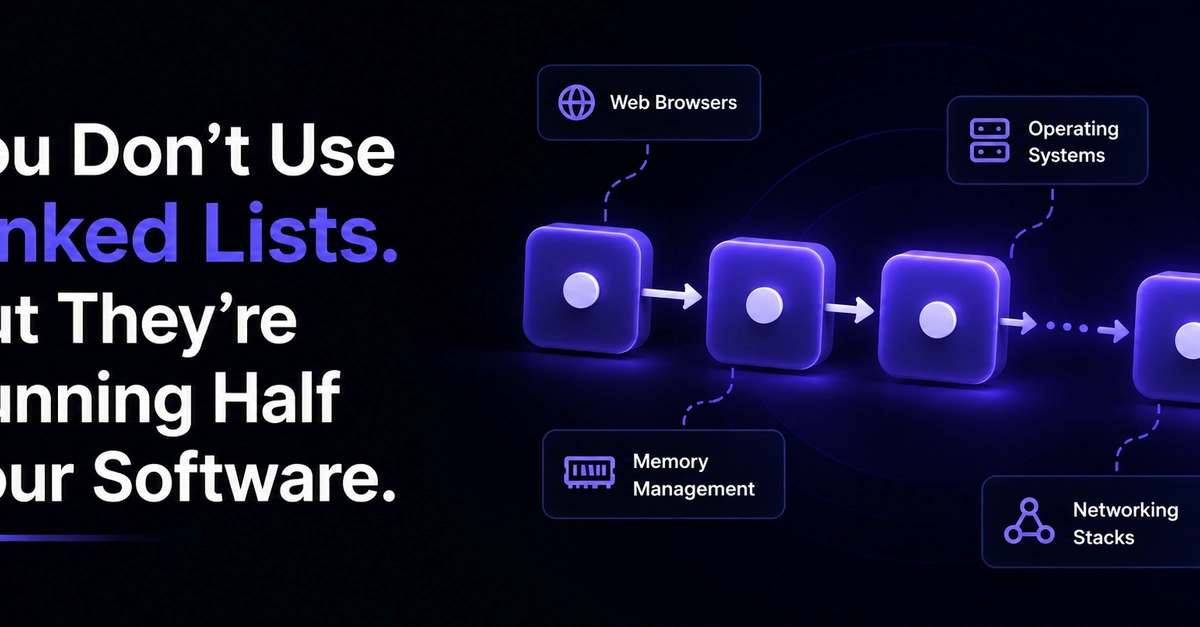
Your browser's back/forward navigation? Doubly linked list. Your text editor's undo history? Doubly linked list. The LRU cache inside every high-traffic web server, CDN, and database query optimizer? A doubly linked list fused with a hash map. Redis's LPUSH/RPUSH commands operate on a linked list. The Node.js event queue has linked list characteristics. The Linux kernel's process scheduler uses circular doubly linked lists internally.