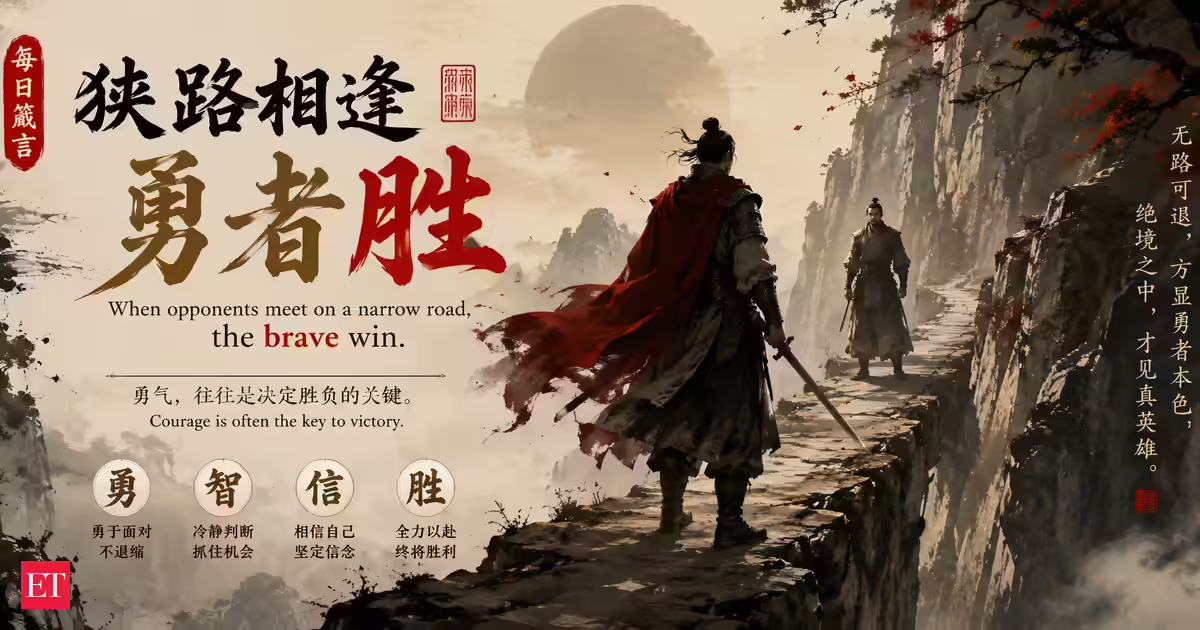
Chinese proverb of the day comes from one of the most battle-hardened corners of human wisdom: the moment when retreat is no longer possible. 狭路相逢勇者胜 — "When opponents meet on a narrow road, the brave win" — is not a motivational poster slogan. It is a survival principle, hammered out over centuries of Chinese military history, civil conflict, and the brutal arithmetic of confrontation with no exit. The proverb's power lies in its specificity. It doesn't speak of battlefields, where there is always a flank to escape or reinforcements to call. It speaks of a narrow road — a place where geography itself removes every option except forward. In that moment, skill matters less than character. Strategy collapses into a single question: who flinches first? That question turns out to be one of the most important a person can ask — not just in ancient warfare, but in boardrooms, operating theaters, difficult marriages, and the private confrontations we have with our own limits. The proverb has outlasted the dynasties that forged it because the narrow road is everywhere. On the surface, this is a proverb about war. Its imagery belongs to ancient China — two soldiers, two armies, a mountain pass too tight to allow maneuvering. One moves forward. One hesitates. The outcome is decided before a single sword is raised. But look closer and the proverb is really about psychological architecture. Courage, in this framing, is not the absence of fear. It is the ability to act decisively inside fear, when the body wants to freeze and the mind is listing reasons to wait. Modern neuroscience gives this ancient observation a precise name: the freeze-flight-fight cascade. When humans face genuine threat, the amygdala fires, cortisol floods the system, and the instinct is to scan for escape. On the narrow road, escape doesn't exist. The brain's default response fails. What determines the outcome is whether a person can override that freeze response and commit — fully, without half-measures. The Chinese military strategist Sun Tzu understood this long before neuroscience could explain it. In The Art of War, he described a principle called death ground — placing troops in positions where retreat was impossible. The logic was counterintuitive but field-proven: soldiers who cannot run fight harder than soldiers who can. The narrow road is death ground. And death ground, paradoxically, unlocks courage that comfortable positions never could. What Most People Get Wrong About This Proverb The common misreading is that this proverb celebrates recklessness. It doesn't. Bravery and recklessness look similar from the outside, but they are structurally different on the inside. Recklessness ignores risk. Bravery sees the risk clearly and moves forward anyway. The soldier on the narrow road who wins is not the one who doesn't understand the danger — it's the one who understands it completely and acts despite that understanding. That distinction matters enormously when people try to apply this proverb to their own lives. History is full of cases where misreading courage as recklessness led to catastrophe. The charge of the Light Brigade is not what this proverb describes. Nor is a startup founder who burns through capital with no plan. The proverb is not about ignoring reality. It's about refusing to be paralyzed by it. There's also a subtler misreading: assuming the proverb only applies to external opponents. Many of the narrowest roads we face have no adversary on the other side. The diagnostic result we're afraid to open. The conversation we've been postponing for months. The creative project we've nearly started a dozen times. These are narrow roads too. The opponent is internal — and the brave still win.Life Lessons from the Chinese Proverb The most useful life lesson this proverb offers is not "be brave." That's too vague to be actionable. The real lesson is more precise: engineer your narrow roads deliberately. Humans are remarkably good at avoiding difficulty when avoidance is available. We procrastinate, defer, pivot, and reframe. Entire industries exist to help us feel productive while sidestepping the one thing that would actually change our situation. The narrow road removes that option. And sometimes — more often than comfort would suggest — removing the option to retreat is the single most productive thing a person can do. Entrepreneurs who burn their boats. Writers who announce their book before writing it. Athletes who sign up for competitions before they feel ready. These are people who have internalized the proverb not as a metaphor but as a method. The second lesson is about the quality of decisiveness. When you cannot go back, the energy you once spent on second-guessing reroutes into execution. Momentum builds. Problems that seemed enormous at a distance become manageable when you're already moving through them. The narrow road concentrates the mind in ways that open fields never do. Finally, the proverb asks something quietly radical of us: trust your courage more than your comfort. Comfort tells you to wait until conditions improve. Courage recognizes that conditions rarely improve until someone decides to move first. Two figures meet where the path narrows to a single lane. One moves forward. One does not. Centuries later, we still know who wins — and more importantly, we know why. The narrow road hasn't changed. Neither has what it asks of us.
Chinese Proverb of the Day: "When opponents meet on a narrow road, the brave..."— The ancient secret that shows why fear never has the final word: A timeless life lesson about courage under pressure
Chinese proverb of the day: "When opponents meet on a narrow road, the brave win." This timeless Chinese proverb reminds us that life's biggest victories are rarely decided by strength alone. Discover its deeper meaning, historical roots, and powerful life lessons that reveal why courage often becomes the greatest advantage when there is no room to retreat.
878 words~4 min read