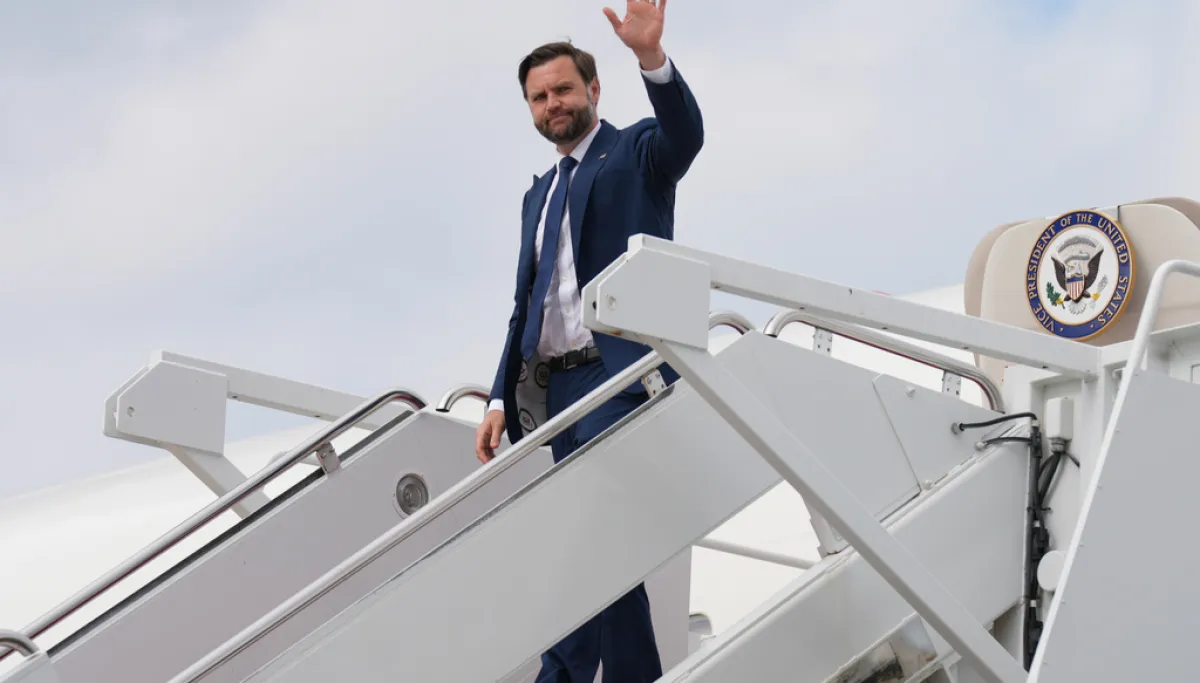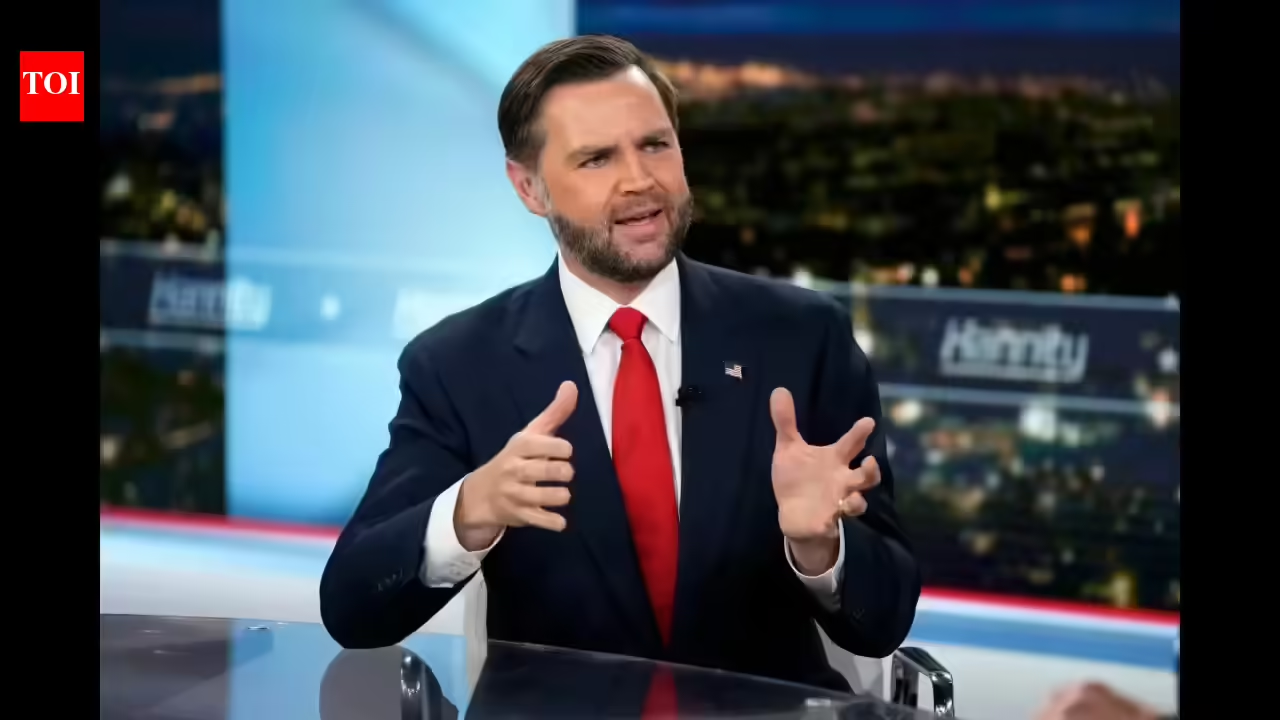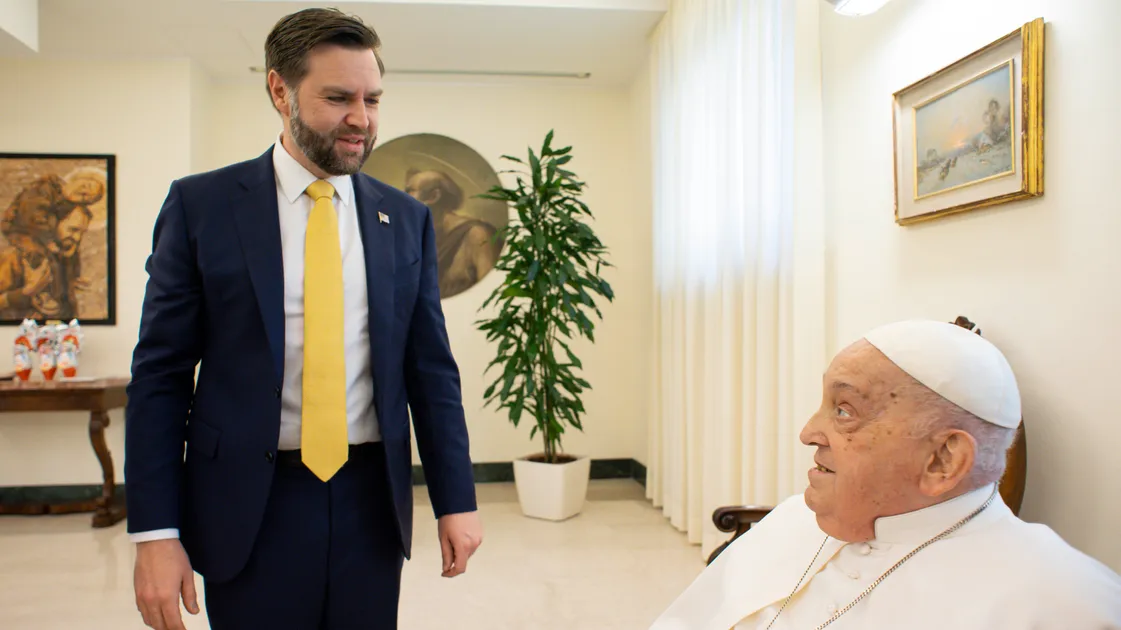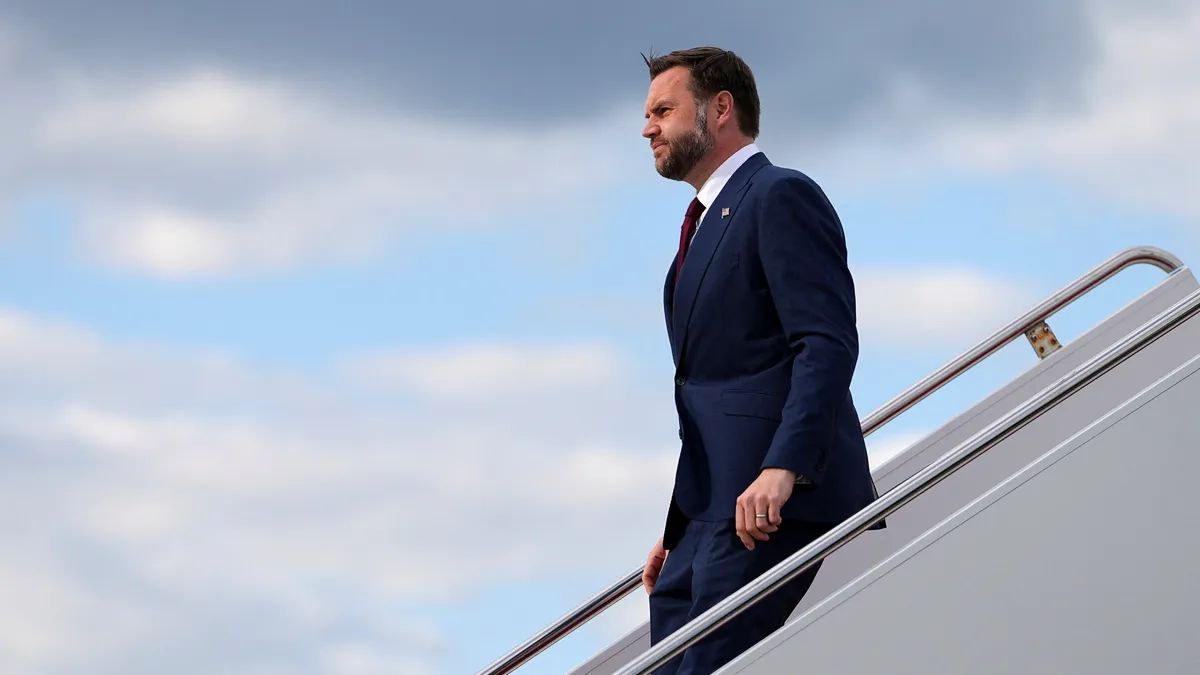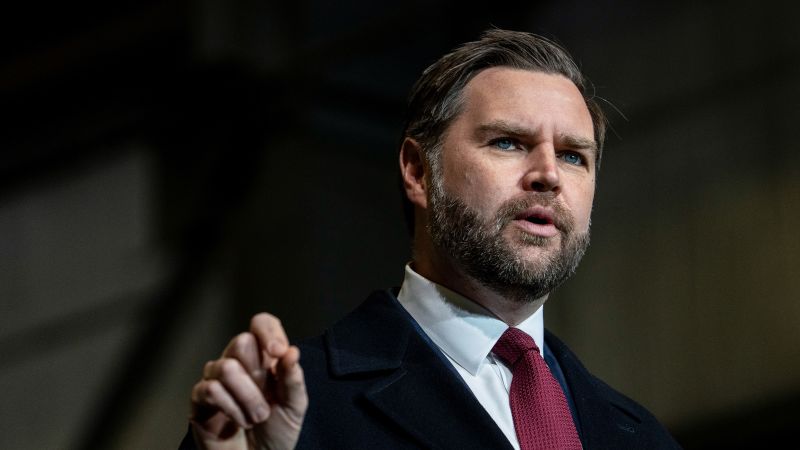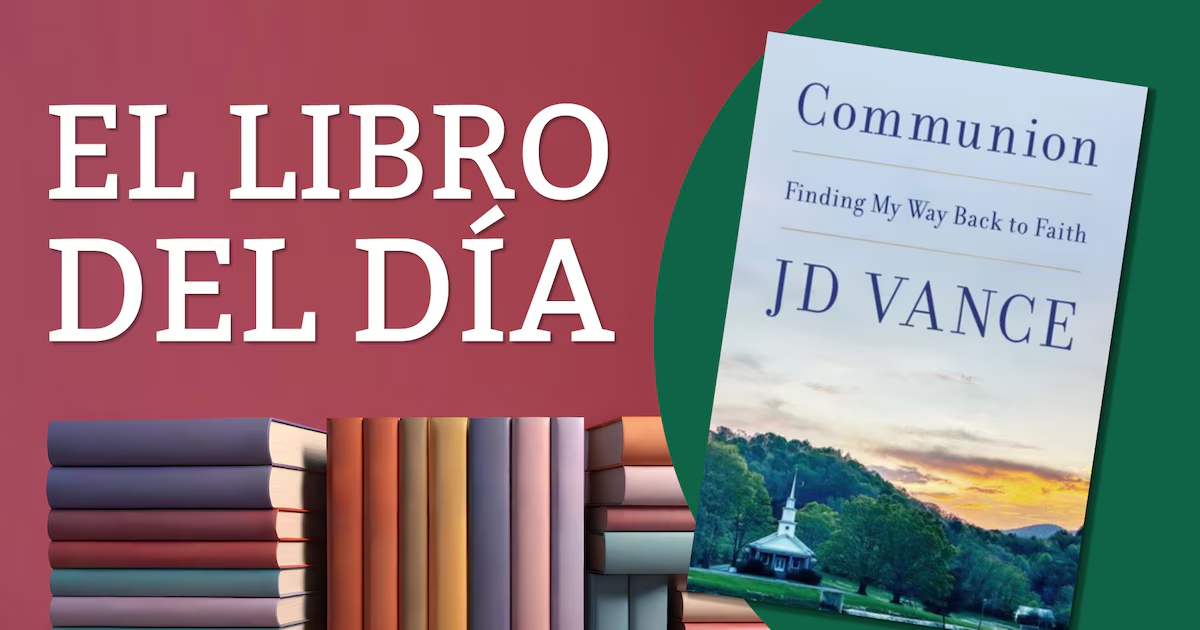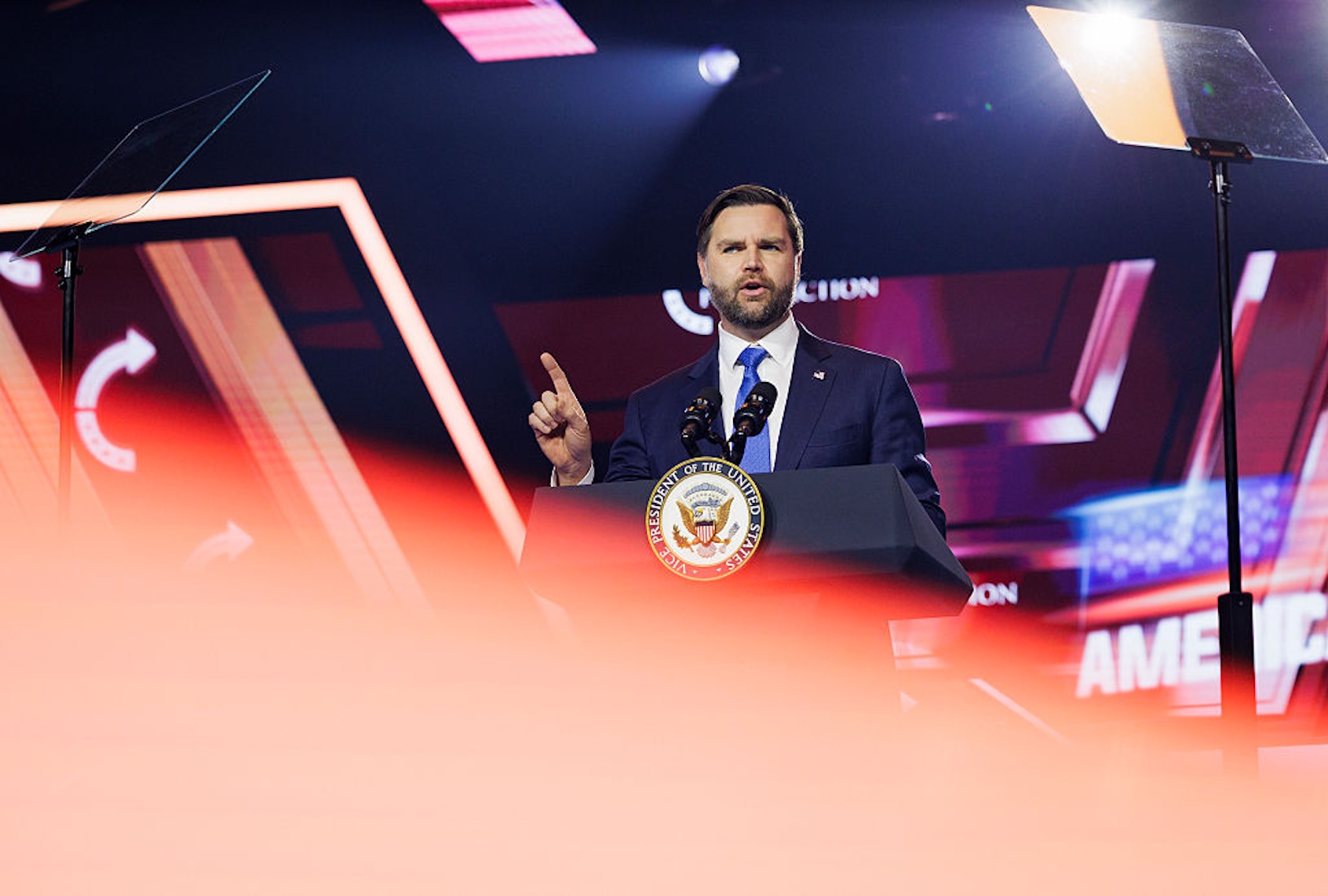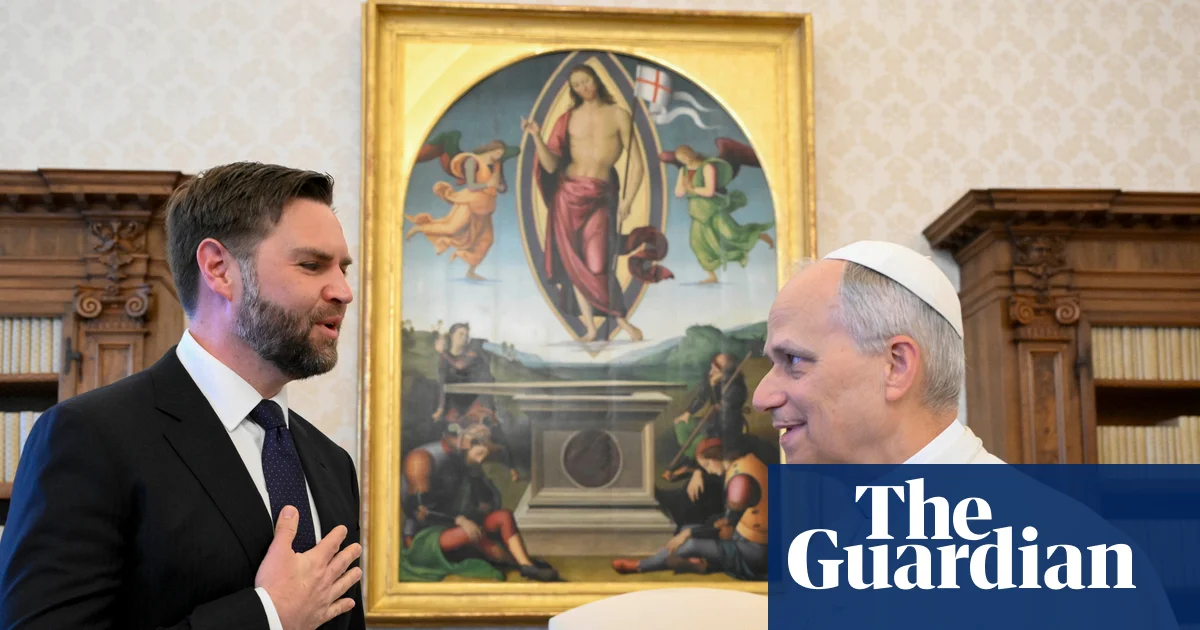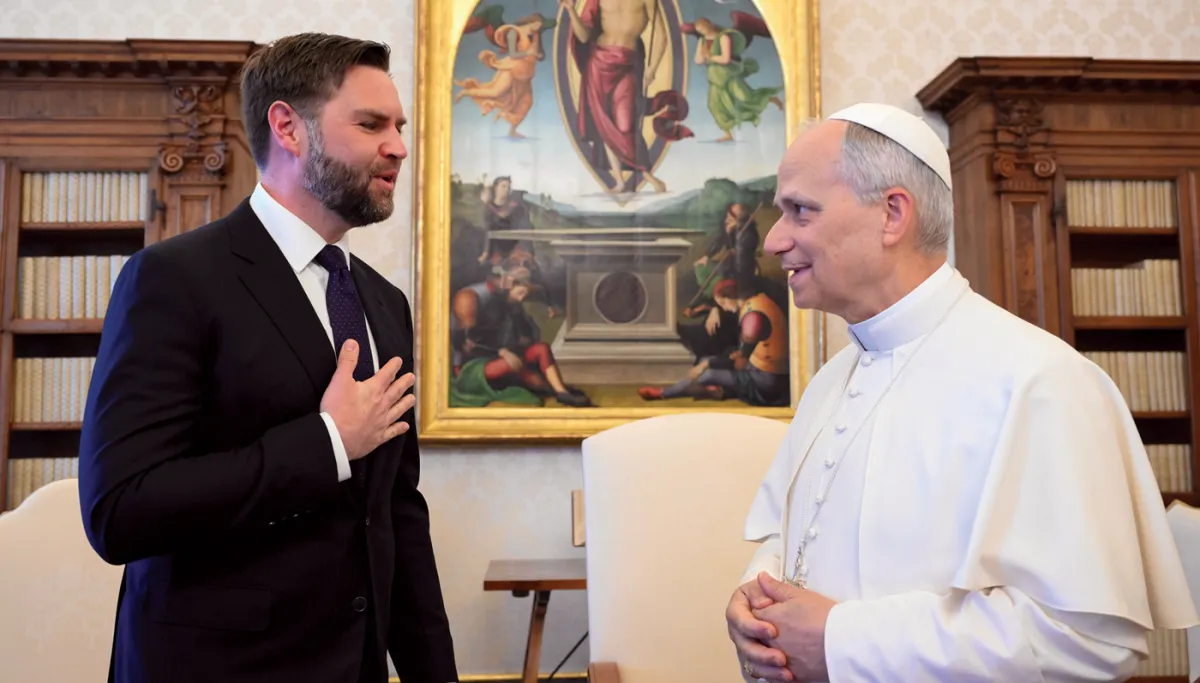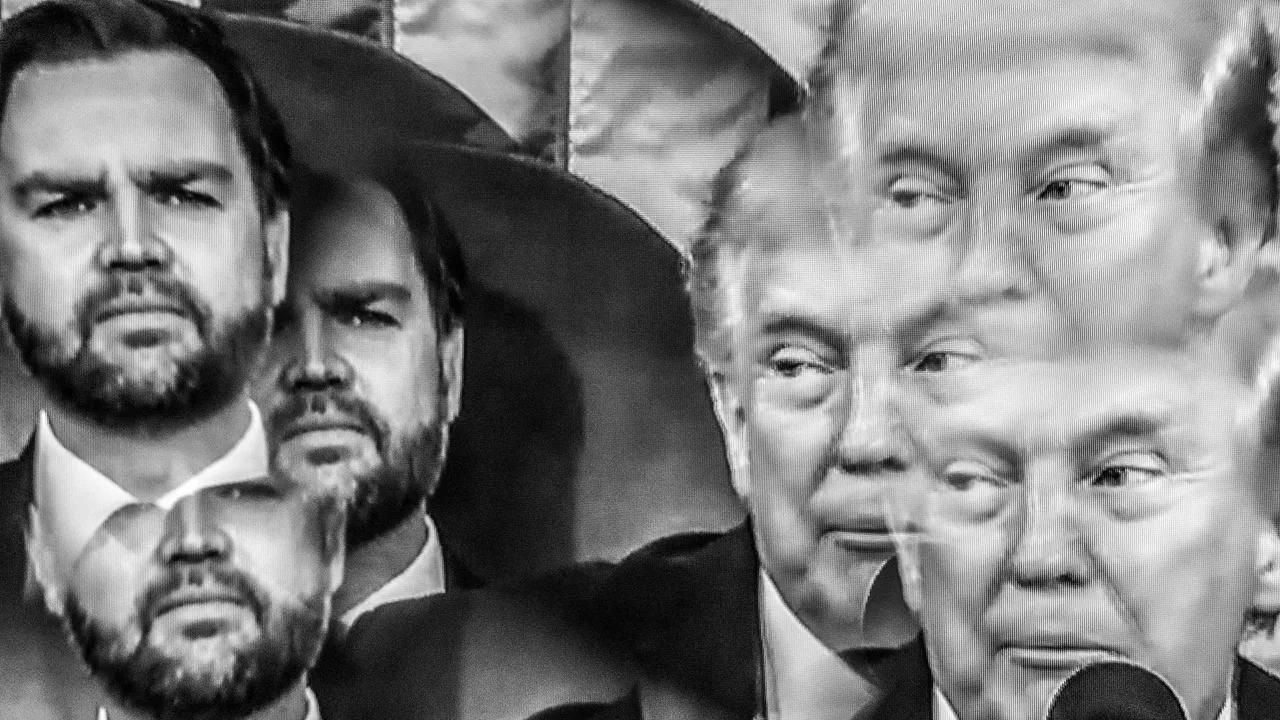
Most Sundays, as J. D. Vance tells it in his new memoir, “Communion,” he and his wife, Usha, take their three children to Mass. “Sometimes we arrive late, trailed by an army of Secret Service agents, and heads turn away from the service to stare at us. I quietly apologize, wondering if the other parishioners can tell that we didn’t brush our daughter’s hair.” This past Sunday, though, Vice-President Vance was in Lucerne, Switzerland, playing peacemaker—tasked with working out the details of the Administration’s vague memorandum of understanding with Iran, which is meant to put an end to President Donald Trump’s war of choice against that nation. Before Vance set out, Trump had made his sense of the stakes clear: “If it works out, I’m going to take the credit. If it doesn’t, I’m blaming J.D.” So it was that a few days after sitting for interviews about a book recounting his conversion to Catholicism—a press tour seen as a soft opening for his likely 2028 Presidential campaign—the self-styled “devout Christian” found himself the public face of a war that he had once privately been reluctant to support, trying to negotiate a truce on behalf of his profane and immoral boss. How, then, does his faith shape his approach to matters of war and peace? You might expect to find out from “Communion,” which is subtitled “Finding My Way Back to Faith,” but much of the book focusses on Vance’s life before politics, and it doesn’t touch much on this subject.“Communion” is a clunky mix of memoir, dad monologue, starchy Catholic disquisition, apologia, and broadside about the perilous state of the world. It was nearly a decade in the making, but it has the hasty quality of writing done by a father of three who works for an overbearing man and who gets his best downtime aboard Air Force Two. Styled as a confessional, it’s more like a humblebrag—the story of a man’s search for self-knowledge that winds up conveying his robust self-regard. And yet the book’s muddled character is revealing. “Communion” has been published amid circumstances that were hardly conceivable when Vance began writing it, not long after he finished his début memoir, “Hillbilly Elegy,” published in 2016. The candidate about whom, in a note to a friend that year, he had worried might be “America’s Hitler,” Donald Trump, is now serving a nonconsecutive second term in the White House, and Vance is now his Vice-President. The Pope, Leo XIV, is an American from Chicago’s bungalow belt, and, after him, the second most prominent American Catholic is Vance himself—a youngish convert from small-town evangelical Protestantism, a Marine veteran, and an alumnus of Ohio State and Yale Law. He worked in venture capital, for a time at a firm co-founded by Peter Thiel, the right-wing billionaire (and lecturer on the Antichrist) co-founder of PayPal; briefly served in the Senate; and is apparently setting up a bid for the Presidency with a book about what he calls his “search for a relevant faith.”Parts of “Communion” are spent defending the Trump Administration’s policies, but its glaze of piety, outward regard for learning, and reverence for history situate it far from the current Oval Office. And that effect is an achievement, whether Vance intended it or not. Fundamentally, “Communion” is a declaration of independence from Trump. The scattershot narrative channels the energies and the prerogatives of the conservative Catholic movement, whose tribune Vance already is, and musters them, seemingly, for a Presidential campaign in which he might distinguish himself from Trump (and perhaps from Marco Rubio, who is also a Catholic) through conspicuous displays of personal religious faith.The through line of the book is a conversion narrative: Vance tells a story of his abandonment of his maternal grandmother’s Christian faith and his return to Christianity by way of Catholicism. He makes this into a call to action, urging American society to reclaim its putative roots in Christianity and its mores. An emerging politician’s embrace of Christian faith has an obvious recent precedent in American politics: Barack Obama, who, at a climactic moment in “Dreams from My Father” (1995), finds himself in a church on Chicago’s South Side, moved to tears by the Reverend Jeremiah Wright’s sermon on “the audacity of hope”—a phrase that became the title of his Presidential campaign-trail book (though he later left Wright’s church, following some controversial remarks the Reverend made). The two men’s faith journeys are distinctly different, of course. Obama’s “search for a workable meaning for his life as a Black American” involved the Black Church, which gets scant attention in Vance’s sketch of America’s Christian roots. But Vance, like Obama, uses a personal embrace of faith to link his outsider narrative to a larger story of American purpose.Although some pages of the book are devoted to the issues of sexual morality that Christian politicians typically address, Vance gives greater emphasis to philosophy and theology. The pages on these subjects are a collection of theo-conservative greatest hits—and an evocation of a world apart from Trumpism. The twin pillars of conservative Christian thought are here: C. S. Lewis (whose “collected works”—several dozen books—Vance says he has “re-read”) and G. K. Chesterton (whose account of the human person as both angel and beast, he explains, “seemed right to me and still does”). So are Job, Augustine, Aquinas, Pascal and his wager, as well as a nineteenth-century Catholic prayer to St. Michael the Archangel, asking him to “Defend us in battle, be our protection against the wickedness and snares of the devil.” (The prayer can be found on Hallow, a Catholic prayer app popular among traditionalist Catholics, which Vance invested in, in 2020, through Narya Capital, a V.C. firm that he co-founded with funding from, among others, Peter Thiel.)At a number of points, Vance’s conversion narrative is right on trend. He got his tutelage in Catholicism from some friars of the Dominican order—the same order that has lately attracted press for cultivating a thriving “theo-bro” culture in a Greenwich Village parish, centered on Sunday-evening Masses for eight hundred and fifty congregants, most of them stylish young social-media adepts, followed by a wine social, called In Vino Veritas, in the church basement. A revelation that Vance had about the enduring power of Christianity during his first visit to St. Peter’s Basilica, last April—“Here in Rome it was obvious: Caesar was dead. Christ still lived”—is recounted in terms akin to those used by Robert Barron, a Catholic bishop who has gained prominence through videos and social media, and who is a regular at the Trump White House. A section on the relationship between industrialized countries’ birth rates and their levels of religious affiliation is informed by the new Catholic natalists, who urge married couples in the West to have large families, in part to offset large families in the Global South. There’s also a shout-out to Rod Dreher, the conservative author of “The Benedict Option,” a widely discussed book proposing that Christians need to create distinctive subcultures away from the toxic mainstream of prosperous secular societies. Dreher was the first writer to publicize Vance’s conversion, through an online interview in 2019.Surprisingly, Vance even tips his hat to “Rerum Novarum,” an 1891 encyclical by Pope Leo XIII. Written in response to the rapid changes brought on by industrial capitalism, the encyclical is claimed by both progressive and conservative Catholics as a charter for their approaches. Progressives cite its emphasis on the dignity of work and workers, and on the need for government to regulate working conditions that threaten this dignity. Vance indicates that he read the encyclical while still in a “Christian curious” phase. Unsurprisingly, he takes the conservative view of it, which emphasizes the role of “mediating institutions” that help people help one another and which the government should sponsor rather than regulate or replace. “This idea that we all exist within particular spheres of family, community, and on and on, building up to a nation, is called subsidiarity,” Vance writes. “And it recognizes that each sphere of life depends on the others. It is very hard to be a good family man unless you have a decent wage and have support from friends, community, and church.” After giving his summary of the encyclical, Vance declares that “it felt more right than any theory of human nature I’d ever read.”The current Pope Leo has made “Rerum Novarum” a touchstone for his pontificate, and the section on the encyclical in “Communion” reads as if it were written with him in mind. For a devout convert to Catholicism, Vance has a bumpy history with the Vatican. On April 10th, more than a month into the Iran war, Leo wrote, on X, that “a disciple of Christ, the Prince of Peace, is never on the side of those who once wielded the sword and today drop bombs.” Two days later, the President lashed out at the Pope on social media, calling him “WEAK on Crime and terrible for Foreign Policy.” Then, speaking at a Turning Point USA event in Georgia, Vance insinuated that the Pope’s insight was not “anchored in the truth,” adding, “I think it’s very, very important for the Pope to be careful when he talks about matters of theology.” Those remarks echoed a provocation from last year in which Vance faulted the U.S. bishops for their solicitude toward immigrants, drawing what was widely interpreted as a rebuke from Pope Francis, in the form of a letter to the bishops.Every time the Vice-President tangles with a Pope, he comes off as a jerk who mistakes his self-confidence for wisdom. That hasn’t done much to help his image, even among Republican Catholics, who, according to a recent Pew Research Center survey, like Pope Leo a bit more than they liked Pope Francis. And it can’t be good for a Presidential candidacy—though the coverage, even when negative, did serve to elevate him to the same league as the Pope, as if he were one world leader addressing another. But, for now, and with this book, Vance seems to be keeping the door open to a rapprochement with Leo—say, a personal encounter at the Vatican that would provide a vivid photo op.How is it that a Catholic bent on gaining greater humility winds up scolding two Popes? More important, how can a person who professes to believe what Vance believes, and who seeks what he seeks—a man who yearns for a “culture of virtue”—thrive in the moral cesspool of the current White House? When Ross Douthat asked Vance, on a Times podcast, to address “three areas where the Administration has felt functionally post-Christian,” he faltered, giving a rambling, lawyerly non-reply: “For every clip that you could show me of me or the President or some Cabinet secretary saying something that in your view is un-Christian, I could show you another few clips of us doing something or saying something that is very Christian.” Vance doesn’t give a satisfactory answer to how a “devout Christian” can square his values with Trump’s in “Communion,” either, likely because there isn’t one.That may be why Vance devotes so much of “Communion” to the years before he joined the Administration. The book leaves the impression that he is already looking beyond Trump; indeed, that he has been all along. But stress tests like the last-minute diplomatic mission to Switzerland suggest that the President is determined to make sure that Vance, no matter how set on the Kingdom of Heaven, will serve Trump first. ♦
Can J. D. Vance Serve Both God and Donald Trump?
The Vice-President has written a book about his faith that leaves out the most important questions.
1,912 words~9 min read