In the world of web traffic, there’s a simple rule: if it looks like a regular user, walks like a user, and even brings its favorite cookies along—it doesn't always mean there’s a human on the other side. Sometimes, it’s just a very diligent bot that happened to read the User-Agent documentation yesterday.
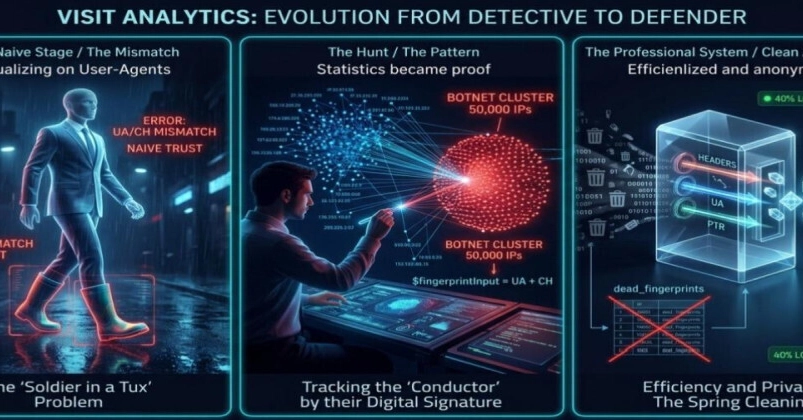
In this article, we’ll share how our traffic analysis tool evolved from naive trust in headers to a paranoid level of verification, and how that led to a "spring cleaning" of our architecture.
(For more on the project's first deep refactoring, read our article: Refactoring Laravel Visit Analytics: The Path to Version 2.0.0 )
Once upon a time, we were young and naive. We believed in the User-Agent string with all our hearts. We looked at it like a passport: "Oh, is that Chrome 128 on Windows 11? Welcome, honored user!" But the statistics from our VisitAnalytics package quickly knocked that romantic nonsense right out of us.
We began to see strange patterns: thousands of "different" devices visiting the site, all with perfectly calibrated, "squeaky-clean" UA strings. But upon closer inspection, it turned out that the behavior of these "people" was suspiciously uniform. They were like soldiers in identical uniforms, marching through a desert where there was no one else but them.