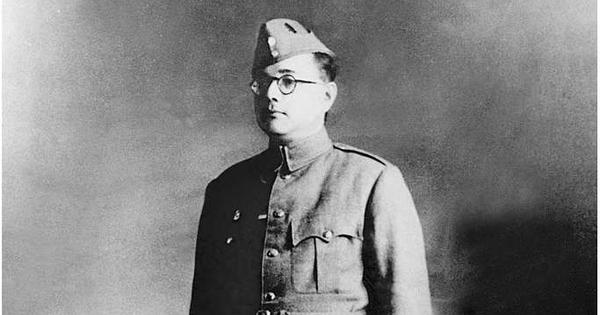
For some Indian history buffs visiting Singapore, a pilgrimage to the Esplanade Park is essential. It is the site of what is locally known as the Former Indian National Army Monument. Here, in July 1945, Subhas Chandra Bose laid the foundation stone for a memorial dedicated to the unknown warriors of the INA.Although the Japanese forces unveiled the completed monument later that August, it was swiftly demolished when British forces reoccupied the city-state. Decades later, in the 1990s, Singapore’s National Heritage Board, backed by financial contributions from the local Indian community, erected a new marker on the exact spot where Bose’s original structure once stood.Yet, a fragment of that original monument survived.When British forces destroyed the structure under the orders of Louis Mountbatten, a handful of INA members managed to salvage a fragment of it. Determined that this last remnant of a monument associated with the leader they called Netaji should not be lost, they secretly carried the relic back to India, risking punishment at a volatile moment in history.By 1946, this fragment came into the possession of Shah Nawaz Khan, a former British Indian Army officer who served as major general in the INA.Khan, a close associate of Bose, had been captured by British Indian forces near Pegu, Burma, in May 1945 and stood trial in Delhi’s Red Fort during the historic INA court-martials, with his defence led by the legendary Bombay lawyer Bhulabhai Desai.On December 31, 1945, Khan, alongside his co-defendants Gurbaksh Singh Dhillon and Prem Kumar Sahgal, was found guilty of “waging war against the King-Emperor” and sentenced to “transportation for life”. The punishment echoed the sentence imposed on India’s last Mughal emperor, Bahadur Shah Zafar, nearly a century earlier in 1858. However, the verdict sparked widespread protests across the country, forcing the army chief to commute the sentences within three days and release the trio.Secular armyFor Khan, the primary attraction of the INA had been its commitment to secularism and communal harmony.At a time when religious polarisation was growing in India and the demand for Pakistan was rising among sections of the Muslim elite, Bose’s army stood for national unity. Khan, who was born into a Muslim Rajput family in the village of Matore in Rawalpindi district, praised Bose’s efforts to bring together people from different religious communities.In his 1946 book My Memories of I.N.A. & Its Netaji, Khan wrote of Bose:“He looked at everyone – Hindu, Muslim, Sikh – without any distinction, and his spirit animated, as his men. There was no ‘communal’ feeling of any sort in spite of the fact that every man had full liberty to practise his religion in any way that he liked.”Khan noted that Bose successfully made his soldiers “realize that they were sons of the same motherland” and that religious differences in India were “the creation of an alien power”. He wrote that Muslims were among Bose’s most “ardent supporters and admirers” because he judged people by their worth rather than their regional or religious background.“It is amazing to see that when Netaji selected one officer from Germany to accompany him during his most hazardous journey to Tokyo by submarine, it was Abid Hussain, a Muslim, on whom his choice fell upon,” Khan wrote. “Again when his troops were sent to the fighting line both divisional commanders were Muslims – Major General M. Z. Kiani and I. When he was on his last trip to Tokyo by plane in August 1945, it was Colonel Habibur Rehman whom he selected to accompany him.”Khan’s memoir explicitly stated that Bose perished in the subsequent plane crash in Taiwan, a conclusion reaffirmed by the Shah Nawaz Committee in 1956.
The search for a lost fragment of Netaji Bose’s Singapore memorial
After the British demolished an Indian National Memorial memorial, a surviving piece vanished across the India-Pakistan divide.
1,426 words~6 min read