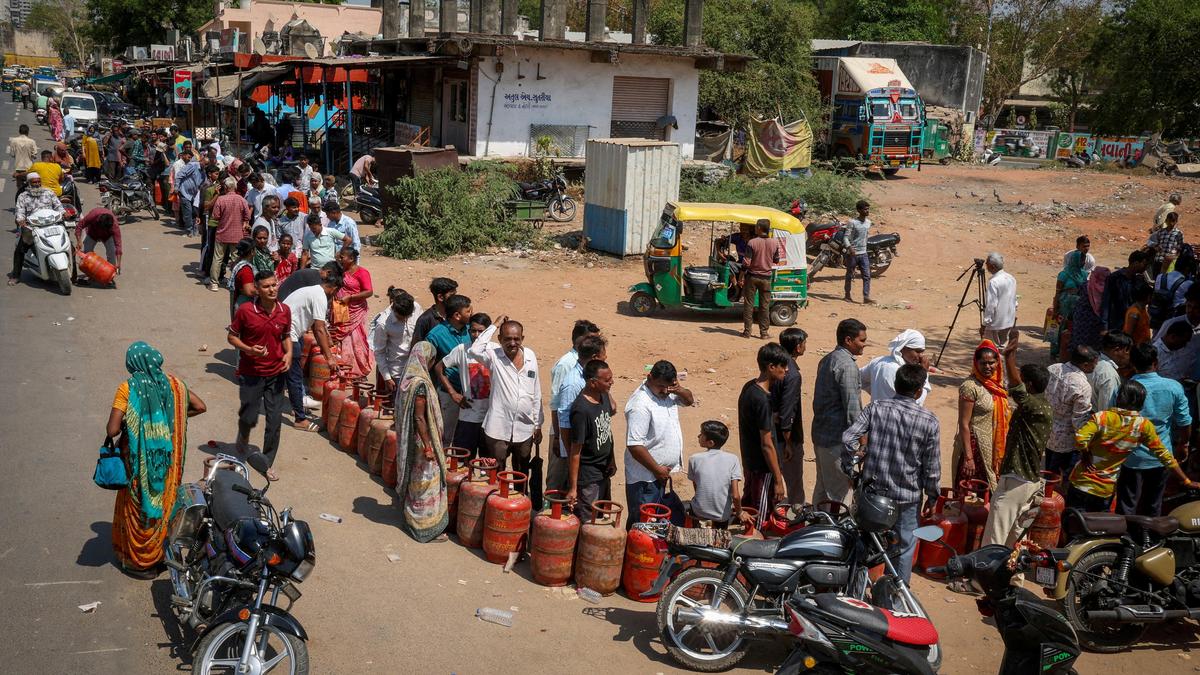
For over a decade, the Narendra Modi government has projected India as the world’s fastest-growing major economy, an emerging manufacturing hub, a Vishwaguru, a global power, a preferred destination for global capital, and a Viksit Bharat on track for 2047. Yet, behind this carefully crafted narrative lies a more troubling reality. The economy faces multiple external shocks while carrying deep structural weaknesses that threaten its long-term prospects.The warning signs are unmistakable. But instead of addressing them, the ruling establishment appears more focused on manufactured controversies, communal polarisation and divisive politics. As television studios debate temples, mosques, medieval rulers and invented enemies, the economy’s foundations continue to weaken.Imported energy, growing risksThe most immediate challenge is India’s growing vulnerability to external shocks. The country imports nearly 90% of its crude oil and about half of its natural gas requirements. Every rise in global energy prices is quickly transmitted to the domestic economy. The recent rise in fuel prices underscores a stark reality: despite the rhetoric of renewable energy, self-reliance and global leadership, India remains heavily dependent on imported energy.The consequences are severe. Rising oil and liquefied natural gas prices widen the trade deficit, weaken the rupee and raise production costs across the economy. In FY2025-26, the Reserve Bank of India sold over $53 billion in the foreign exchange market to support the rupee — its largest intervention in more than a decade. Foreign exchange reserves have fallen from over $720 billion to around $681 billion. An economy with strong fundamentals should not have to spend such vast sums merely to slow its currency’s decline. The issue is politically significant as well. Narendra Modi, as Gujarat Chief Minister, often linked the rupee’s value to national pride. Today, despite that rhetoric, the rupee has fallen to a historic low of about ₹95 against the U.S. dollar.Compounding the problem is the uncertainty surrounding fertilizers and agriculture. Again, India’s apparent strength in manufacturing fertilizers masks a dangerous vulnerability. Domestic urea production depends heavily on imported LNG. Almost all the fertilizers India produce are linked to heavy imports such as LNG and potash. Any disruption in global gas supplies, any sharp increase in LNG prices or supply chain disruption immediately threatens fertilizer availability and affordability.The challenge is compounded by the monsoon outlook. A weak monsoon affects far more than agriculture. Lower crop yields reduce rural incomes, weaken consumption, fuel food inflation. They also increase the need for government spending on relief, procurement and subsidies, which is unlikely under the Bharatiya Janata Party’s rule. These risks reinforce one another. Rising fuel costs, expensive fertilizers and a weak monsoon together create a vicious cycle that suppresses demand when the economy needs stronger domestic consumption.Weakening rural safety netsA responsible government would respond by strengthening employment guarantees and social protection. Instead, the Modi government abolished the Planning Commission and has steadily weakened MGNREGA, one of the country’s most effective rural safety nets. As a result, millions of rural households now face greater economic uncertainty with fewer protections than they had a decade ago.Beyond these immediate pressures lies a deeper structural concern. India’s external sector remains heavily dependent on services exports and remittances. The record $135 billion in remittances received in FY2024-25 has been a key factor in financing the current account deficit.Even this strength carries a warning. Increasingly, India’s remittances come not from migrant workers in West Asia but from highly skilled professionals in the United States, the United Kingdom and other advanced economies. The rise of right-wing politics and anti-immigration sentiment — championed by leaders such as U.S. President Donald Trump and echoed across much of the West — poses a growing threat to this model. At the same time, artificial intelligence (AI) is transforming software, data processing and other professional services in which Indian workers have traditionally excelled.The danger is not that remittances will disappear overnight, but that one of the pillars supporting India’s external balance could gradually weaken. If remittance growth slows while energy imports remain high, pressure on the current account and the rupee will intensify.International investors are already turning cautious. Foreign portfolio investors have withdrawn over ₹2.2 lakh crore from Indian equities this year, while India has slipped from sixth to seventh in global market-capitalisation rankings. Domestic retail investors have limited the damage, but the message is clear: global investors are becoming less convinced by India’s growth story.Even more worrying is India’s position in the technological transformation currently reshaping the global economy. Mr. Modi’s hollow guarantees have not only weakened what was built earlier but also his diversionary politics has prevented a discussion on what the future would be like and what India’s role in it would be.The 21st century will be defined by AI, semiconductors, advanced manufacturing, robotics and frontier science. Yet, India remains largely absent from these strategic sectors. Although the country has a vibrant startup ecosystem, much of it is concentrated in digital intermediation rather than technological innovation. Food delivery, ride-hailing and quick-commerce platforms may create high valuations, but they do not build technological sovereignty. Many of India’s celebrated startups still depend on organising abundant low-cost labour through digital platforms rather than developing globally competitive technologies.The contrast with global leaders here is striking. Taiwan dominates advanced semiconductor manufacturing through TSMC. South Korea commands critical positions through Samsung. The U.S. and China lead in AI, advanced chips and foundational technologies. India possesses immense engineering talent but remains heavily dependent on imported semiconductors, imported technology and imported capital equipment. Despite years of slogans about innovation and self-reliance, the country remains a marginal player in the industries that will define the future.Scant transformationThis is perhaps the most serious indictment of the Modi decade. The promised manufacturing revolution has not materialised. The demographic dividend remains unutilised. Millions of young people continue to confront precarious employment, stagnant wages and shrinking opportunities.Every failure has been passed on to ordinary people with a dose of hyper-nationalism. Wealth and opportunity continue to concentrate in fewer hands. The burden is socialised; the benefits are privatised.Electoral victories should not be mistaken for economic success. A government can win elections while pursuing policies that weaken the long-term foundations of economic development.The tragedy of contemporary India is that while the economy sends increasingly urgent distress signals, public attention is repeatedly diverted towards communal polarisation and manufactured controversies. Citizens are encouraged to fear one another rather than question policies that affect their livelihoods.India possesses the resources, talent and productive capacity to chart a different path. But doing so requires confronting the policies that have brought the country to this point. It requires defending public investment, strengthening social protection, rebuilding employment generation, investing in science and technology, reducing external dependence and restoring economic priorities to the centre of public life.Above all, it requires a resolute and united struggle against policies that enrich a few corporates while burdening millions with poverty. The choice before the country is stark: continue down the present path of division and economic fragility, or build a broad democratic movement with left-of-centre economics, capable of defending livelihoods, jobs and the future itself. The time to wake up is now, before it is too late.D. Raja is General Secretary, Communist Party of India (CPI)
The cracks beneath the peddled story of India’s growth
The economy in India faces multiple external shocks while carrying deep structural weaknesses that threaten its long-term prospects
1,189 words~5 min read