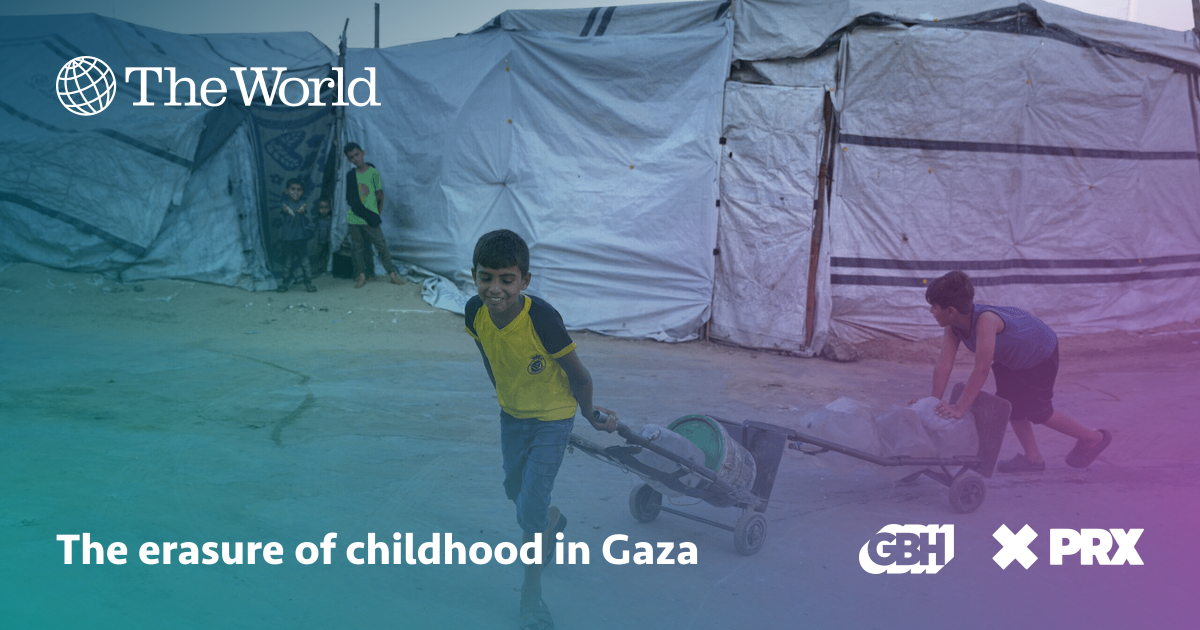
Public radio’s longest-running daily global news program.AboutContactDonateMeet the TeamPrivacyTerms of use©2026 The World from PRXPRX is a 501(c)(3) organization recognized by the IRS: #263347402.The erasure of childhood in GazaChildren account for roughly 30% of those killed by Israeli forces in Gaza in recent years. That’s according to a new UN report that charges Israel with deliberately targeting and killing Palestinian youth. The World’s Host Carolyn Beeler speaks with Dr. Bing Li, an ER doctor who works at Nasser Medical Complex in Khan Younis in the Gaza Strip, who treated dazed and confused children injured in an Israeli airstrike on June 24, 2026. Israel-Hamas warJune 26, 2026Updated: June 26, 202610:27Displaced Palestinian children haul water containers at the Yarmouk soccer stadium that was damaged during the Israel Hamas war, in Gaza City, June 20, 2026.Childhood in Gaza has been erased. That is the conclusion of a new report from the UN alleging that Israel has deliberately targeted and killed children in the territory. The report says roughly 30% of those killed by Israeli forces are children. It argues that Israeli actions before and after the ceasefire amount to crimes against humanity and genocide. Israeli officials have rejected the findings, calling them a “libelous sham.”The World reached out to Dr. Bing Li for a firsthand account. She’s an emergency physician from Arizona volunteering at the Nasser Medical Complex in Khan Younis in the Gaza Strip. Host Carolyn Beeler spoke with her after an airstrike sent people to the hospital in droves.Warning: This story includes some graphic descriptions.Palestinian children, some sick and others wounded, arrive at Jordan’s King Hussein Bridge border crossing en route to Amman, for medical treatment, April 27, 2026. Raad Adayleh/AP PhotoFor injuries like this, unfortunately, it’s going to be a lifetime of disability. The rest of the eye, whatever’s left, can’t be salvaged in these cases, especially with the contamination and the force of these types of injuries. Children shouldn’t be facing blast injuries. They shouldn’t be facing bombs. Nobody should, but especially not a 1-year-old. And so, that eye will have to be removed surgically. And what’s even more horrendous is that from a medical standpoint, this baby is now also at risk of losing the other eye, because once there is such an injury where there’s a rupture to one eyeball, the other eyeball is at risk to also be attacked by the body’s own immune system. And so, he’s at risk of losing sight in both eyes.Having arrived to Gaza last year, shortly before the ceasefire, unfortunately, not as much has changed as we were hoping. So, there was a lot of talk of more medical supplies being able to make it in, of more capabilities to be able to treat injured patients after the ceasefire taking place. So, in fact, the hospital had been planning to be able to start reconstructive surgery and restart many programs this January in 2026. However, those programs haven’t been able to start because of a lack of supplies being able to get through the border.There’s still a blockade and also a lack of fuel and a lack of basic supplies for the running of the hospital and for basic functions. For example, today the hospital had to shut down electricity in many parts and only keep the lights on where it was most important to keep ventilators running, to keep critical surgical operations running, but otherwise basically shutting off the power because that’s the only way to keep those critical operations functioning. And it’s quite nerve-wracking when you know that that’s the state of the availability of fuel in the hospital, which is the first priority, to receive this fuel.A Palestinian girl injured in the Israeli military’s ground and air offensive on Gaza, sits in an ambulance as the first group of sick Gaza children arrives in Jordan for medical treatment at the King Hussein Bridge border crossing on March 4, 2025. Raad Adayleh/AP PhotoWhat you’re hearing are surveillance drones basically watching the area, but they also all carry a small munition in them. So, in fact, the strike that I was talking about earlier today was from one of these drones, which is one of the things that is very appalling, the fact that the drone is able to see what they’re striking.So, they are able to see that these are children who are in the area. In fact, there was a strike that happened a few weeks ago where it appeared that the drone had waited until a child was in the vicinity before striking when they had a chance to strike earlier.Palestinian children wounded in the Israeli bombardment on a residential building in Bureij refugee camp, are treated at al-Aqsa Martyrs hospital in Deir al-Balah, central Gaza Strip, June 4, 2024.Saher Alghorra/AP/File photoThe tanks and the signs of the Israeli troops being present is definitely visible. From Nasser Hospital itself, from the windows, you can see military positions from three sides into the sea, the naval ships. In fact, I’ve seen these ships shooting at fishermen while they’re basically in their small boats, in their little rowboats, trying to fish these large, essentially, artillery rounds. To the south, you can see the Israeli positions. To the east, you can see the Israeli positions. You can see the towers that they’re building. You can see the entrenchment, and you can see the buildup of these tall berms. In fact, we’re even receiving alerts from the UN that the Israeli movements are coming in closer and squeezing us in even further.I’m currently the acting security officer for our organization, and we’ve received alerts that we can now no longer go as far east or as far south as we used to. And that has a detrimental effect on the supply of aid and on operations of aid organizations throughout the Gaza Strip. There are, in fact, parts of the Nasser Hospital that staff are afraid to go to — some of the staircases and some of the windows — because supposedly the Israeli snipers can see you from those positions.Palestinian children, some sick and others wounded, arrive at Jordan’s King Hussein Bridge border crossing en route to Amman, for medical treatment, April 27, 2026. Raad Adayleh/AP PhotoAbsolutely. We’re seeing community support that is extremely inspiring. When I was first working here in the north of Gaza, when I first arrived, I was in a hospital that was much smaller with less staff. And community members literally come and they help hold up blood products to give to patients. They help carry patients back and forth from the CT scan to the ER to the surgical wards. It’s really a lot of people coming together.I remember once there was a patient who collapsed in the middle of the street and 10 strangers basically picked her up and brought her to the ER. And we asked them like, “Who is this?” And they said, “We don’t know. We found her, but then we brought her in.”And they stuck with her the whole time until they found out if she would be OK or not. So, you really see that it’s a community that cares for each other. And as much as there’s so much difficulty that is going on, it’s a people who really desire to survive and desire to have their lives back.Parts of this interview have been lightly edited for length and clarity.
The erasure of childhood in Gaza - The World from PRX
Children account for roughly 30% of those killed by Israeli forces in Gaza in recent years. That’s according to a new UN report that charges Israel with deliberately targeting and killing Palestinian youth. The World’s Host Carolyn Beeler speaks with Dr. Bing Li, an ER doctor who works at Nasser Medical Complex in Khan Younis in the Gaza Strip, who treated dazed and confused children injured in an Israeli airstrike on June 24, 2026.
1,234 words~6 min read