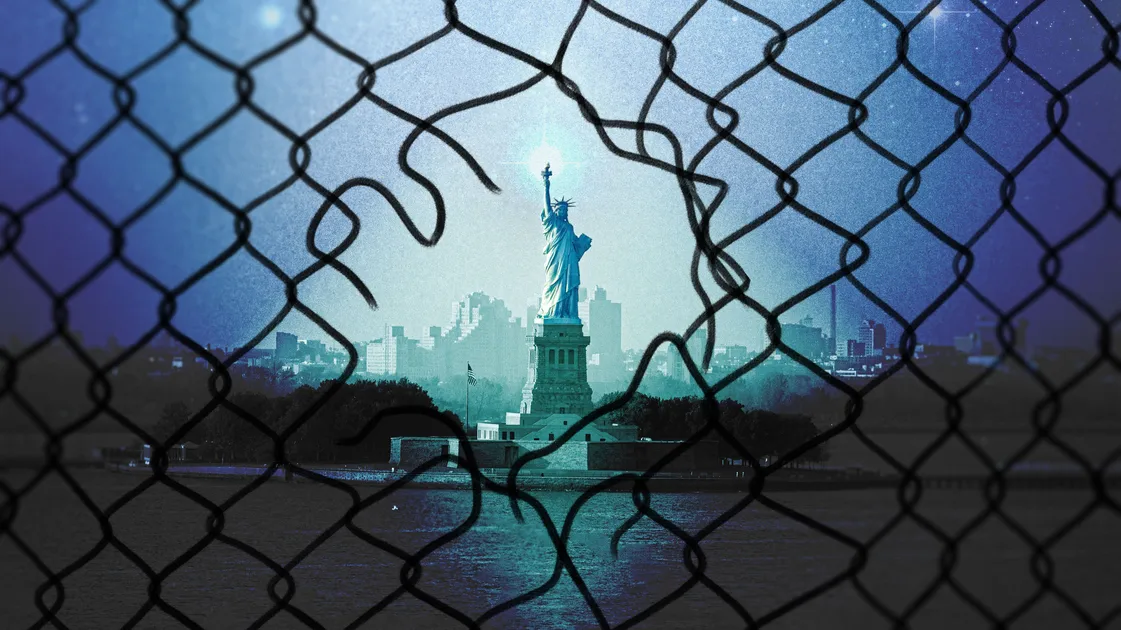
From the beginning, the United States was a land of immigrants. They signed the Declaration of Independence — which included a grievance against the king of England’s immigration restrictions — fought in the Revolutionary War and helped draft the Constitution. Their America was deeply flawed. Slavery persisted for nearly 100 years — and institutionalized segregation for 100 more — after the founders declared that “all men are created equal.” Settlers committed genocide against America’s Indigenous populations. And laws concerning immigration, when they were eventually written, showed the racial and national bigotries of their authors. But all the while, tens of millions of immigrants landed on America’s shores, were shaped by the United States’ embrace, and shaped the country in return. The nation did as Thomas Paine instructed in 1776 — to “prepare in time an asylum for mankind.” Nowadays, though, the United States doesn’t feel much like a place of refuge. Government lawyers argue they have the power to lock up millions of immigrants indefinitely, without criminal charges or bond hearings. President Donald Trump slanders people born elsewhere as “poisoning the blood of our country.” Federal agencies fantasize about deporting nearly one-third of the U.S. population — even though that would include tens of millions of citizens. It wasn’t always this way — and it doesn’t have to be like this. So, on the semiquincentennial of the United States’ independence, we wanted to know: What would an immigration “revolution” look like in the United States? To answer that question, we spoke to people who have thought deeply about it: a former ICE detainee, a pastor who has accompanied people to immigration court for years, a retired immigration judge, an immigration detention abolitionist, a journalist, a geographer, and an organizer who works with immigrant workers around the country. We asked them what they will be thinking about this July 4, and what the rest of us should consider for the future. “America’s immigration enforcement isn’t about keeping the country safe. It’s about control.” Growing up under Israeli military occupation and apartheid, I thought I understood the depths of state brutality. I was wrong. Two years ago, I protested the ongoing genocide against my people. For exercising my First Amendment rights, the Trump administration threw me into an ICE jail for 368 days. They punished me for calling for freedom and dignity for myself and my people. In that dungeon, far from my dying homeland in Palestine, I suffered my first seizure ever. The stress, medical neglect, dehumanization, lack of sleep and lack of proper nutrition in ICE confinement broke my mental and physical health. I am now diagnosed with epilepsy, a seizure disorder I will carry for life. My body has become a permanent record of the cruelty of the American immigration system. Here is what the world misunderstands: America’s immigration enforcement isn’t about keeping the country safe. It’s about control. It’s about punishing those who refuse to be silent, like Mahmoud Khalil and Yaakoub Vijandre. It’s about separating families, destroying communities, depriving people of their freedom and making people afraid to speak out. Israel killed 200 of my family members in Gaza with U.S. weapons. Their names are an echo in the sky, and their memory lives. I am still here. I am still speaking. But my body is breaking, and my family is suffering. The oppressive system that imprisoned me is the same system that enabled their genocide. I live each day knowing I could be sent to Israel, where Palestinians like me face arrest, detention, violence and death. If we are to rewrite the rules someday, we must abolish these unjust prison systems entirely. No more private prisons. No more illegal administrative detention, where the Israeli military throws Palestinian children, doctors and journalists into torture camps. No more deporting people to their deaths! The only just immigration system is one that values life and dignity over punishment and control.– Leqaa Kordia, Palestinian activist who spent over a year in ICE detention Palestinian activist Leqaa Kordia greets family, friends and supporters at a welcome home rally on March 22, 2026, in Paterson, New Jersey. Despite three court orders to release her, Leqaa spent a year in ICE detention as part of the Trump administration's crackdown on Palestinian student activism.Andrew Lichtenstein/Corbis via Getty Images“Immigration courts need independence.” The Trump administration is doing everything it can to destroy the immigration court system. Two cornerstones of any court are judicial independence and due process. Right now, Trump is dismantling both. Crucially, immigration judges are executive branch employees who can be fired. Trump has coerced immigration judges, on threat of losing their job, into being “deportation judges,” as he calls them. For years, working with the National Association of Immigration Judges, I spoke to legislators about how the immigration court ought to be reorganized either under the judicial branch, or as an Article I court under the legislative branch. But immigration judges’ concerns were dismissed under the mistaken belief that the law would protect our independence. Just because the law protects judges’ independence does not mean that Trump has followed the law. Instead, his administration has fired over 100 judges without cause or recourse. Other judges have quit or retired rather than be forced to do the wrong thing. Now, the administration is pushing immigration judges to “pretermit” asylum cases — that is, dismiss them without a full hearing — even though hearings in court are often the only time the full facts of a case are heard, and even though respondents in immigration court often appear without an attorney and aren’t able to fully exercise their rights.Some will say that immigrants facing deportation don’t deserve due process. But due process is a safeguard that protects everybody. U.S. citizens are sometimes mistakenly detained and deported. So are many immigrants in the legal process who have valid cases to stay in the country. Justice is done when people who have the right to remain in the United States have the right to present their applications to an independent body. As things stand, it may still be called a court system, but it’s not acting like one.In order to protect due process, even for noncitizens, immigration courts need independence from the executive branch — as the Trump administration’s dramatic, systematic abuse of the system demonstrates.– Denise Noonan Slavin, retired immigration judge and former president of the National Association of Immigration Judges“Only the people save the people.”There are many adults who have never known a time when U.S. immigration politics weren’t ruled by lies.The mid-1980s was the last time the country made a major attempt to “fix” immigration in a way that wasn’t just about punishing immigrants and militarizing the border. Republicans and Democrats in Congress — and Republican President Ronald Reagan — agreed on a plan to give equal rights to a generation of immigrants who sought to pledge allegiance to the U.S. flag. But that was 40 years ago. Immigrants haven’t changed. We are still human beings, motivated by everyone on this land before us. We love our families and our community. We pay taxes and ask for little in return. We commit far fewer crimes than native-born U.S. citizens. We know that the country accepts our labor more readily than it accepts our humanity, and we know it takes time for immigration laws to evolve. What changed? The reach and power of the lies about us, particularly since 9/11. White nationalist and other anti-immigrant extremists repeated the lies about immigrants loud and long. Lies about terrorism, rape, murder and cat-and-dog-eating. The lies poisoned our politics and helped elect the most anti-immigrant president in modern history. The country is now walled in by fear. Internment camps are a surging for-profit industry. A federal police force roams the streets in ski masks.What or who will save us from the lies? It will not come from the political class. Our best hope is found in the real world, in communities across the country where people are working together with what is true. We immigrants have been fixing things ourselves, one job at a time, one neighborhood at a time, and one family at a time. We’re protecting one another from immigration raids. Protesting outside ICE prisons. Picking up children stranded at schools. Pushing for better laws. Imagining a better world, and setting out to build it.We call this bottom-up, street-corner immigration reform. Amid all the lies, this much is true: Only the people save the people. Solo el pueblo salva al pueblo.– Pablo Alvarado, co-executive director of the National Day Laborer Organizing Network“I have accompanied people to ICE check-ins and court hearings where fear is palpable.”For me, the Gospel is not a theory; it is a way of life. Jesus teaches us in the Gospel of Matthew: “I was hungry and you gave me food, I was a stranger and you welcomed me, I was in prison and you visited me.” (Matthew 25). Those words are at the heart of my ministry.Every day, I accompany my immigrant brothers and sisters in immigration courts. I witness their fear, uncertainty, and often the pain of family separation. My presence there is a simple way of saying: “You are not alone; God walks with you.” At Saint Peter’s Church, we have developed a legal clinic where attorneys provide free legal assistance to immigrants. Every week, we distribute food and clothing to more than 850 families. I have also had the privilege and responsibility of serving as the legal guardian for more than 200 unaccompanied immigrant youth.I do not see this work as extraordinary. It is simply my response to the Gospel’s call. Because when we serve the stranger, the hungry and the vulnerable, we serve Christ himself.I will never forget the pain of mothers and fathers entering immigration court not knowing whether they will be able to embrace their children that same evening. I have accompanied people to ICE check-ins and court hearings where fear is palpable. But I have also witnessed extraordinary resilience. Even in the midst of suffering, hope remains alive.I believe the United States needs a conversion of the heart: a movement from fear to encounter, and from suspicion to solidarity.Scripture reminds us again and again: “Love the stranger, for you were strangers yourselves.” At some point in our family histories, most of us were strangers. My hope is that we can learn once again to see one another as members of one human family. Because in the heart of God, no one is a stranger. And when we open our doors to our neighbors, we discover that God opens doors for us as well.– Father Fabian Arias, pastor of Saint Peter’s ChurchFather Fabian Arias of St. Peter's Church embraces a man from Venezuela and his child after the man was detained as he left his immigration hearing at the Jacob K. Javits Federal Building on March 5, 2026, in New York City. The man was ordered to turn himself in at a later date.Michael M. Santiago via Getty Images“The immigration detention system as we know it today is not actually that old.” Imagining a world without detention might seem difficult in the current political climate, but the immigration detention system as we know it today is not actually that old. The modern detention system was born in the early 1980s, when the U.S. government began systematically detaining Haitian migrants who were seeking safety and opportunity, and soon after expanded the policy to a broader category of migrants. While detention in some form has existed on and off since the 19th century, this new iteration would grow in ways we had never seen before, aided by the American obsession with punishment and mass incarceration. Some half a million people pass through the detention system each year.Today, the Trump administration’s violent attacks on immigrant communities and the horrendous conditions in detention centers have laid bare the enduring harm of this system. For decades, detained people and advocates on the outside have been fighting against the inhumane treatment and conditions in detention, as well as the ever-expanding system. Ending detention isn’t just about freeing people and tearing down walls but creating a world where immigrants and non-immigrants alike are able to thrive. That looks like investing in education, housing, climate resilient infrastructure and healthcare, instead of a cruel and abusive detention system. When taxpayer dollars are invested in what we care about, we have more than enough resources for everyone to live a fulfilled life. No matter where someone came from or how they arrived in the United States, their life is of value, and they should be treated with dignity and respect. ICE’s immigration detention system does not need to exist, and communities across the country and people currently detained are organizing to end it and build a better future for all of us. – Silky Shah, executive director of Detention Watch NetworkA detainee inside Delaney Hall detention center during a demonstration over poor conditions there on June 6, 2026, in Newark, New Jersey. Andres Kudacki via Getty Images“So much that this administration is doing is legal.” Do Americans really support deporting a mother of three who’s nursing a baby at home because she happened to have gotten pulled over? Do they support tearing apart families who’ve been in the United States for decades because someone had a paperwork issue years ago? What about putting someone behind bars for months, and deporting them to a country where they’ve never lived, because they crossed a border when they were 2 years old and couldn’t make a decision for themselves? Plenty do support that agenda, but they should be honest. Based on the government’s own data, the vast majority of people being deported, or who are stuck in detention, do not have criminal convictions at all. In fact, less than 1% have serious, violent criminal convictions.For decades, Congress hasn’t dared to fix the fundamental issues in our immigration system, leaving it up to presidents to use their discretion to balance enforcement while also allowing humane pathways for people who are here, or who want to come here. The Trump administration has thrown that balance out the window with its over-the-top, monomaniacal attempt to deport every single person it possibly can, regardless of whether they’ve even broken any laws. So much that this administration is doing — punitive fines, the ability to hold people in detention — is legal, taking advantage of laws and policies that have been on the books for decades, when we were deporting 5,000 people per year rather than 400,000. People on the left should accept that there is going to be some enforcement, and those on the right must understand that trying to deport everyone is just un-American. But above all, Congress must act. And in my view, it should revisit immigration laws every year, so that our system responds to the real world.– Austin Kocher, political and legal geographer, research assistant professor at Syracuse University“The opposite of a camp is community.” Social change isn’t won by playing defense. We need to have a positive vision. And that means leading with a belief in freedom of movement for all people, and in human rights for everyone, regardless of where they are born. The yearslong quest in Congress for “comprehensive immigration reform” has amounted to Democrats capitulating to the right on key issues. It also assumes that our system responds to a real problem. In reality, the system is the problem. Our status quo hasn’t existed for long, and it will likely change. Borders aren’t fixed, natural things. They are tools, not facts. Forty percent of the world’s national borders were drawn by just two countries in the past century.Similarly, while the logic behind immigration detention — locking people up, controlling their movement — has existed in North America for centuries (in the form of, for one example, the reservation system), immigration camps as they exist in something close to their current form only appeared in the late 1800s. In recent decades, both parties have built up the camp system, and Trump has grown it at an unprecedented pace. Detention is a linchpin in the immigration enforcement regime, and ending detention would seriously limit the government’s ability to effect mass deportations. Bureaucratic mechanisms like permitting and zoning are chokepoints, vulnerable to local community pressure. And as we’ve seen over and over this year, that pressure can work. If we want change, we must each connect with two groups. First: Immigrants with precarious status, or no status at all — those who are targeted, marginalized, and held behind bars at camps or scapegoated outside of them. And second: Our neighbors. The opposite of a camp is community. The only way to shut down a camp and build something better in its place is to work with and for your neighbors. Rely on them, be reliable for them, and organize with them. – John Washington, journalist and author of “The Case for Open Borders,” “The Dispossessed: A Story of Asylum at the US-Mexico Border and Beyond” and the forthcoming “How To Close A Camp” These responses have been lightly edited for style, length and clarity.
This Is How The 'Immigration Revolution' Starts
HuffPost spoke with a former ICE detainee, an organizer for day laborers, a retired immigration judge and others about what an immigration revolution would look like.
2,857 words~13 min read