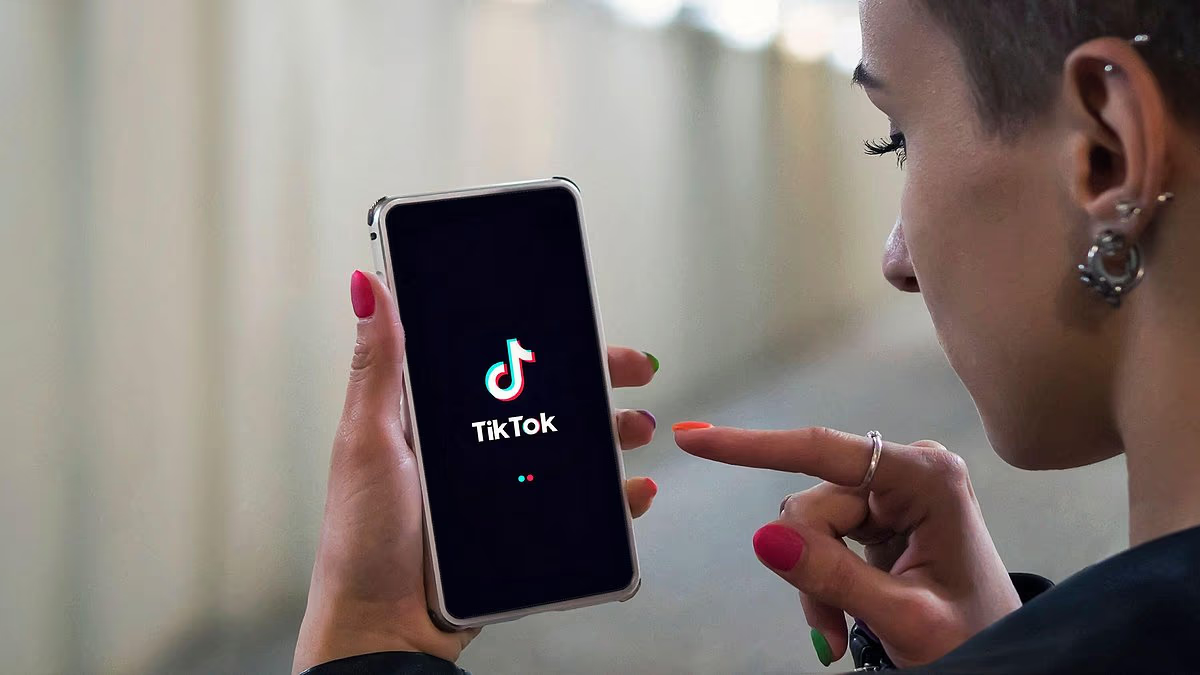
I don’t know how you came across this article, though I am of course thrilled that you did. Perhaps you found it on this newspaper’s amazing website; or perhaps, like me, you still like to have a hard copy delivered every day in your letterbox.You may be one of those faithful few who still use a paper to light the barbecue, or to swat the mosquitoes engendered by this country’s stunning new tropical climate.If you are under 55, though, it is increasingly likely that it just popped up on your social media feed. You were happily doom-scrolling cute cat videos or extreme skiing when your device suggested you might like to read this column, and the question is why. Why you?Why this piece? Why now? You think it’s just a function of your personality and preferences, as expressed over the years in your online presence. The theory is that the machine’s algorithm has served up this piece because it desperately hopes it is what you will like; and I am sure – in this particular case – that is indeed the basis of the recommendation.But what if some algorithms are actually trying to skew what you think, not by giving you what they think you will like, but by subtly manipulating what articles you read and what videos you see? What if foreign powers are using electronic gremlins to condition your views – your entire political psychology?I mention all this because the other day I was invited for a meeting in London with one of those secret-squirrel types who once had something to do with Israeli intelligence. He had concerns about TikTok.Well, I could see why that might be a worry. TikTok is a social media platform that provides an unending stream of short videos. It is globally huge and getting ever bigger in the UK. About 50 per cent of adults use TikTok, and more than 83 per cent of UK TikTok users are under 35. The other day I was invited for a meeting in London with one of those secret-squirrel types who once had something to do with Israeli intelligence. He had concerns about TikTokThat means the TikTok algorithm has a vast cultural and political impact. By deliberately curating the videos you watch, the algorithm could help to prejudice your emotional response to events.The reason this former spook wanted to see me was that he believed he had found evidence of an anomaly in the TikTok recommendations. It was possible, he said, that the people behind TikTok – the Chinese – have their thumb on the scales.He explained that his former colleagues had done an experiment. They had created 59 bots, and opened TikTok accounts for all of them. They didn’t search for anything. They didn’t create their own online personalities. The bots didn’t ‘like’ or ‘dislike’ anything.They just scrolled through everything the TikTok algorithm threw at them and over a period of a month – around March this year – these dummy TikTok users were fed 6,500 videos, some of which were sent more often than others. The Israelis then did a very clever thing. They tried to work out the algorithm – the basis on which TikTok was sending the videos.Using all the publicly available data about these videos – the number of times they had been viewed and liked and shared – they found they could pretty much explain what TikTok was doing, and the principles of the algorithm.But there was one category of video – they claimed – that simply didn’t conform to these predictions: videos mocking or otherwise criticising Donald Trump’s war on Iran. According to the Israeli study, these were 21 per cent more likely to pop up on your phone or laptop than you would expect, given the number of times they had previously been viewed, shared, liked etc. If their understanding of the algorithm was correct, these videos were being substantially ‘over-recommended’ by TikTok.It might be a fluke, the study’s authors admitted, but if so it was a one in 30 million chance.Well, what do you think? Is Beijing-owned TikTok using its colossally popular social media platform to strengthen anti-Trump sentiment and undermine the West? The reason this former spook wanted to see me was that he believed he had found evidence of an anomaly in the TikTok recommendations. It was possible, he said, that the people behind TikTok – the Chinese – have their thumb on the scalesYou can see why that might well be the case. The Chinese have the technology, they have the means to shape the propaganda, and they have hundreds of millions of impressionable young Western minds whose opinions can be gently massaged by the algorithm, so that they become ever more sceptical about Trump, about Israel, and more inclined to take a position that is pro-Iran and, by extension, pro-China. As you might expect, I have done some basic journalism and asked a few other people to look at the Israeli study. There are plenty of reasons to be cautious about the claims, not least their provenance.Very few governments or populations apart from Israel think it was a good idea for America to attack Iran, and there is hardly anyone who thinks the execution – such as failing to predict the closure by the Iranians of the Strait of Hormuz – has been brilliant.The global consensus is things have not, so far, been well thought through. So, you can see why the Israelis, who are rightly apprehensive about Iran, might want to question the way so much of the world has arrived at that anti-Trump consensus. It might be very useful, from an Israeli point of view, to suggest that social media is being cunningly slanted by the Chinese.That is not to say that the Israeli findings are necessarily wrong – you just have to wonder about motive. The more important objection is that the experiment – while thoroughly ingenious – may have failed actually to capture the full complexity of the TikTok algorithm.It may be that TikTok is using data not available to the 59 bots. The algorithm might be sensitive to how long people spend looking at a video that satirises Donald Trump, for instance. The algorithm may take account of whether they scroll past it, or linger on it, or research the author, and so on.It might be that people are engaging with anti-Trump videos in ways that the TikTok algorithm recognises, but which the Israeli experiment has not detected. That could account for the discrepancy the Israelis found.But the truly important and worrying thing is that we just don’t know. The UK population, especially younger people, are spending more and more time scrolling social media for the type of videos that shape political opinion.The algorithms that determine what they watch are mainly American – in the case of Google, X, Instagram, Facebook – or Chinese in the case of TikTok. None of them is based in this country. None of them is remotely accountable to the people of this country, or any of its democratic institutions.None of them is transparent or even intelligible to us. By relentlessly targeting pre-existing preferences, the algorithms of social media are already reinforcing divisions in society, coarsening and polarising debate so that politics is notably more vituperative than it was 20 years ago.I don’t know whether this Israeli study is right or wrong, but if foreign powers are using algorithms to slant opinion, that is even worse. By pandering sedulously to our views and interests, by gaining our confidence, these algorithms are in a unique position to manipulate and brainwash us all.Commercial confidentiality should be no protection. We must understand how they work.The algorithm watches you. The algorithm knows you. The algorithm loves to make money out of you.The algorithm can clearly manipulate the way you think. It’s time we knew more about the algorithm and the people behind it.
BORIS JOHNSON: What I've heard about electronic gremlins is terrifying
The other day I was invited for a meeting in London with one of those secret-squirrel types who once had something to do with Israeli intelligence. He had concerns about TikTok.
1,316 words~6 min read