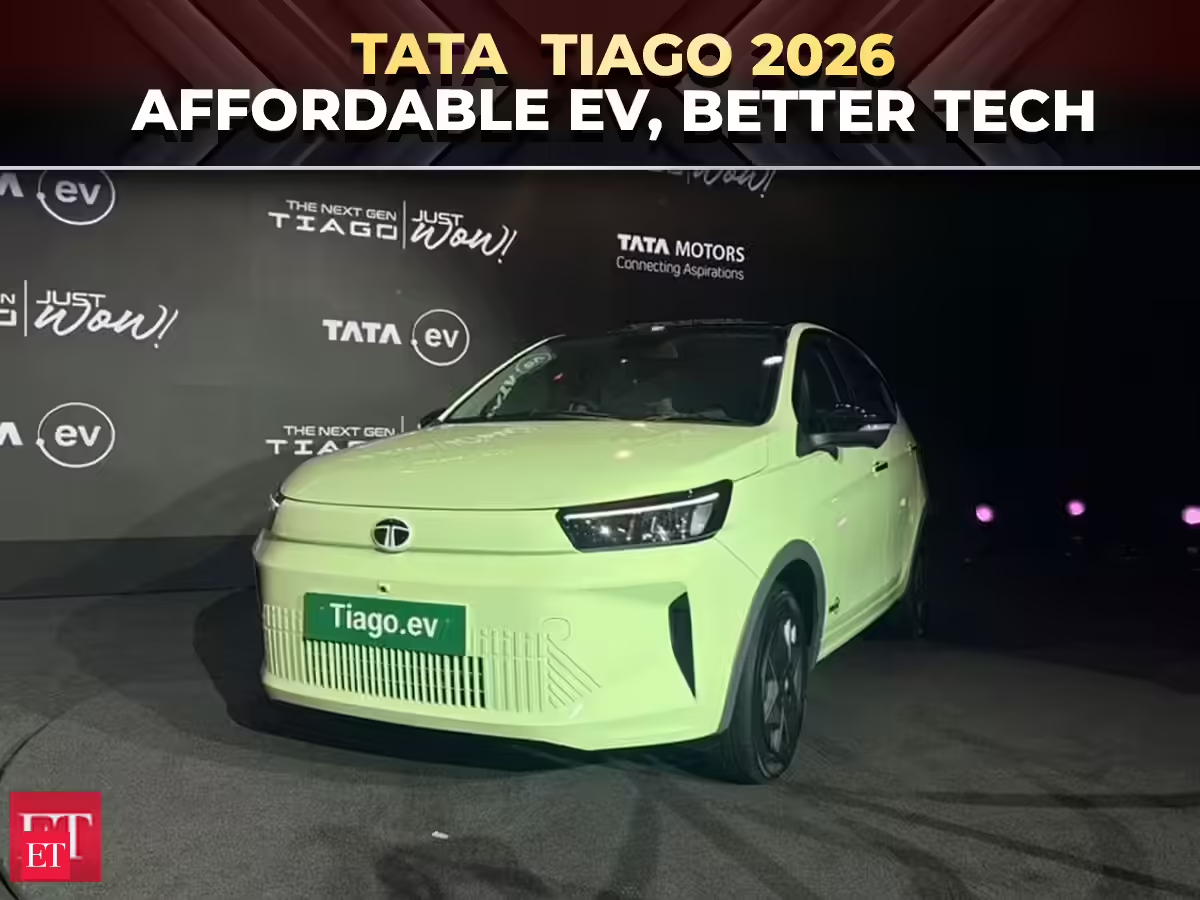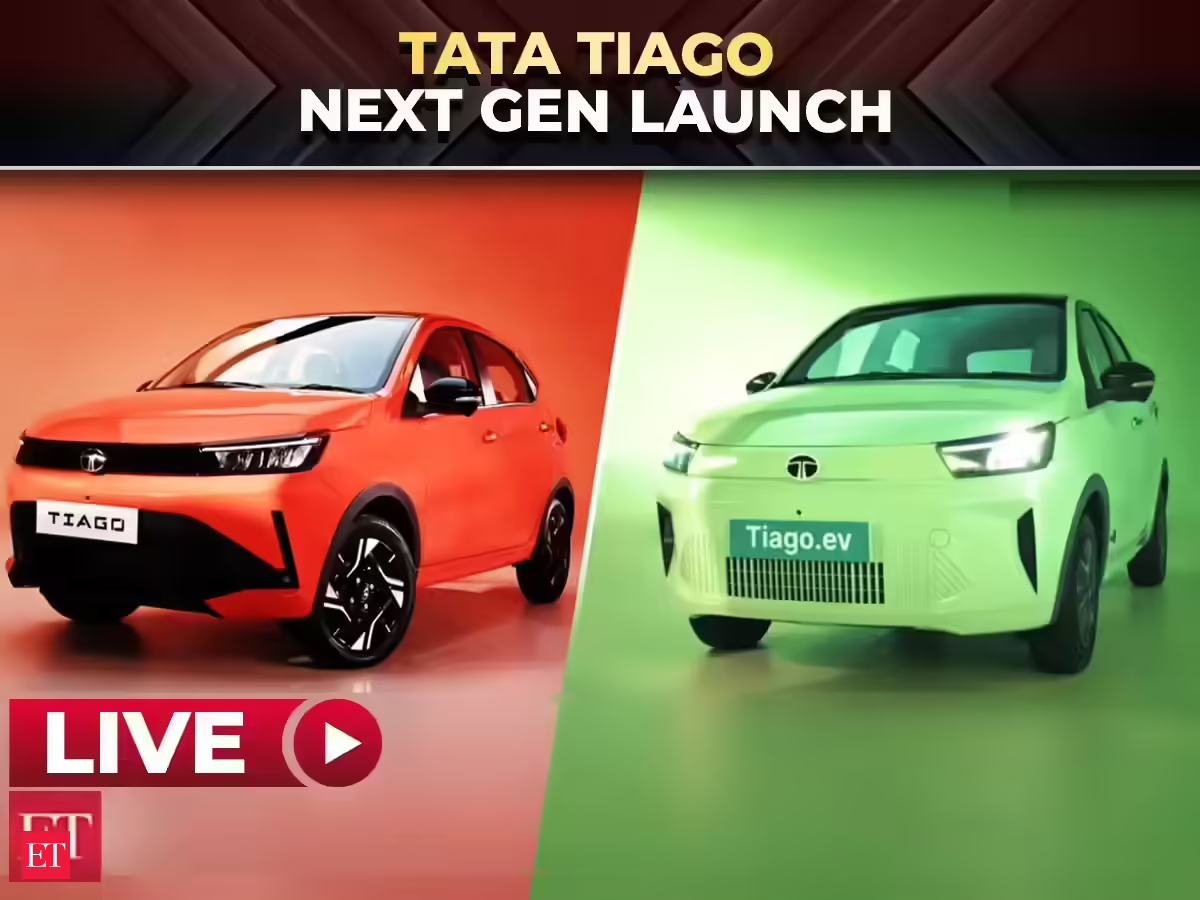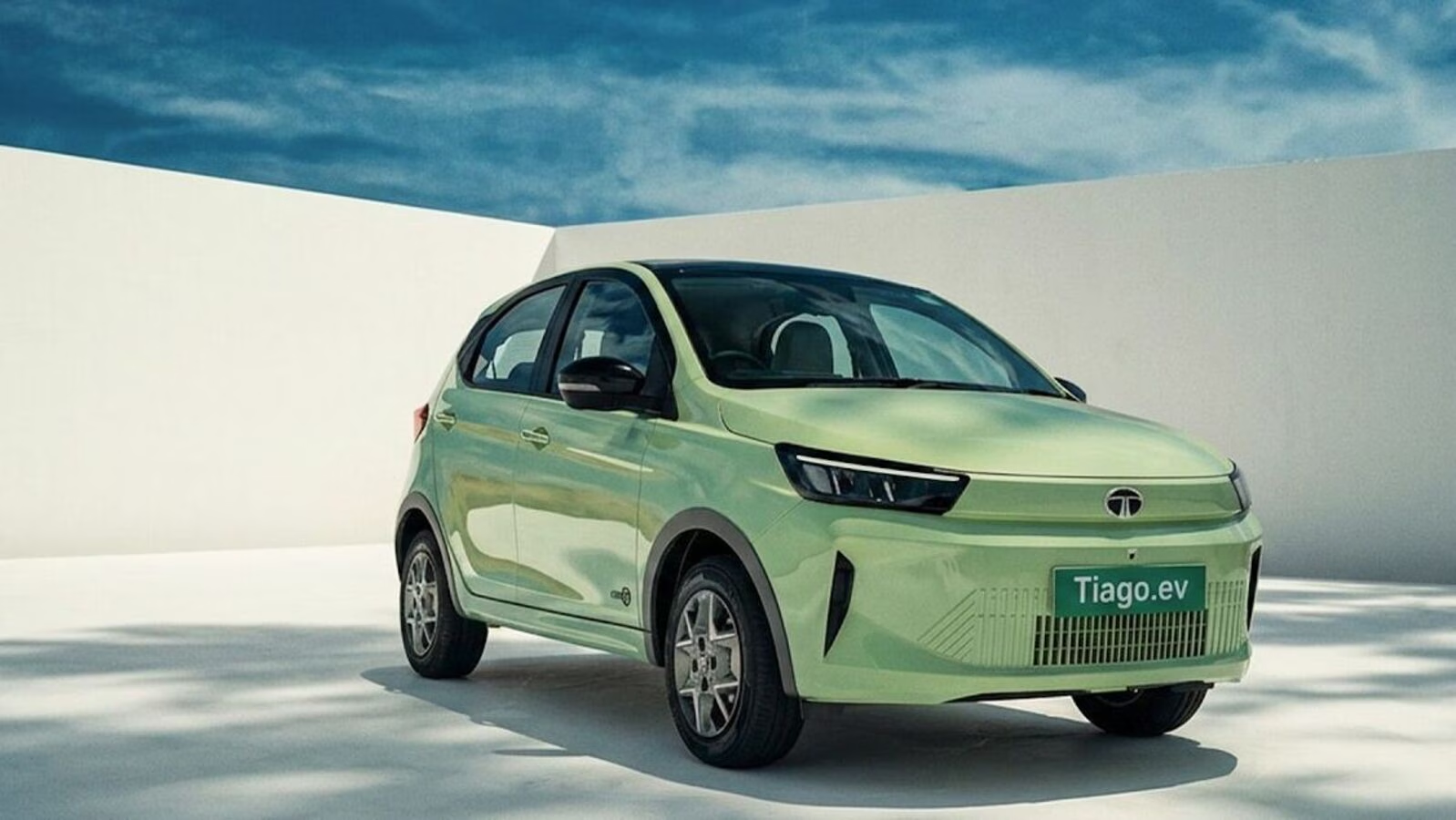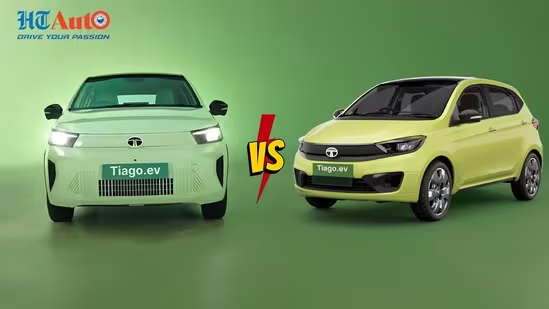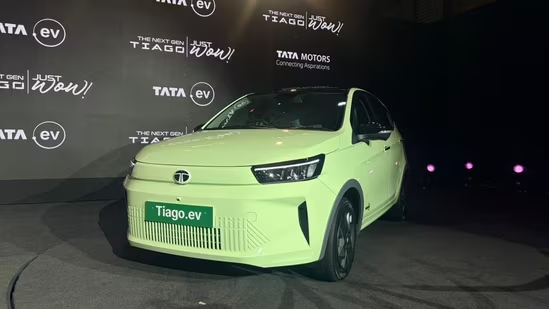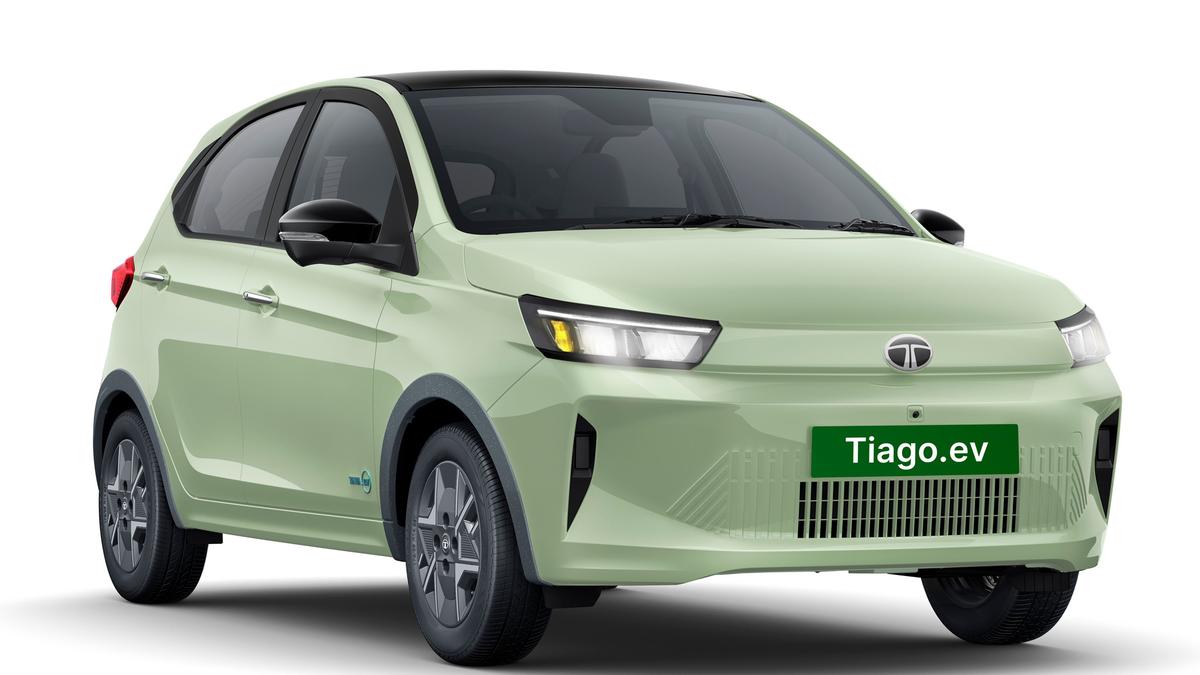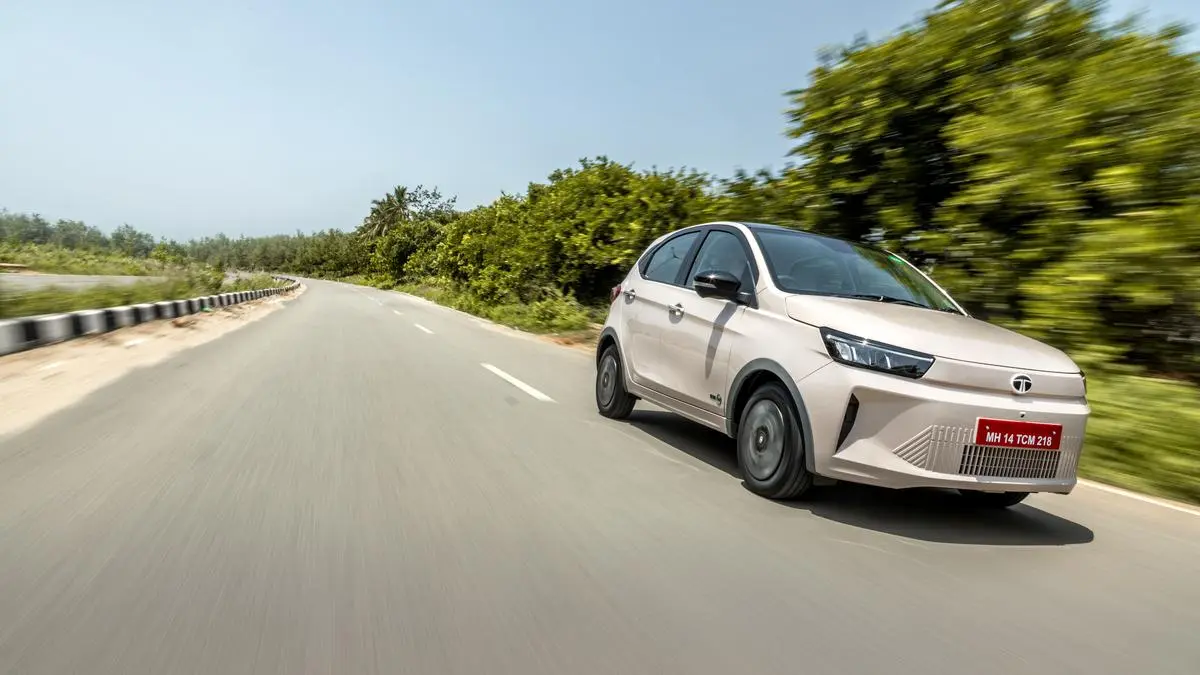
If you’re a first-time car buyer, I envy you. You’re really spoilt for choice and no matter what kind of car you choose to own, the likelihood of you having brought home something compelling is at an all-time high. The Tata Tiago.ev is the newest to join that tribe of cars. All right, it’s a facelift — and a pretty thorough one, too — but Tata, of late, has built quite a reputation for approaching mid-life updates rather rigorously. The result is a Tiago.ev that’s substantially evolved.KEEPING IT COOLLike in the petrol/CNG version we reviewed earlier, the Tiago.ev gets a brand-new front end, a cleverly redone rear end while retaining its side profile. Its more EV-esque nose — cleaner, more minimalist — looks refreshing and bears the Tata emblem with a white bezel that you’d expect to be illuminated but isn’t. The EV gets a lighter grained trim (same as on the Punch.ev) around the wheel wells, which looks quite nice.In profile, the Tiago.ev’s simple, friendly styling featuring large windows remains untouched, although it doesn’t necessarily gel with the boxier front end. At the rear, there’s a chunky reflector bar (not illuminated) that runs across the length of the boot lid. The EV, like the top-end petrol version, also gets the option of a blacked-out roof which looks sporty and adds to the Tiago’s youthfulness. Also, the EV gets 14-inch steel wheels shod with aero covers (I’m not a fan) and 175/65 tyres.INSIDE LOOKTo say the cabin is vastly improved would be a huge understatement. It’s not as if the Tiago’s cabin was particularly lacking, but with this revision you get a cleaner, more contemporary layout with greatly improved materials, and an overall maturity to its design and appeal. The sea of all-grey has been managed wisely with the right use of textures and materials, and to my absolute delight there’s not a trace of piano black in there anymore. Instead, in visually dominant areas, such as on the steering wheel and bits of the centre console, there’s tasteful plastic trim that emulates brushed metal and looks very premium.There are good-quality physical controls for all functions and screen-dependence is non-existent. For those of you who insist, there is a twin-screen setup, neatly integrated and fortunately not too attention-grabbing. The driver’s instrument display is a compact unit which is easy to gather information from on the move, while the infotainment screen is larger and crisper, and features a very good reversing camera view as well. The grey fabric you see on the dash and the floating door-mounted panels look really good, too, but scuff way too easily.The front row of seats feel particularly comfortable and spacious even over extended periods of time, and outward visibility from the driver’s perch is excellent, making the Tiago.ev an easy car to adapt to, for new drivers. It’s at the rear that there’s a severe space crunch; I mean, you can perhaps squeeze two adults in there, but they aren’t going to enjoy it, what with their knees digging into the front-row seatbacks. This is one limitation of the existing Tiago platform Tata hasn’t been able to improve upon and, perhaps, where it may stand to lose ground if its rivals choose to enter the ring.SMARTER, SMOOTHERHas the driving experience changed greatly, too? Of the two battery packs on offer (19.2 kWh and 24 kWh), I drove the higher-spec version and, yes, it drives better. Thanks to improved throttle mapping, the Tiago.ev now responds with far greater composure to low-speed inputs, something that will particularly help newer drivers who may find the EV’s responses a bit too sharp. The software, too, has been recalibrated to favour efficiency, while also offering better dynamic range predictions.There are two driving modes on offer — City and Sport — and while there are no paddles, you do get physical dash-mounted buttons to control the four regenerative braking levels, the lowest being a freewheeling mode. In either driving mode, I found steps 1 and 3 of regen to be most effective, with step 2 offering no noticeable change in demeanour. In City mode, the Tiago.ev feels light and easy to drive, with the throttle feeling perfectly intuitive. In fact, there’s a spiritedness to the Tiago’s stride even in City mode, and Sport takes it up a notch higher. No cause for concern for newer drivers, though. Out on the highway, the Tiago.ev felt adequately equipped for quick overtakes and, likewise, held the speed limit with ease.The steering feels well-calibrated, too, and makes light work of city driving. Under aggressive cornering (not something you’re expected to do), the MRF tyres did feel overwhelmed, though. Among the highlights of the Tiago.ev’s package is its inherent stability and its high-speed roadholding, aided by its low stance, is quite admirable. Ride quality, too, is rather good and it takes surprisingly well to broken roads at most speeds. Braking, however, felt quite poor, with our test unit lacking any sort of bite; even if this was specific to our test car, Tata must ensure consistency to deliver appropriate braking performance.Now, for the most critical bit — range. At 99 per cent charge, the Tiago.ev displayed a range of 215 km and, having driven it (enthusiastically, with far from ideal inputs) for roughly 115 km, the state of charge dropped to 24 per cent, at which point the range displayed was down to 50 km. What this effectively translates to is a comfortable 150 km of range under average driving behaviour (without being alarmingly close to running ‘dry’). With extremely mindful driving, you can perhaps take that number up to 180 km as well. Therefore, if you commute 300 km a week, two full charges (20 to 80 per cent in 30 minutes) should serve you quite well.All of this for ₹6.99 to ₹9.99 lakh (ex-showroom) must feel like a steal, surely? Yes, if you’re intent on buying a small hatchback that’s well-suited to newer drivers. The revised Tiago.ev is certainly a strong step in the right direction, not only for what it offers as a value-rich car for first-time buyers, but also for how it represents the Tata brand of cars. In buying one, though, you will not only have to look past the rather compelling Tiago iCNG, but also, ahem, the base, 30-kWh variant of the Punch.ev which is, in fact, priced nominally lower. Told you, I envy you!@TheMotorGramPublished on June 26, 2026
Tiago.ev: Charged Up
Discover the upgraded Tiago.ev: a youthful and intelligent evolution that enhances performance and features.
1,069 words~5 min read