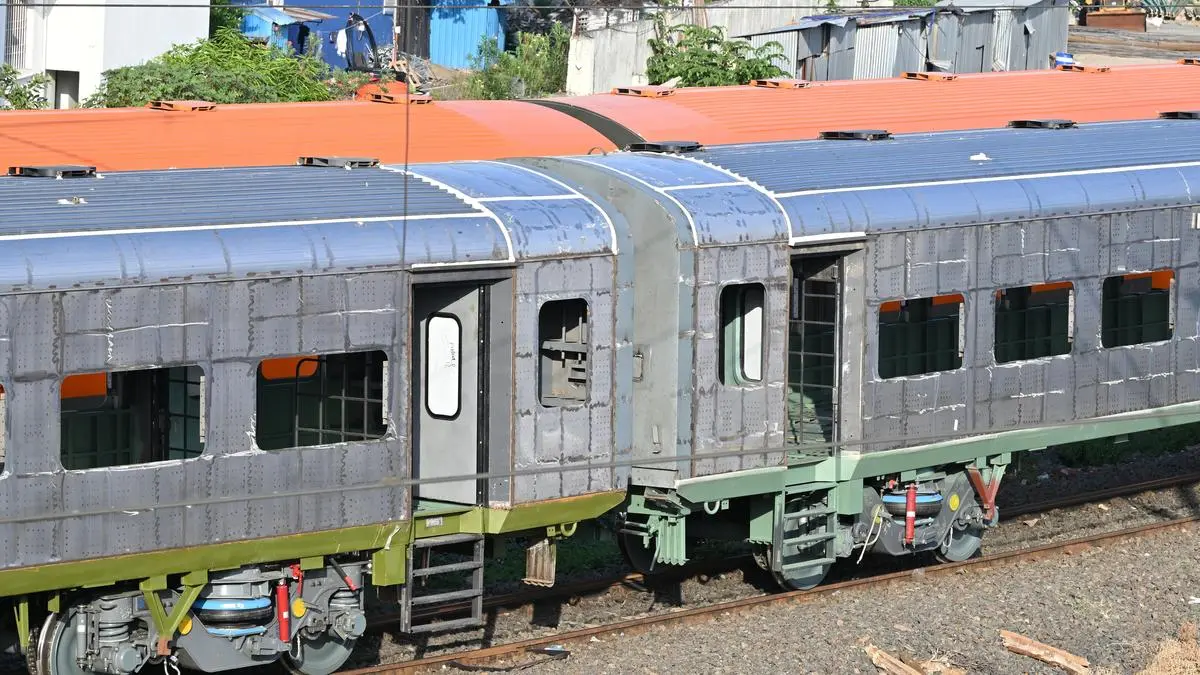
(file picture)According to information shared by senior ARAI officials, the objective was not to introduce new safety features but to verify whether the coach behaved as engineers expected under a controlled collision.
If you’re travelling on a Rajdhani, Shatabdi, Duronto or one of the thousands of Mail and Express trains equipped with Linke Hofmann Busch (LHB) coaches, one question matters if the unthinkable happens: How well will my coach protect me in a serious collision?For years, Indian Railways’ answer has been the LHB coach itself. Introduced to replace the older Integral Coach Factory (ICF) coaches, LHB coaches were engineered with stainless-steel bodies, anti-climbing Centre Buffer Couplers and energy-absorbing structures designed to better protect passengers during a collision.crash testOn June 24, Indian Railways physically crash-tested an LHB coach for the first time, deliberately crashing two passenger coaches into a fixed barrier at 44 kmph at its dedicated crash test facility in Lucknow. The exercise, carried out jointly with the Automotive Research Association of India (ARAI) and the Research Designs and Standards Organisation (RDSO), marked India’s first full-scale validation of LHB crashworthiness against the European EN 15227 standard.According to information shared by senior ARAI officials, the objective was not to introduce new safety features but to verify whether the coach behaved as engineers expected under a controlled collision. Engineers examined whether the passenger compartment remained protected, how collision energy travelled through the structure, whether the anti-climbing couplers kept adjacent coaches aligned and how the coach absorbed crash forces. Hundreds of sensors and high-speed cameras recorded every stage of the impact, producing data that will now be used to validate engineering models and refine future coach designs.The timing is significant. Indian Railways is in the middle of one of its biggest safety and fleet modernisation programmes, with annual safety-related capital expenditure increasing from ₹39,200 crore in 2013-14 to ₹1,17,693 crore in FY2025-26, and ₹1,20,389 crore allocated for FY2026-27.Today, LHB coaches form the backbone of India’s long-distance passenger fleet. More than 43,000 coaches are in service, operating on Rajdhani, Shatabdi, Duronto and a growing number of Mail and Express trains. Since 2014, Indian Railways has manufactured more than 42,600 LHB coaches—an eighteen-fold increase over the previous decade. During FY2025-26 alone, railway factories produced 6,677 coaches, while production of conventional ICF coaches has been phased out.Automotive testingOne of the defining aspects of the exercise was the role of ARAI, India’s automotive testing and certification agency under the Ministry of Heavy Industries.Best known for Bharat NCAP crash testing and vehicle homologation, the Pune-based organisation brought expertise in crash instrumentation, structural analysis, telemetry and data acquisition that has traditionally been used to validate passenger vehicles.The railway crash test marks the latest expansion of those capabilities beyond automobiles. ARAI has previously validated Obstacle and Derailment Detection systems for the Delhi Metro Rail Corporation, undertaken structural and vibration testing for railway components and applied its expertise in sensors, electronics validation and lightweight materials to rail projects.As Indian Railways upgrades its passenger fleet, the collaboration reflects a broader convergence between the automotive and railway sectors, where engineering capabilities developed for one mode of transport are increasingly being applied to another.Published on June 26, 2026