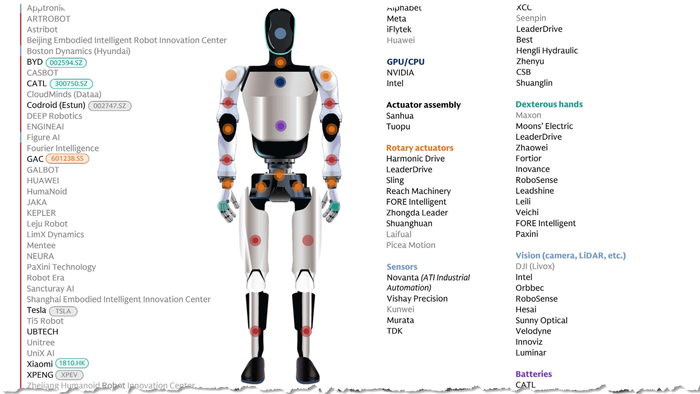
Illustration: Sarah Grillo/Axios. Stock: Getty ImagesThe next phase of AI adoption and investment is expanding into the physical economy — factories, mines, utilities and oil rigs — Goldman Sachs says in a report exclusively shared with Axios. Why it matters: Investor attention is still trained on frontier AI labs, but Goldman argues the next wave of deals and investment will come from deploying AI across the real economy.Zoom in: Goldman estimates roughly $7.6 trillion will be invested globally in AI infrastructure from 2026-2031, across compute, data centers and power.Yet software accounts for less than 0.5% of global GDP, Goldman says, leaving "the other 99.5%" of the economy to AI's next frontier."We're only just beginning" to see AI's impact on industrial businesses, Mark Sorrell, global head of industrials at Goldman Sachs, told Axios.Between the lines: The traditional boundaries between tech and industrial companies are blurring. AI has made technology companies more collaborative with non-tech firms, Jung Min, Goldman's global co-head of tech, media and telecommunications told Axios. Sorrell said conversations with manufacturing executives have shifted from whether factories will adopt AI to how quickly automation will spread.Looking a decade ahead, Sorrell said many expect production lines to rely on far more robots than human workers, particularly for unsafe work.Follow the money: AI is advancing faster than the money to deploy it can materialize, which is either a reason to be optimistic or a reason to fear a pending AI market bubble, depending on who you ask. But Min argued that it's "healthy" for companies to tap new sources of capital to meet AI demand from across the economy."Which sectors thrive and which stall" is "a challenge of capital architecture as much as engineering," the report notes.Threat level: The changes are creating a sense of urgency inside boardrooms."There's definitely a little bit of, 'If I don't move, do I get left behind?'" Sorrell said of conversations with corporate clients.Tech M&A has already reached $566 billion in 2026, up from $334 billion in all of 2025, according to Dealogic data cited by Goldman.Geopolitical tensions haven't slowed deals in the space, Sorrell said, as global energy prices have come down. The bottom line: AI's next chapter won't be confined to Silicon Valley. Goldman says it will increasingly be built across the physical economy.
Exclusive: Goldman bankers say the next AI boom is in the physical economy
AI has made technology companies increasingly dependent on non-tech firms.
379 words~2 min read