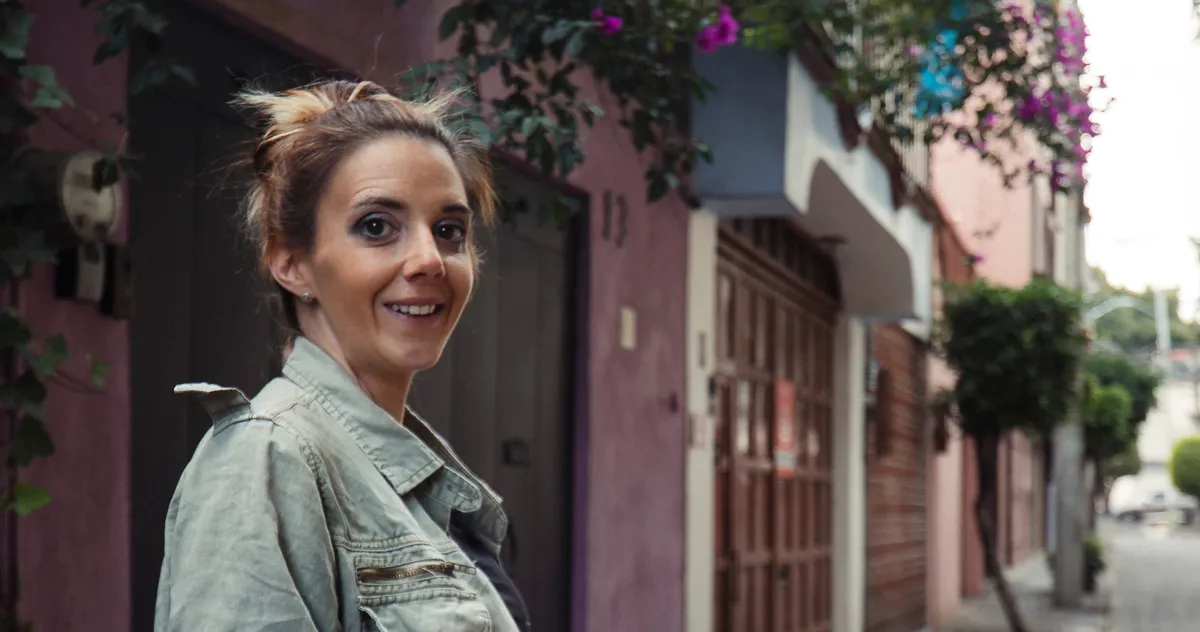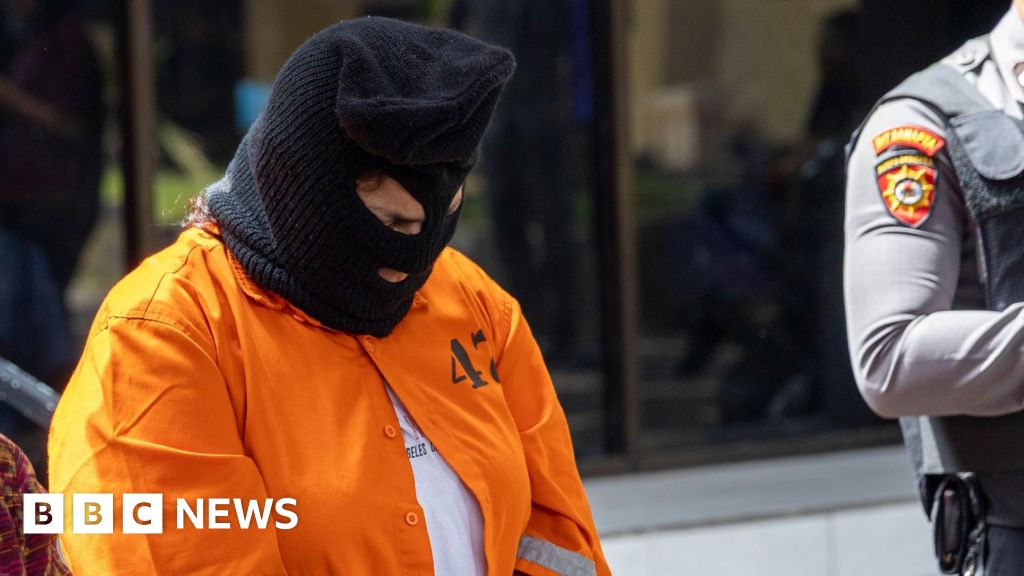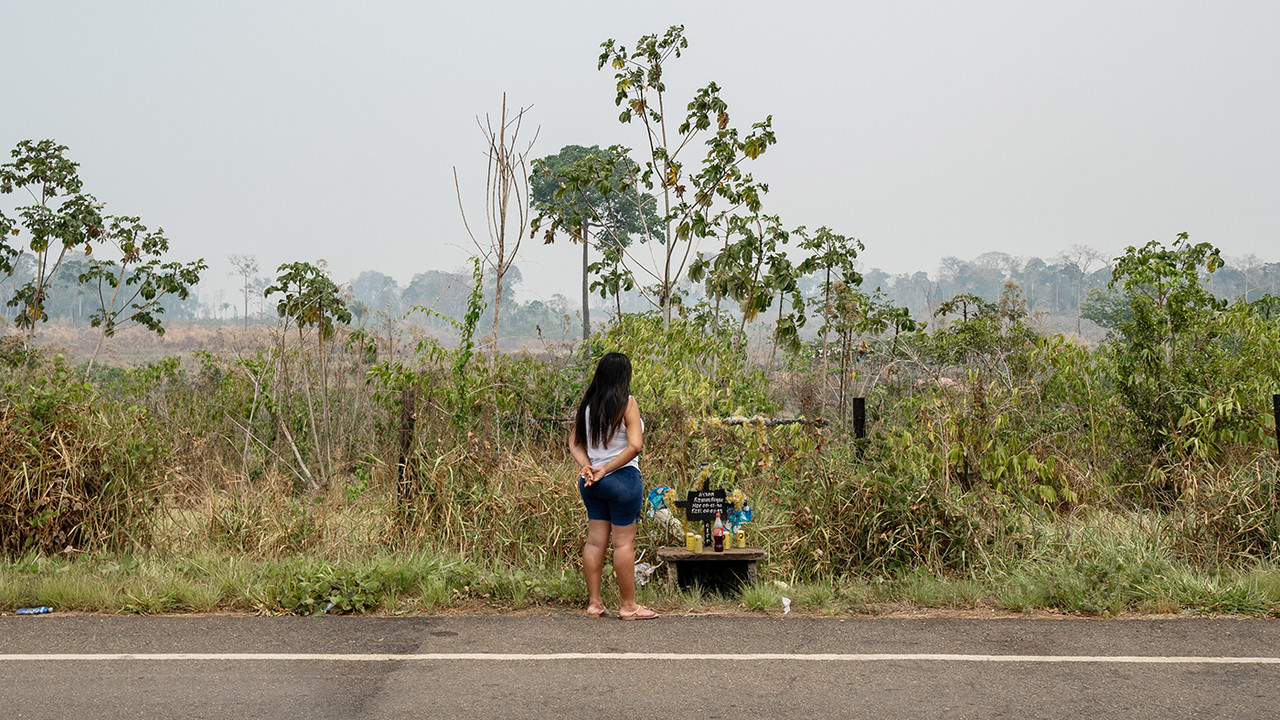
26th June 2026 By Robyn Huang It was a humid night in October 2023 and Nancy Thalía Ramos Roque, 27, was on her way home from a bar in Puerto Maldonado, a city in the Peruvian Amazon. She had been drinking cheap Brazilian beer with her friends and dancing to songs that reminded her of her childhood, and she teetered unsteadily down the street in her tight white shorts. As she approached her flat, there was a sudden, blinding glare of headlights. Before she knew what was happening, ten police officers raced towards her. They shouted her name and dragged her inside. Her nine-year-old daughter cried as officers flooded into the cramped living room. Ramos’s mother, who had been babysitting, demanded to know what was going on. No one answered her. The police filmed the arrest, and the next morning Peruvian news channels broadcast footage of Ramos looking dazed on the sofa, her leg jiggling with nerves as officers peppered her with questions. Newspapers described her as the cabecilla, or ringleader, of a regional human-trafficking network, operating under the alias “Sandra”. Ramos later admitted that she had been paid to transport migrants across the Brazilian-Peruvian border. Most then journeyed onwards towards the United States. News of her arrest reached me in Mexico City, where many of the migrants that she helped ended up as they waited to cross into America. I’d heard people talk about a coyote in Peru they knew as “Mama Sandra”. Coyotes, as those who guide migrants across the border are known, often rob their charges or abandon them in the jungle. But two of the Afghan migrants I knew spoke warmly of Mama Sandra, grateful that she had delivered them safely to their next crossing point. The line between decent citizen and hardened migrant-trafficker can be surprisingly blurred One of these men, Surat, had been travelling with his daughter and granddaughter. He told me that Ramos had arranged for his group to stay in a hotel when they were delayed at the border, brought food for them all, and watched his granddaughter so her mother could rest. Surat’s family stayed in touch with Ramos long after crossing the border with her. “It wasn’t just business,” he said. “It was human.” Another Afghan, Muhammad, told me Mama Sandra was “a good woman”, and that migrants trusted her. As I watched the video of Ramos’s arrest, I found myself wondering about her story. Was she the caring figure the Afghans had talked about, or a player in a ruthless organised-crime network? For the past three years I’ve tried to find out who she was, interviewing her family, colleagues, customers and business rivals, as well as Ramos herself. Ramos was one of several people arrested as part of Project Turquesa, an operation launched by Interpol and the United Nations Office on Drugs and Crime in 2023 to dismantle migrant-smuggling networks in Latin America. Such operations have helped reinforce a common view in America: that the extraordinary surge in irregular migration into the United States which took place between 2020 and 2023, during which millions crossed the Mexican border, was driven by hierarchical, organised gangs. In reality, the surge was driven by the migrants themselves. Most were trying to escape poverty and violence, and pinned their hopes on America because of stories they’d heard from friends and relatives which suggested they could prosper there. Moreover, not all migrant-smuggling networks are run by gangsters. In the Amazon basin many are informal, and run by families. Among women in particular, I discovered, the line between decent citizen and hardened migrant-trafficker can be surprisingly blurred. Puerto Maldonado is the capital of the Madre de Dios region: a lush, river-laced plain at the foothills of the Andes that is almost completely covered in rainforest. Ramos was born in 1996 in Iberia, a small town not far from the border with Brazil and Bolivia. Her father worked on construction jobs deep in the jungle, and was away for much of her childhood. Victoria, Ramos’s mother, sold food to wildcat gold miners and chopped and hauled wood from the jungle to sell to illegal timber merchants. Off track (opening image) Nancy Thalía Ramos Roque stands beside a roadside memorial to her brother, Nixon, who died in a traffic accident. After his death, she took over the migrant-smuggling routes he had operated across the tri-border region between Brazil, Bolivia, and Peru. Ramos, outside the border restaurant where she used to work (top). After her arrest she moved into her mother’s flat in Puerto Maldonado, together with her son and daughter (left). A photo of Ramos and her siblings as children (right) While Victoria was working, there was no one to look after Ramos and her three older siblings when they were not at school. Sometimes Ramos’s older brother Nixon would watch her; often she was simply passed from neighbour to neighbour, or put to work. By the age of six, she was already selling second-hand shoes and clothes at a local street market. On longer missions Victoria would take the children with her into the jungle to gather wood. Ramos learned to identify mahogany and cedar, the most valuable branches, and did her best to drag them back to the path. She has some happy memories from her childhood: the family’s patch of farmland, their chickens and pigs, the river where she and Nixon, the sibling she was closest to in age, would skim stones and fish together. But there are dark ones too. When I interviewed her in Peru, Ramos told me matter-of-factly that when she was seven she had been assaulted by a man her mother had hired to help with logging. He covered her mouth and dragged her behind a tree, she said. Afterwards Ramos told her mother, who fired the man but did not report him, fearing that it would “cause too much trouble”. The incident was never spoken of again. When she was 13 Ramos left school to work full time as a street vendor. Three years later she gave birth to a baby girl. The father, her boyfriend, invited her to live with him in his family home. But his relatives disapproved of Ramos, and within months the pair had separated, leaving her to raise their daughter alone. Life was hard, and violence was everywhere. One boyfriend beat her up, and sought to control her. She got in trouble with the police herself for getting into a fight with another woman. When she was 23 she had a son, but the relationship with the father was unhappy and didn’t last. When she was 13 Ramos left school to work full time as a street vendor. Three years later she gave birth to a baby girl Not long afterwards she moved in with another boyfriend, but she said that he too turned out to be abusive. Nixon tried to help her stay strong. “If you show fear to bad people they will hurt you,” he would tell her. “You should be like a clown, laugh on the outside, cry on the inside.” One morning Ramos’s boyfriend came home drunk and accused her of seeing other men. According to a statement she gave to the police, he forced her into the street where he beat her in front of the neighbours. She managed to get away from him and ran barefoot into a neighbour’s house, where she hid until the police arrived. She and the children moved back in with her mother for a while, then eventually rented a small place nearby. Her life was a mess. As she had done so often in the past, she turned to Nixon for help. Nixon was a complicated character. Police and court records show that he had several criminal charges dating back to his teens, including convictions for theft and sexual assault of a child. Instead of a quinceañera (a coming-of-age celebration), Ramos had spent her 15th birthday sitting beside her mother in court for one of his hearings. As an adult Nixon worked as a carriero (contraband smuggler), spiriting alcohol and petrol across the Brazilian border. Ramos, needing money, asked if she could help him on his runs. She began going with him to the Acre river on the Brazil-Peru border. Nixon taught her the lore of the crossing: how to watch the road for police patrols and where to hide until they passed; when to pay officers at checkpoints and when to turn back; how to move goods by motorbike to the river and transfer them to boats that would cross into Peru; which forest paths to take to bypass the police. She liked the work. Riding on the motorbike with her brother, she felt freed from the stresses of daily life. Crossroads At the market where she works, Ramos’s mother Victoria wipes away tears while recalling the family’s past (top). Once an isolated town, today Puerto Maldonado sits at the centre of a frontier economy shaped by trade and migration (above) Ramos had no qualms about being Nixon’s sidekick. Many families ran small smuggling operations in the area. Besides, in her eyes, her brother could do no wrong. Throughout our many conversations, I was struck by the difference between the dismissive tone she used for men in general, whom she considered selfish and dangerous, and the warmth with which she talked about Nixon. She trusted him completely. “He supported me,” she said. “He was very loving towards his family. He had two personalities: at work, he was serious…he seemed like a bad person. But at home he was cheerful, fun and affectionate.” One morning in 2020, a few months after she started working with Nixon, Ramos was in her kitchen making breakfast for the children when she heard a knock at the door. She opened it to find Nixon standing there in the dark, looking tense. “Come with me,” he told her. “We have a job.” Ramos didn’t ask questions. She took the children over to Victoria’s house, then climbed on to the back of Nixon’s motorcycle, speeding across the plain as the rising sun streaked pink across the hazy sky. They slipped through the Brazilian border, as they had so many times in the past. Gradually the jungle gave way to houses on stilts as they approached a small town called Assis Brasil. The air was alive with the sound of cicadas and crickets. Nixon came to a stop, and he and Ramos dismounted. Ramos expected to see the usual crates of contraband fuel or cigarettes waiting for them. Instead, ten migrants stood there—“dark-skinned foreigners”, as Ramos later described them. By then, this stretch of the border had become an established link in a migration corridor leading from Brazil up to Ecuador and then into Colombia and the Darién Gap, which straddles South and Central America. The gap is extremely hard to cross due to its dense jungle, treacherous ravines and dangerous animals. For many years few people tried. But by the 2010s migration patterns were shifting. Crises in Venezuela, Haiti and Afghanistan had created a surge of people wanting to reach America. The rise of smartphones increased awareness of smuggling routes and made it easier for people to travel using GPS. The illegal movement of people through the Americas became big business. “If you show fear to bad people they will hurt you” Ramos watched as two cars pulled up. Nixon had hired drivers to take the migrants as far as the Peruvian border-police checkpoints; the siblings followed on Nixon’s bike. Just before they got to the checkpoints the drivers stopped and let the passengers out. There were jungle paths that let people bypass the police, and Ramos knew them well. Nixon indicated that she should take the lead. For nearly three hours, she walked with the migrants, her brother bringing up the rear. At the end of the trail, Nixon handed over his charges to another man for the next part of the route. Ramos didn’t think about it much at the time, but she had just become a people-smuggler. Over the next two years, Nixon and Ramos became famous along the migration corridor. Migrants tended to start their journey by flying into São Paulo on tourist, humanitarian or temporary work visas. There they contacted Nixon and travelled—by plane if they could afford it, by bus if they could not—to Assis, where the crossing between Brazil and Peru began. From Peru they could get into Ecuador, and onwards towards Central America. Ramos and Nixon tended to do their border runs at night or before dawn, when there was little surveillance. Even so, the police couldn’t be avoided altogether. Often it was possible to bribe them to let the migrants through. Sometimes, however, a new unit would have been rotated in; then Ramos and Nixon would have to cut away from the road and take the migrants on a canoe along the river, through Bolivia, before turning back into Peru again. Gradually, Ramos started to do more of the co-ordinating herself—hiring drivers, arranging food and transport, and contacting the handlers who would take migrants onwards. Sometimes she worked with other smugglers; sometimes she competed with them for the same customers. Some of the migrants’ stories stayed with her: an Afghan man who had watched the Taliban kill his father; a Cuban woman assaulted by Bolivian border guards in front of her family. She often thought about the Afghan women, who seemed afraid of their husbands and reluctant to challenge them. At the peak of migration along the Puerto Maldonado corridor, Ramos was moving about 80 migrants a week. They usually paid around $650 each, but that covered the entire journey to Ecuador, and there were many expenses along the way: police bribes in one town alone cost $100 per person. Ramos reckoned she took home roughly $700 a month—twice what she could earn cleaning or waitressing. The job did not make her rich, but it meant she could cover her rent, activity clubs for her children and other basic expenses. Sometimes the work was dangerous. Once, she was trying to guide a group of Haitians, including a baby, who had been stuck on the Brazilian side of the border for more than a week. She called a Brazilian coyote to take them on a detour through the jungle into Bolivia. But the man disappeared with the money she had given him, abandoning her with the migrants in unfamiliar terrain. They walked for hours through heat, flooded trails and swarms of insects. “We were all desperate,” she said. When the group stopped by a river for a drink, they were ambushed by Bolivian police officers, who fired their rifles into the air. The migrants scattered. Ramos was arrested and separated from the others; she never saw the migrants again. She was taken to a police post near the border, where officers demanded money for her release. That night, she said, a senior officer pressed her to have a drink with him. She worried he was going to rape her, but in the end he drank so much he passed out. Ramos managed to persuade the other officers to let her leave. She called a Brazilian coyote to take them on a detour through the jungle into Bolivia. But the man disappeared with the money By early 2022, Ramos was worried that the work was becoming too dangerous. Police patrols were increasing, which meant a higher risk of arrest. She was also convinced that rival smugglers were after Nixon. She begged him to abandon the business, and he promised that he would at some point. That March, Nixon was riding his motorbike down the jungle highway when he collided with a speeding lorry. He died instantly. Ramos fell apart after Nixon’s death. She drank heavily, often leaving her children with Victoria. She struggled to provide for them. She had part-time work at a restaurant near the border, but neither this nor shifts at her mother’s market stall gave her a steady income. Eventually, Ramos decided to supplement her meagre earnings by returning to smuggling, this time taking charge of the route herself. One of the first things she had to do was build her brand. In the world of people-smuggling, reputation is everything; few would entrust their journey to an unknown. But it’s hardly a transparent business: rumours and legends get attached to particular names, often with little basis in reality. Ramos had for some time been operating under the alias of Sandra. She insisted to me that this was in honour of a relative with that name who had died. But it was also the alias used by another migrant-smuggler operating on the same stretch of corridor, called Geidi Sandi Caimachi Flores. Ramos knew Caimachi, who was also from Iberia, and must have known that adopting the alias would help her snare some of Caimachi’s customers. The two women even looked similar. Inevitably, migrants mistook one for the other. To complicate matters further, other coyotes sometimes used the name Sandra to intercept groups and exploit them, according to Ramos. She told me a story about a group of 22 migrants who were diverted from their path by someone claiming to be acting on behalf of “Sandra”. The impostor’s group robbed the migrants and assaulted one of the women. Love and loss Family and friends have left flowers, beer, and sweets beside the cross marking the spot where Nixon died (top). A photo on Ramos’s phone showing her son as a newborn (above) In 2021 Caimachi found herself under investigation by the police, and Ramos became the only Sandra anyone could find. Next she had to build her team. Though she had no proof, Ramos was convinced that some people in Nixon’s network had been spying for his rivals, so she put together her own group of guides, fixers and safe-house owners. Sometimes she had no choice but to hire the same drivers and boatmen used by all the smugglers along the route. But where she could, she brought in women she believed she could trust: single mothers, widows, survivors of abuse. These people already knew how to navigate life on the margins. Most already worked in the informal economy: moving contraband, washing clothes or selling sex. Among her recruits was a Bolivian woman, Carmen (the names of Ramos’s helpers are pseudonyms), who was adept at navigating the route used when the bridge over the Brazilian-Peruvian border was closed. Carmen was an experienced smuggler of contraband beer and worked alongside her husband. He beat her, but she stayed with him nonetheless. “She was me, years ago,” Ramos said. There was also Yolanda, an Ecuadorian widow who smuggled goods—and later migrants—through the Peru-Ecuador border; and Rosa, a mother of five with a violent husband who washed migrants’ clothes for Ramos. By 2023 Ramos was co-ordinating a network of 15 women. Rosa said the group was like a family. They would share food and money, she said, and helped organise celebrations for the birthdays of one another’s children. I spoke to some of these women and was struck by how readily they talked about the abuse they had suffered, not just from their partners but from men in almost every setting they had encountered. When someone brought up a harrowing story the other women barely reacted. At the peak of migration along the Puerto Maldonado corridor, Ramos was moving about 80 migrants a week Ramos insisted she looked out for the women in her network, but the work they did was dangerous. Yolanda was once arrested and horribly mistreated by the police while guiding a group in a northern border region of Peru, Ramos told me. The restaurant where Ramos worked became known as a meeting-point for both migrants and smugglers. It was a mint-green shack with peeling paint, plastic chairs and a dusty veranda, serving locals and travellers alike. On the wall inside was a quotation, written in gold lettering, which Ramos would glance at from time to time. “Nunca debes tener miedo de lo que estás haciendo cuando es correcto”—“You should never be afraid of what you’re doing when it is right”. By 2022 the police presence on the border had increased further as America put more pressure on Latin American countries to curb illegal migration. Soon, only two big smuggling networks were left in the Madre de Dios region. One was presided over by a Peruvian-Brazilian trafficker named Rayle Augusto Sullca Gayoso, known as Oso (Bear). The other was Ramos’s. According to Manuel Calloquispe, a journalist who covers smuggling and illegal mining in the area, Oso had operated for years in the same border zones as Ramos. The son of a Peruvian father and Brazilian mother, he entered migrant-smuggling around 2017. By then, Caimachi—the original Sandra—had already been working the route for several years. Oso helped Caimachi move migrants and collect payments, before setting up his own operation as the trade became more profitable. Among his associates were two men known as Chaval and Willy. Chaval had been investigated for domestic abuse; Willy had appeared in multiple Peruvian police reports about migrant-smuggling. The relationship between the two groups would later be one of the main points of disagreement between Ramos and Peruvian prosecutors. Ramos said Chaval and Willy worked with Oso’s group but occasionally co-ordinated with her when their routes overlapped. They referred migrants to one another and sometimes helped move each other’s groups through different sections of the border. Prosecutors, citing intercepted calls in which Ramos appears to direct the two men, argued that both men were working under her. They said this showed her to be the leader of a large network, rather than the smaller, independent operator she claimed to be. A river runs through it Ramos used to help migrants cross the border on canoes (top). The Interoceanic Highway transformed the region into a major transportation corridor (left). The Acre river threads along the borders between Brazil, Bolivia and Peru (right) Unbeknown to Ramos, Peruvian police had actually been monitoring her since 2021. In October 2023 they made their move, arresting her on the street and charging her with running a criminal organisation they called Los Coyotes del Oriente—a name not used by those working along the route. After she was arrested, I tracked down Caimachi to try to understand what Ramos’s role in the smuggling economy had been. She said that Peruvian prosecutors were right to portray Ramos as the most powerful operator and that Ramos was aggressive in her dealings with rivals. “When someone starts making money, they start getting full of themselves,” Caimachi told me, adding that Ramos “said all the passengers arriving were hers. No one could interfere because they were all her passengers.” Caimachi also alleged that Ramos was pitiless with her customers. “Sometimes they would leave the passengers stranded. Without food, with nothing. Many times, you’d find passengers abandoned along the highway,” she said. “They were short on money; sometimes they didn’t pay the full amount, and they’d be left behind.” One Afghan migrant told me a story about his journey across the border which seemed to support Caimachi’s characterisation. He’d arranged his family’s passage on WhatsApp through someone called Sandra, whom he’d never met. He said that the service she ran was relentlessly extractive. “It was all logistical,” he said. “Transfers and payments. If someone fell behind, there was no one to help.” But I couldn’t find any witnesses who had actually seen Ramos behave in this way. In the murky world of smuggling, rivals will always badmouth each other. Caimachi certainly had reason to paint her one-time competitor in a bad light, and it was possible that the Sandra the Afghan man had talked about disparagingly was someone else entirely. Ramos denied mistreating migrants. In the world of people-smuggling, reputation is everything; few would entrust their journey to an unknown As I read through the case records, though, it became clear that Ramos had become more calculating as she rose up in the smuggling business, if not necessarily amoral. In one intercepted call, she can be heard speaking to a lawyer after migrants she had guided were detained and had given statements. Ramos asked whether any of them had named her. “I instructed them on what to declare,” he reassured her. (When I asked her about this recording, Ramos said the prosecutors had misconstrued her conversation and she had been talking about a friend’s case.) Ramos was held in solitary confinement for more than a week. Later, she was moved to a shared cell with 36 men and women, including rapists and drug traffickers. There was no room to lie down. If she slept at all, she said, it was standing up, pressed against the many bodies around her. She was released on parole just before Christmas in 2023. When she left the prison at dawn she saw her family waiting for her outside. The children ran to her in tears. She said she spent weeks apologising to them. Although she has appeared at numerous hearings since then, a verdict has yet to be reached. In Peru smuggling cases can go on for years, delayed by changes of judge, missing witnesses or the sheer backlog of unresolved files. Ramos has admitted to smuggling migrants, but she is appealing against the charge that she was the head of a smuggling organisation. In December 2023 a lower court rejected the prosecutors’ request for pre-trial detention, saying there was not enough evidence that Ramos ran a single, organised operation. Prosecutors appealed, arguing that even without a clear structure, Ramos was the one organising and moving people along the route, which they said was enough to call her a leader. If that charge is upheld, she could face up to 25 years in prison. Past is present Ramos has struggled to provide for her family since her arrest (top). A sign above the restaurant where she used to work in says, “Nunca debes tener miedo de lo que estás haciendo cuando es correcto” (“You should never be afraid of what you are doing when it is right”) (above) After Ramos’s arrest, the women in her network found themselves out of jobs. Yolanda vanished. Carmen moved on to washing cars and picking chestnuts. Rosa hasn’t found another source of income. “Now I just stay home and look at my partner’s face,” she told me. “There’s nothing else.” I first went to see Ramos in September 2024, nine months after her release. If she had made a lot of money from smuggling, there was little to show for it now. She was living in Victoria’s home, a second-floor flat in Puerto Maldonado, wedged between a nursery and roadside stalls. The flat was small, with cracks in the walls. Laundry was piled on the table and toys and schoolbooks littered the floor. At first, I was intimidated by her. She seemed stony-faced and never smiled. But after a few days of talking, a softer side emerged. She became sentimental when she talked about Nixon. She proudly showed me a photo of her son playing football and a video of her daughter dancing. The case was obviously weighing on her. Neighbours repeated rumours that she was trafficking sex workers and human organs, and her daughter was bullied at school. At times Ramos seemed to be trying to shape how I portrayed her, saying that she had smuggled migrants for humanitarian reasons and—somewhat contradictorily—that smuggling was a normal economic activity in that part of the world. Yet she did not come across as the criminal mastermind that Peruvian prosecutors had depicted. She still used the same phone number, despite knowing police had been listening to her calls. Every development in the case sent her into a flurry of activity, and she always seemed to be reacting to circumstances, rather than controlling them. Journalists and analysts at NGOs who are familiar with the Madre de Dios region said that Ramos’s depiction of herself as a jobbing smuggler working with different groups, rather than the cabecilla of a large, hierarchical organisation, was plausible. “Girls like her, from the border, from Iberia, like Caimachi, among others, became involved with migrant-smuggling because of a lack of income and because they know the border route,” Calloquispe, the journalist, told me. “They aren’t bad people.” “When someone starts making money, they start getting full of themselves,” Caimachi told me Ramos is under so much stress she finds it hard to eat or sleep. She swings wildly between optimism and despair. She has burned through all her savings paying for a lawyer. No one will give someone with her reputation a job. Smuggling work, even if she had wanted to go back to it, is no longer an option. It is too risky, and demand has fallen as word has spread that, under President Donald Trump, it is now virtually impossible to claim asylum in America. In May 2025 Ramos boarded a riverboat and made a three-day voyage along the Inambari river until she reached the wooden shacks of the mining camps, where bars and brothels have sprung up to serve illegal gold-miners. There is no police presence in the camps, and all work is paid in cash. She slept in a tent and found work as a dama de compañía, a woman paid by the bars to sit and drink with miners (and have sex with them if they want to earn more). On her first night, she was woken up by a man climbing on top of her. No one intervened. She left the job shortly afterwards and eventually found a position as a cook, alongside another woman who watched her back. The work was still “ugly”, she said—drunk men would grope her and say terrible things to her—but it paid the lawyer’s bills and kept her children fed. Tired and afraid of sliding further into debt, she stayed because she saw no alternative. And so she keeps going, one pay packet at a time. ■ Robyn Huang is a journalist in Mexico City Photographs by MATTHEW REICHEL
The “good” people-smuggler
A single mother moved hundreds through the Amazon. Was she a helpful hustler or a hardened criminal?
5,015 words~23 min read