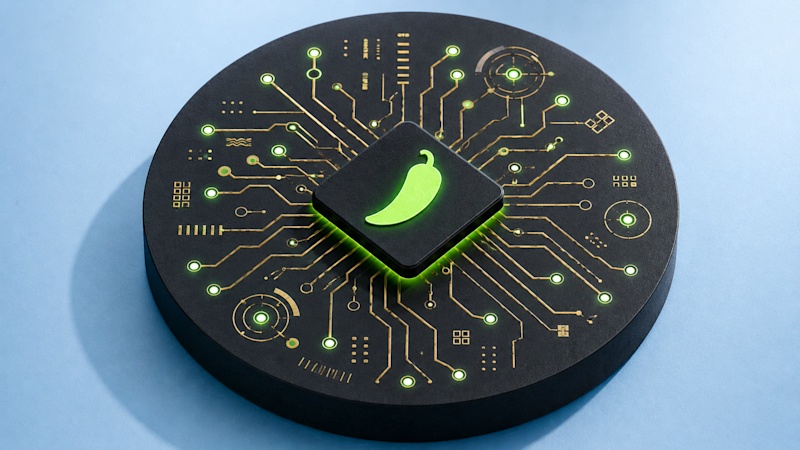
American artificial intelligence (AI) startup OpenAI and American chipmaker Broadcom on Wednesday unveiled Jalapeño, the startup’s first custom AI chip built for inference, a process that enables AI models such as ChatGPT to serve users more effectively.What exactly is Jalapeño?The application-specific integrated circuit (ASIC), co-developed with Broadcom and system partner Celestica, is designed to deliver lower-cost, high-performance AI inference. An ASIC (Application-Specific Integrated Circuit) is a microchip customised for a specific function, rather than general purpose use.OpenAI said it designed the chip from scratch in nine months. Broadcom handled silicon implementation, networking, and connectivity, while Celestica developed the physical computing hardware of the chip, including its circuit board, hardware frame, and system integration. The company claims that the chip’s engineering samples are already running machine learning workloads, including GPT-5.3-Codex-Spark, at target performance and power levels.The companies first disclosed the project last October, aiming at deployment of over 10 gigawatts of custom AI accelerators used for large language model (LLM) inference.Has OpenAI started using the new chip?No. Jalapeño marks the first generation of OpenAI's in-house compute platform, with initial deployment planned by the end of 2026.Why are such chips being built?Custom ASICs are alternatives to general purpose processors such as the graphics processing units (GPUs) produced by giants such as Nvidia. While Nvidia's H100 and A100 GPUs remain the industry's general-purpose AI processors, major cloud and AI companies are increasingly developing custom chips tailored to their own workloads.These custom chips claim to lower power consumption and reduce the cost of running AI models. As a result, tech companies such as OpenAI have turned to Broadcom and Marvell Technology, key providers of these custom silicon designs for data centres.Per a 2024 Reuters report, research firm 650 Group's Alan Weckel estimated that the market for custom data centre AI chips was expected to double to $20 billion in 2025. Separately, Needham analyst Charles Shi estimated the broader custom chip market was worth about $30 billion in 2023, or roughly 5% of global annual semiconductor sales.Does this mean OpenAI is moving away from Nvidia?OpenAI has been one of Nvidia's largest customers for AI chips, but surging demand for its models is pushing it to diversify its compute stack. Earlier this year, the company struck a deal with Amazon Web Services to use its Trainium AI chips and has also partnered with Advanced Micro Devices (AMD) and AI chipmaker Cerebras to expand its access to AI hardware.What does this mean for Nvidia?Nvidia is also exploring custom silicon. Per a report by The Information, the company was evaluating Intel's manufacturing technology for a processor that combines four GPUs into a single package, although it has not placed an order.The move builds on the Jensen Huang-led company’s broader push into custom AI chips. Reuters reported in 2024 that Nvidia had created a dedicated unit to design bespoke AI processors for cloud providers and enterprise customers, seeking to tap the fast-growing custom chip market.What about OpenAI’s rivals?Other AI companies are also moving beyond Nvidia. Per a CNBC report that came out in May, Microsoft is in talks to supply its custom Maia AI chips to the Dario Amodei-led AI startup Anthropic.Anthropic has also diversified its AI infrastructure, signing a 10-year, $100 billion deal with Amazon Web Services (AWS) to use Trainium chips and announcing support for Google's Tensor Processing Units (TPUs).Google, meanwhile, introduced its inference-optimised Ironwood TPU last year and, according to The Information, has ordered more than three million TPUs from Intel for delivery in 2028.
OpenAI spices things up with Jalapeno chips: Why the Sam Altman-led AI startup is building its own processors - The Economic Times
OpenAI said it designed the chip from scratch in nine months. Broadcom handled silicon implementation, networking, and connectivity, while Celestica developed the physical computing hardware of the chip, including its circuit board, hardware frame, and system integration.
579 words~3 min read